Memo Published March 12, 2026 · 5 minute read
Do Americans Believe Banning Data Centers Will Lower Electricity Prices?

Support for a federal data center moratorium has begun to surface among some Capitol Hill Progressives, including high-profile figures like Senator Bernie Sanders (I-VT). Lawmakers cite concerns about the rapid development of artificial intelligence and runaway electricity demand as justification for halting new development. But new research from Third Way shows that, while most Americans are skeptical about data centers, support for a nationwide moratorium on buildout doesn’t extend far beyond the Beltway. And, while Americans are concerned about the impact of data centers on their energy bills, they don’t think banning data center buildout is the best policy approach to soaring utility bills.
In a survey of 1000 registered voters conducted in early March by Third Way and Impact Research:
- Voters associate data centers with rising energy prices. 48% said they believed a temporary moratorium on data center construction would lower electricity prices, and 70% said they were worried data centers would increase their utility bills
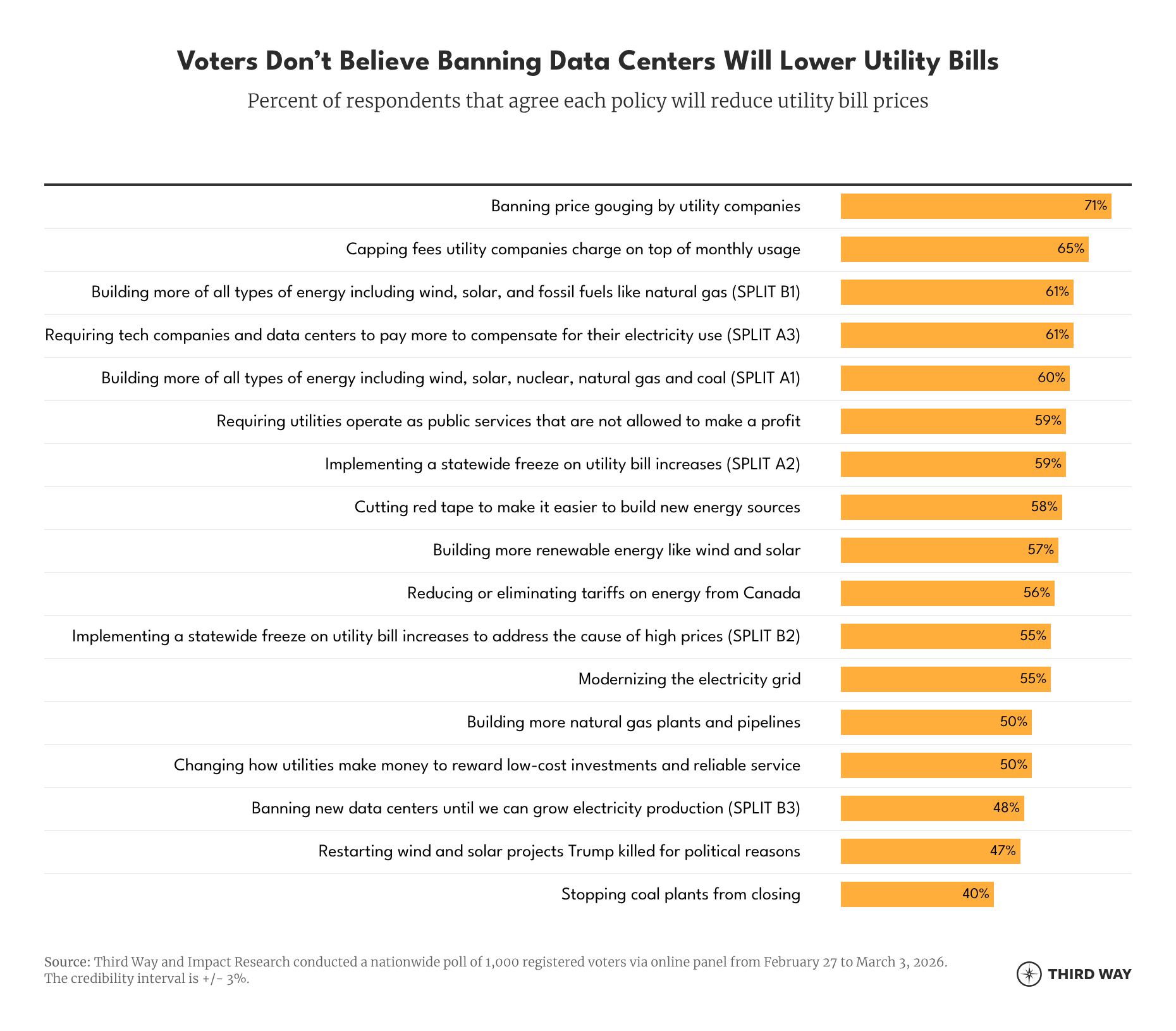
- But policies that require tech companies to cover their costs and protect working people from cost increases win much broader support. 61% of respondents believe requiring tech companies to cover the costs of their electricity use would reduce prices for working people
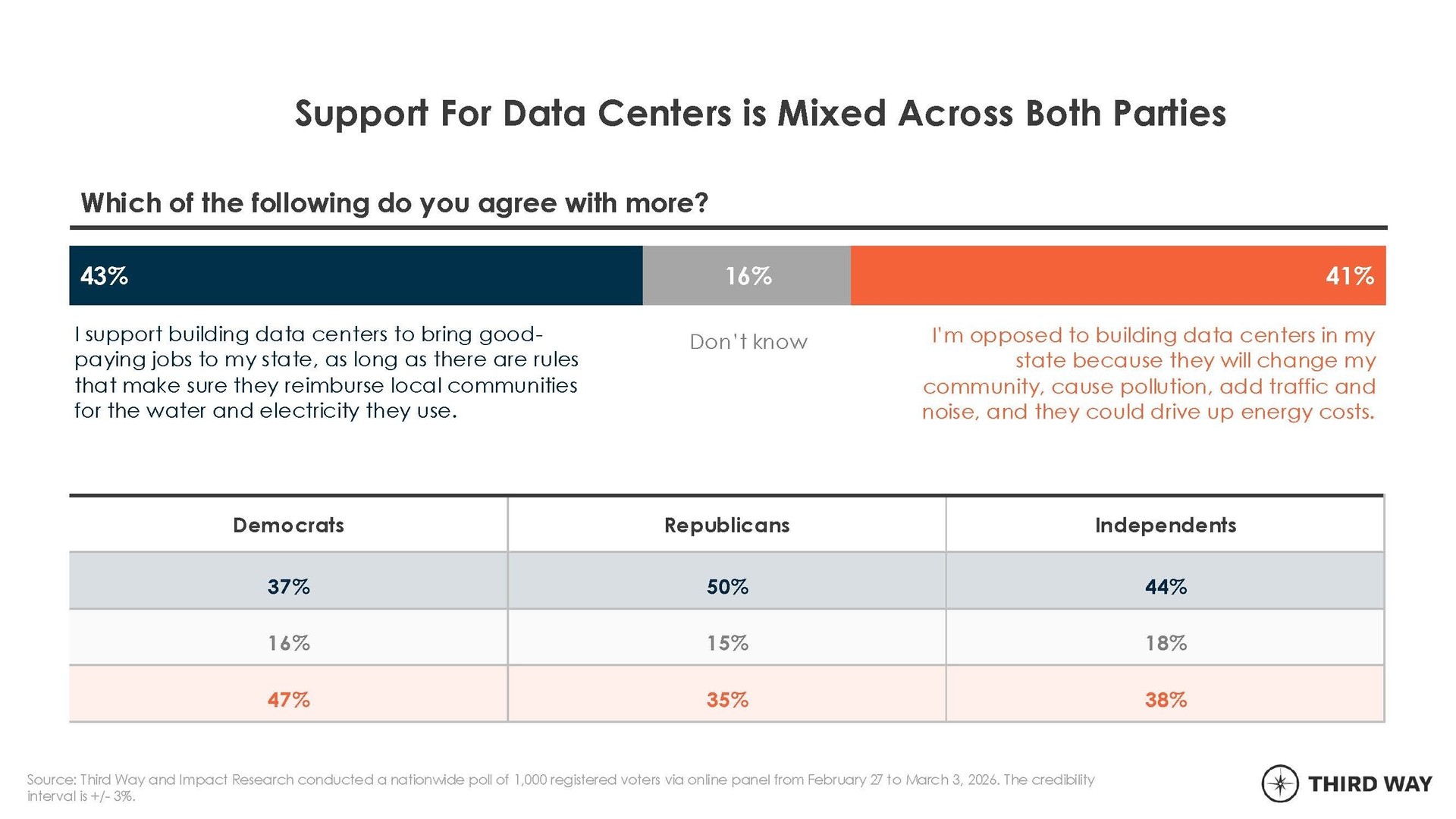
- Americans are closely divided on whether they would support or oppose new data centers in their state: 43% support building data centers, if developers reimburse communities for the water and electricity used. 41% are opposed.
- Popular policy interventions to address rising utility bills focus on ensuring consumers get a fair deal, not on banning data center buildout.
What Do Americans Think About Data Centers and Energy?
Just 30% of respondents had favorable views of data centers. That’s lower favorability than any other institution or individual tested, including the President (43%), the Democratic (41%) and Republican (42%) parties, and natural gas (45%) and electric (44%) utilities, all of which cracked 40% favorability with the general population. Though necessary for America’s economic growth, particularly for US leadership in AI, data centers are largely unpopular, regardless of partisanship.
By contrast, anxiety about energy prices is near universal. 86% of registered voters said their energy costs had increased in the last few years, and respondents ranked energy fourth among their cost-of-living concerns, behind housing, groceries, and health insurance and above childcare, education, taxes, and prescription drugs. A plurality of respondents (43%) said that while they can manage their energy costs today, they would struggle to pay if bills rose any further. A quarter of respondents said their monthly utility bills need to decrease if they’re going to make ends meet.
Americans are connecting high utility bills to growing electricity demand from data centers: respondents ranked data centers among the top causes of rising energy costs, just behind inflation. 70% of respondents worry that data centers will increase their utility bills.
People understand that rising demand – both from data centers and from other large load users like factories – without additional supply results in higher costs for families and small businesses. And they’re looking for pragmatic solutions to address rising costs today.
What Do Americans Think Congress Should Do About It?
This is where public opinion and progressive policymaking start to diverge. While Senator Sanders, Congressman Maxwell Frost (D-FL), and Congresswoman Pramila Jayapal (D-WA) have called for a data center moratorium to slow the growth of AI and reduce electricity prices, the median American is less certain that this is the right approach.
Respondents were split on whether they would support or oppose new data centers in their community. 43% support building data centers, as long as there are clear rules ensuring communities are reimbursed for water and electricity use. 41% oppose building data centers because they will change the community, cause pollution, and drive up energy costs.
Voters’ attitudes towards data centers do not fall neatly along party lines. Republicans are somewhat more likely to support new data centers than Democrats (37% of Democrats support data center buildout, compared to 50% of Republicans), but members of both parties are fairly mixed in their views. 16% of respondents said they weren’t sure how they felt. There is no overwhelming consensus here. Americans are still figuring out how they feel about data centers and their implications for electricity prices.
When voters were asked directly whether they believe a temporary ban on new data centers would lower electricity prices, 48% said yes. But a significantly larger share, 61%, said requiring tech companies to pay more to offset their electricity use would reduce prices for working families. 28% said instituting such a law would bring prices down a lot.
Of the 17 proposals we tested to decrease electricity costs–including building more clean energy, expanding fossil fuel production, modernizing the grid, and cutting federal red tape–requiring tech companies to pay more for their electricity tied for third in perceived efficacy. Banning new data centers ranked 15th.
What’s Next?
The bottom line here is that Americans’ attitudes towards data centers are rapidly evolving and, to a certain extent, divorced from partisanship.
Americans do not believe the progressives’ proposal to ban data center buildout will significantly reduce energy costs. Instead, they want policies that hold tech companies and other corporations accountable, ensure they pay their fair share, and protect consumers from getting ripped off.
Methodology
From February 27 to March 3, 2026, Third Way and Impact Research conducted polling via an online panel of 1,000 registered voters nationwide with a +/- 3% credibility interval.