Americans Caught Between Trump's Cruelty and Democrats' Chaos

Over the past few months, the Trump Administration’s actions on immigration have only grown more extreme—from the deployment of the National Guard in major cities to ICE’s heavy-handed tactics in Chicago and the unprecedented push to deport unaccompanied children. Yet, even as voters watch these scenes unfold and lose confidence in the Administration’s approach, they still do not trust Democrats to manage immigration more effectively.
In a new focus group of 55 swing voters and a national survey of 800 general election voters and 516 voters in battleground House districts, both conducted with Normington Petts, we found an electorate caught between two unsatisfying extremes: the cruelty of Trump’s policies and the perception that Democrats can’t maintain order at the border. This research builds on our March poll and takes a closer look at how Americans view the One Big Beautiful Bill’s immigration provisions—and what messages best equip Democrats to push back.
The results reveal an electorate with far more nuanced views than the national debate suggests. Voters want balance: a forward-looking vision that emphasizes how immigration strengthens America, accountability for those who break the law, and compassion for those who follow it.
Voters Hesitate on Republicans but Still Don’t Trust Democrats
Voter attitudes toward the government’s handling of immigration are shifting—but not evenly. While support for some of President Trump’s and Congressional Republicans’ immigration policies has softened, views on border security remain largely unchanged. In fact, a striking 77% of voters say that illegal immigration is in a better place today than it was a year ago, with most—56%—saying it’s “improving but still a problem.” As explained by one Biden/Trump voter, “After the Biden free-for-all, I am glad to see some control being taken back.”
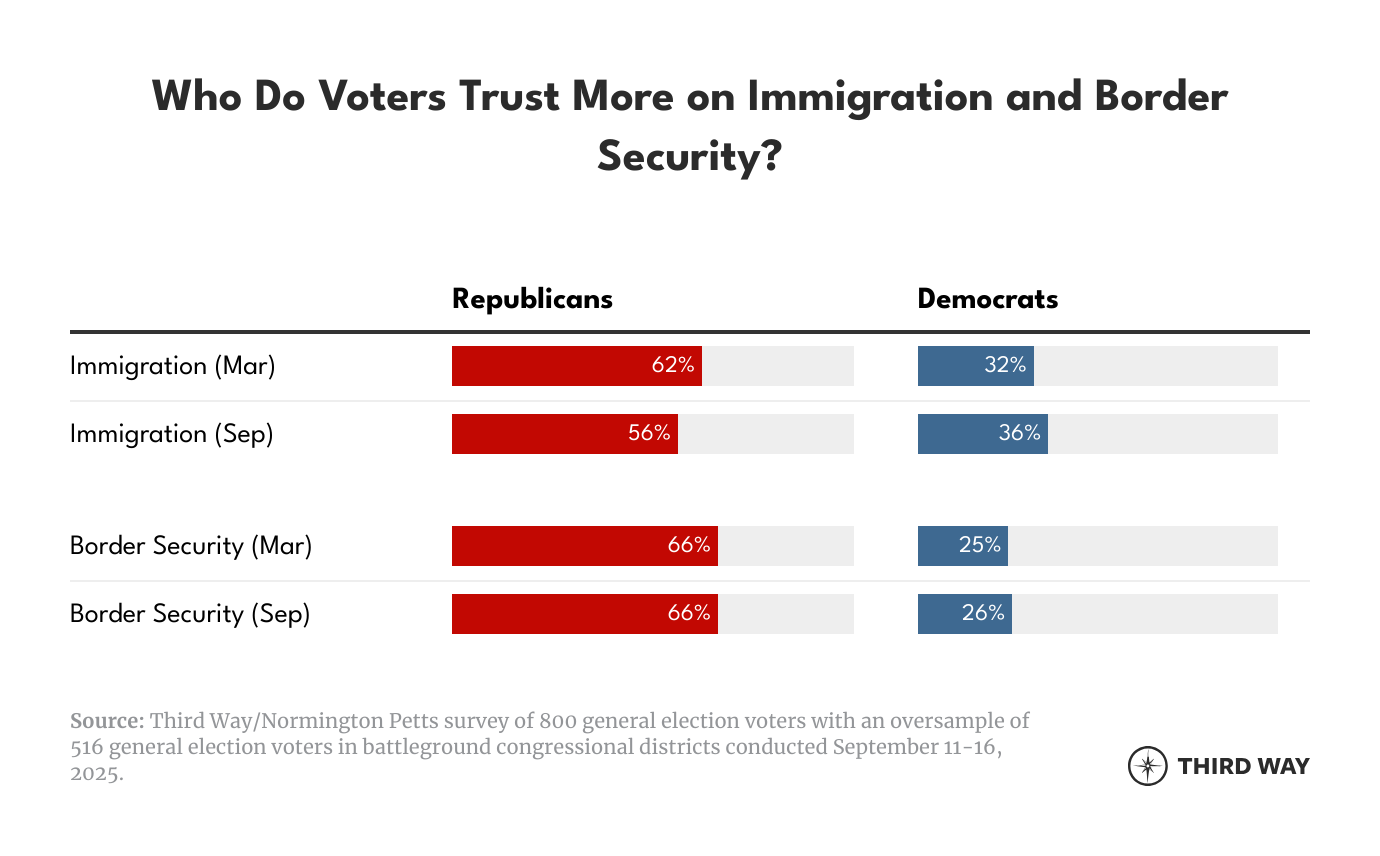
Between March and September, voters’ trust in Republicans over Democrats to handle immigration fell from 62% to 56%. But confidence in Republicans’ ability to manage border security held steady at 66%. Democrats made modest but significant gains: their 30-point deficit on trust in immigration shrank to 20 points. Yet, the 40-point deficit on border security persisted. That’s a crucial distinction—because while voters are softening in their views toward Trump and his party on immigration overall, they still don’t trust Democrats to manage the border responsibly.
“Three out of my four grandparents were immigrants. I support immigration, but it cannot keep going the way it was. Changes had to be made—just not this drastic.”
– Biden/Trump voter
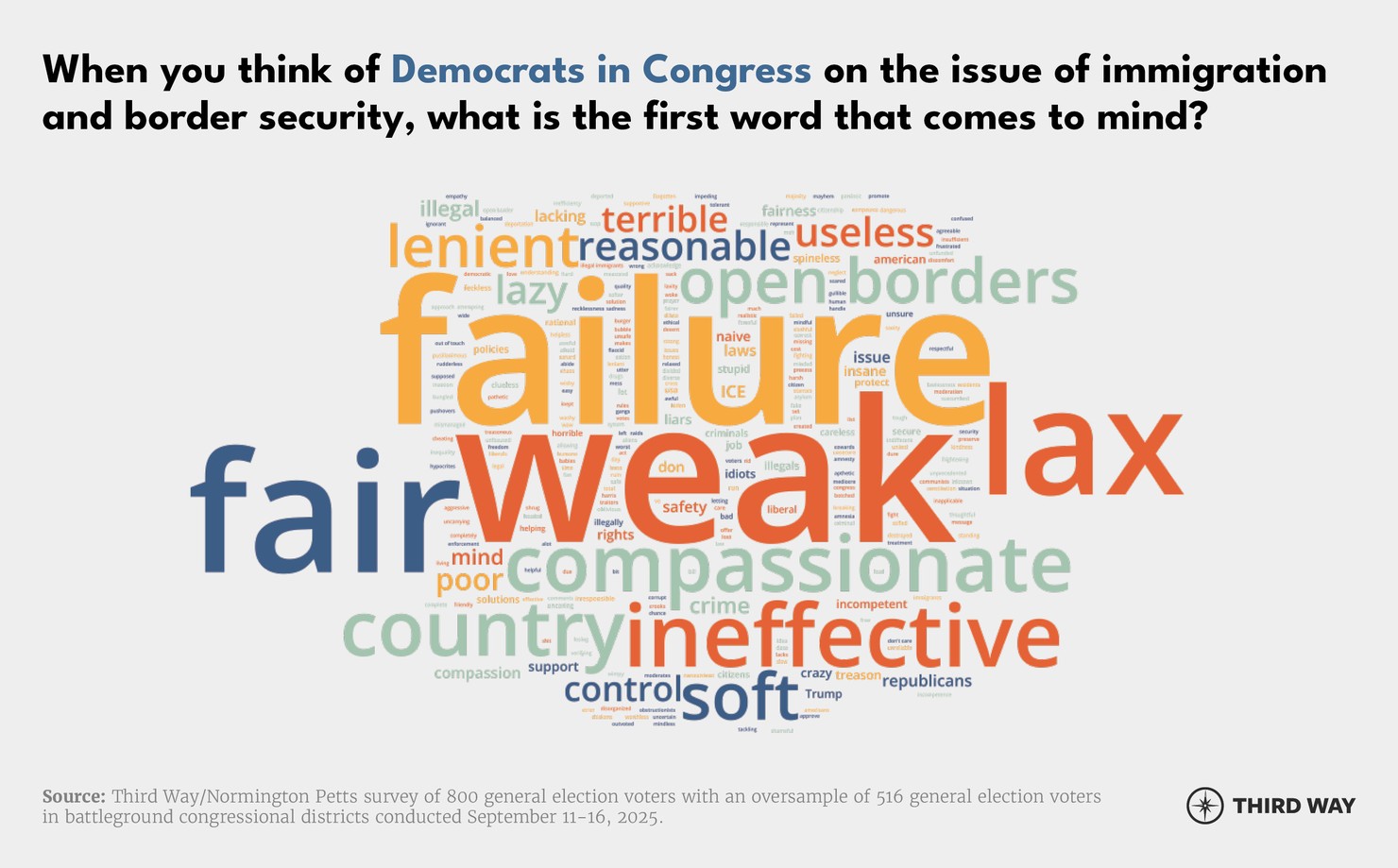
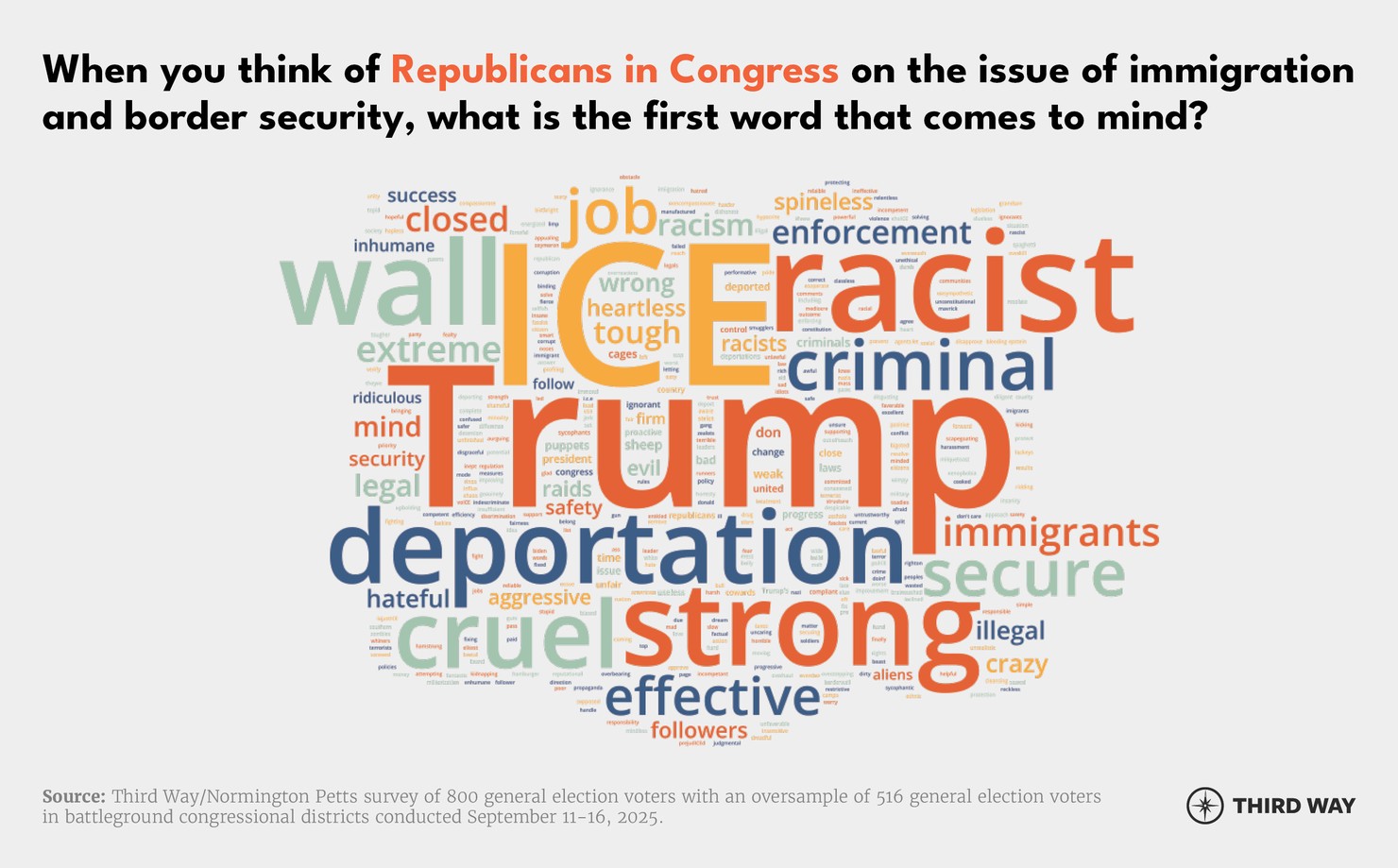
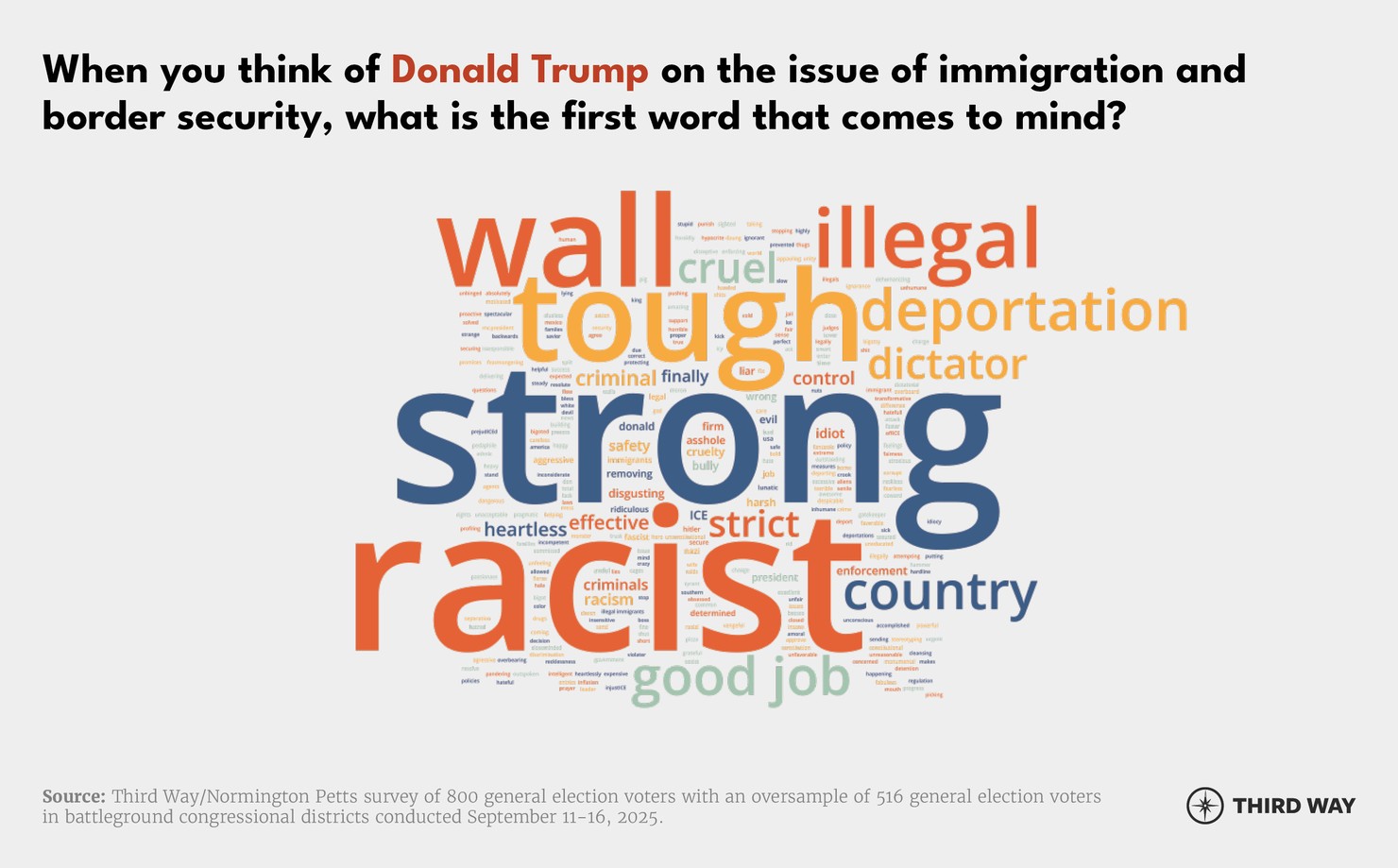
Voters Are Torn between the National Extremes on Immigration
Voters’ views on immigration remain nuanced—even when the national conversation doesn’t. When asked whether they prefer an immigration policy that is “too harsh” or “too compassionate,” voters were evenly divided. Most Americans are navigating the middle ground, not the extremes.
Voters support both border security and asylum. Despite President Trump’s suspension of asylum and voters’ deep concerns about border security, an overwhelming 86% of voters still want the United States to maintain an asylum process. A majority (55%) believe individuals fleeing danger should be able to apply for asylum, but only at official ports of entry, not anywhere along the border. This finding underscores a key theme from our March polling: voters want order and humanity. Even Democrats, who are largely supportive of asylum, are split on whether asylum applications should be limited to certain entry points, with 48% saying people should be able to apply for asylum no matter where they arrive on the border, compared to 43% supporting asylum only at ports of entry. Meanwhile, Hispanics were less favorable of asylum than the broader population, with 68% wanting the United States to maintain asylum but significantly favoring limited applications to designated entry points. Twenty-three percent said asylum applications should be allowed no matter where applicants arrive, and 45% wanted asylum applications limited to ports of entry. This shows that staking a position in support of limiting asylum claims to ports of entry can satisfy both primary and general election concerns.
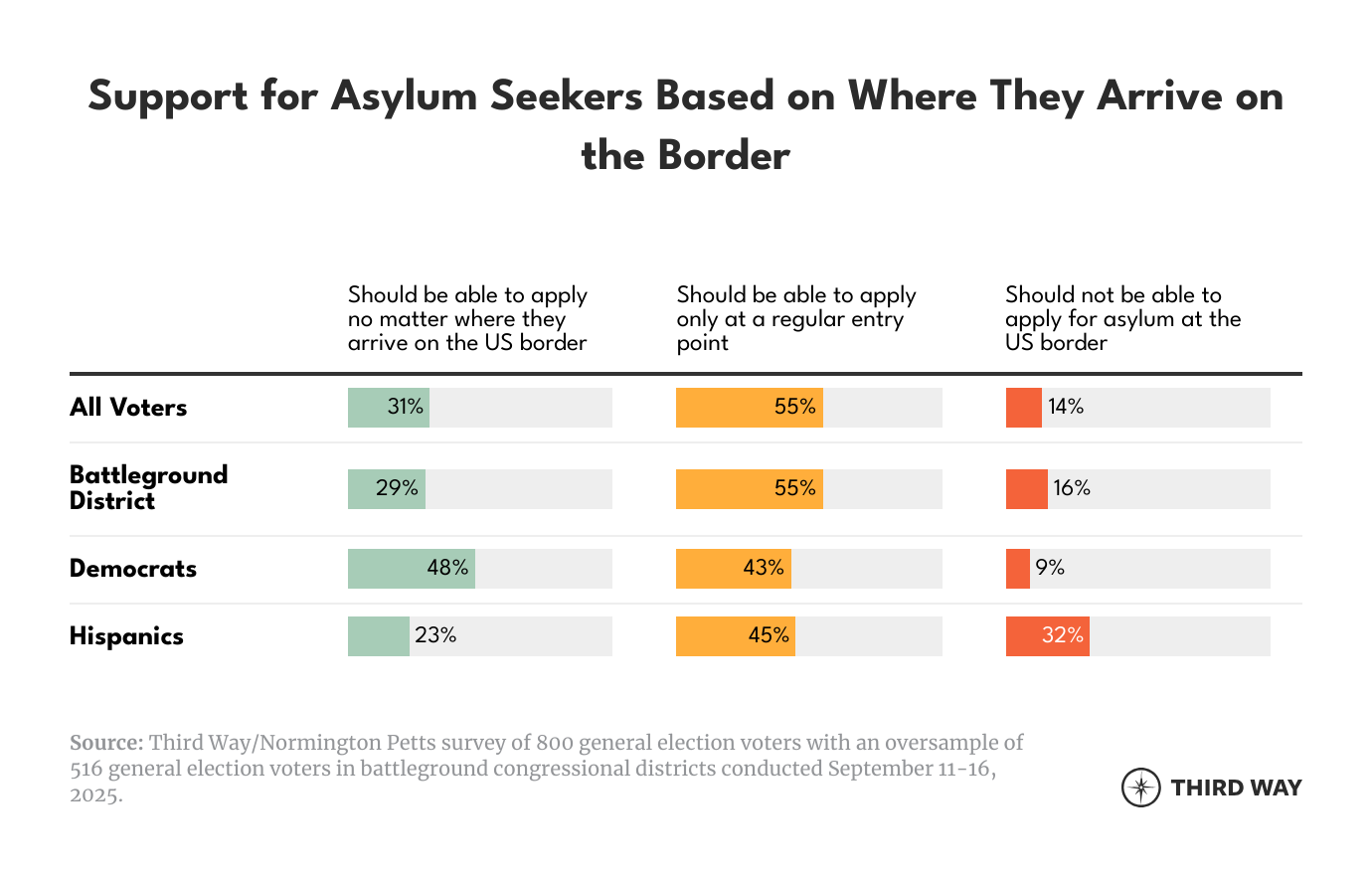
Voters support deportations and due process. A strong majority backs the deportation of violent offenders, but they also want fairness and efficiency. Eighty-one percent of voters agree that undocumented immigrants who commit violent crimes should be tried in US courts and deported if convicted. Voters prefer this approach over prolonged detention or imprisonment—a sharp contrast to a recent House bill that expands incarceration for unauthorized immigrants, including the possibility of life sentences in America. Even 79% of Democrats and 75% of Hispanics support deportations in this scenario.
Voters support immigration enforcement and limits. Voters largely support local law enforcement participating in certain ways in federal immigration enforcement, but they also want clear boundaries. While 46% say local police should assist ICE no matter the situation—meaning they favor blanket participation in all immigration cases—support for that cooperation jumps to 89% when the immigrant in question has committed a violent crime. That mirrors how many jurisdictions structure their policies—prioritizing participation in serious cases while keeping local police focused on community safety. When compared with several other options, the position that local law enforcement should never cooperate with ICE only gains 10% support, including 11% in swing districts, 9% among Hispanics, and 18% with Democrats. However, the position of Democrats changes significantly depending on how the question is asked: when simply asked whether they agree or disagree that local law enforcement should never help ICE, 64% of Democrats agree—showing that Democrats are significantly less tied to law enforcement participation than the general electorate. Moving the conversation to more winnable ground, one Trump voter said something that the national survey seemed to back up, expressing concerns about enforcement that “unfairly targets nonviolent immigrants.”

Voters support legal processes and legalization. Even with the recent softening on the Administration’s approach to immigration, a majority, 51% overall and 56% of Hispanics, still approve of the President’s handling of immigration enforcement and ICE raids. Yet, at the same time, a majority also favors giving undocumented immigrants a chance to stay legally: 76% support a path to legalization for undocumented immigrants. Each voter in our focus group who originally voted for Biden in 2020 and then voted for Trump in 2024 supported a path to legality for undocumented immigrants without criminal records, including one who suggested “offer them a path to citizenship but with a penalty for coming here [illegally].”
And even though discussions in DC sometimes swirl around whether such legalization should necessarily include a pathway to citizenship, voters don’t seem to distinguish between the two—offering legal status without a guarantee of a path to citizenship tested nearly identically.
Voters See Risks in the Immigration Enforcement Windfall
The One Big Beautiful Bill Act (OBBBA) dedicates an extraordinary $170 billion to immigration enforcement—more than the combined annual budget of every local and state law enforcement agency in the country. It represents a transformative infusion of resources that could rapidly reshape America’s immigration enforcement system. Our national poll and focus group examined how Democrats should frame this funding and its potential consequences to best appeal to voters.
Overall perceptions of OBBBA remain negative—but immigration enforcement funding divides voters. At first glance, voters react cooly to the law as a whole: just 44% of those polled expressed support. When asked what they associate with OBBBA, most named cuts to Medicare and Medicaid, as well as tax breaks for the wealthy and cuts to the Affordable Care Act—and immigration enforcement barely registered. One Trump voter noted “This bill will hurt a lot of people struggling to make ends meet.” But once participants learned about the $170 billion for immigration enforcement, support rose: 53% of focus group participants supported that component of the bill.
Across both the focus group and polling, several critiques of the $170 billion proved especially persuasive:
- Corruption: Concern that the funding would enrich private prison contractors by building unnecessary detention centers.
- Diverting Resources: Recognition that agents from the FBI, DEA, Homeland Security Investigations, and even the IRS are being pulled off counterterrorism, narcotics, and child-exploitation cases to bolster deportation operations.
- Failure to Prioritize Criminals: Frustration that ICE continues to raid workplaces instead of targeting violent offenders.
- Tradeoffs: Awareness of issues that did not receive the funds. For example, while farmers struggle with rising costs, they receive only $10 billion in emergency aid compared to $170 billion for enforcement. One Biden/Trump voter explained, “Farmers rely on these funds for food, yet they get pennies compared to ICE.”
“The fact that the FBI and DEA are being weakened to pump up ICE is clearly unacceptable and illogical.”
– Biden/Trump voter
Arguments focused on ICE’s sheer size or imagery of masked agents raiding immigrant neighborhoods were notably less effective.
It is also important to note that after being presented with the arguments to oppose the $170 billion, the focus group moved more against the funding than did the polled voters—suggesting this type of messaging will be more effective for longform communications than it will be for quick hits. Since voters start relatively open to supporting a surge in enforcement funding, it takes longer to make the case persuasively that this infusion will have bad consequences.
Conclusion
The data are clear: to win back trust, Democrats must show—not just say—that they take border security and immigration enforcement seriously. That doesn’t mean mirroring Republican overreach; it means proving that enforcement can be strategic, accountable, and consistent with American values. Majorities also continue to support asylum for those fleeing danger and legal pathways for long-settled undocumented immigrants. These aren’t contradictory impulses—they reflect a public that wants immigration handled with order and humanity.
The way forward requires Democrats to claim the ground on which voters are already standing: balanced enforcement, legal pathways that strengthen the economy, and border and enforcement that provide security but not cruelty. If Democrats can articulate and own that vision—showing they are a party of both compassion and control—they can remediate one of their greatest political struggles and live to fight another day.


More in Social Policy
View all Social Policy
Democrats’ Immigration Opportunity
Latest Publications
Winning the Fight on Crime and Public Safety
The Immigration Enforcement Revolution: How a Historic Funding Surge Is Reshaping American Criminal Justice
Battleground Democrats Aren’t Ducking the Immigration Fight
On Immigration, Battleground Voters Want Both Order and Opportunity
Never Miss an Update
Sign up for updates on the pragmatic, center-left ideas shaping the future of American policy.