Report Published June 14, 2013 · Updated June 14, 2013 · 21 minute read
The State of Relationship Recognition in 2013
Sarah Trumble & Lanae Erickson
Takeaways
In the 17 years since DOMA was passed, our country has made significant progress—but the last 12 months may prove to be the most important yet in our country’s evolution. Here’s why:
- Gay couples can marry in twice as many states as 1 year ago, and half the country lives in a place with relationship recognition.
- Americans’ attitudes towards gay couples are more positive than ever.
- Marriage has gained an avalanche of political support.
- Voters supported marriage at the ballot box.
- The Supreme Court is poised to remake the landscape.
When Congress passed the Defense of Marriage Act (DOMA) in 1996, it sparked a nationwide discussion on relationship recognition for gay couples that continues to this day: who should decide whether couples get recognized? What should that recognition look like? Is marriage ‘in everything but name’ sufficient? In the 17 years since DOMA was passed, our country has made significant progress—but the last 12 months may prove to be the most important yet in our country’s evolution
Change #1
Gay couples can marry in twice as many states as 1 year ago, and half the country now lives in a place with relationship recognition.
When Congress passed the Defense of Marriage Act (DOMA) in 1996, no state recognized any sort of committed relationship between a gay or lesbian couple. That year, only 5% of the nation’s population lived in a locality that had any kind of relationship recognition law whatsoever. For the past 3 years, our State of Relationship Recognition Reports have charted the progress our country has made since DOMA was passed, and it is a vast understatement to say that progress has been significant. Today, 12 states and the District of Columbia have laws allowing gay couples to marry: Connecticut, Delaware, Iowa, Maine, Maryland, Massachusetts, Minnesota, New Hampshire, New York, Rhode Island, Vermont, and Washington. That number has doubled since just one year ago.* Seven states provide gay couples with the full legal rights of marriage at the state level under the guise of civil union or domestic partnership laws: California, Colorado, Hawaii, Illinois, Nevada, New Jersey, and Oregon. And Wisconsin offers its residents domestic partnership benefits, though they are not equivalent to marriage protections. In the other 30 states, 49 localities have established their own local domestic partnership laws.1 As of June 2013, 49.5% of the country—more than 150 million Americans—lived in a place with some sort of relationship recognition law for gay couples.
*Though eight states had passed marriage laws at the time our 2012 report was published, two could not be enacted until surviving public referenda in November 2012.
Breakdown of U.S. Population Living in Jurisdictions with Relationship Recognition Laws2
1996 | 2011 | 2012 | 2013 | |
Living in a state that allows gay couples to marry | 0% | 11.4% | 15.4% | 18.2% |
Living in a state with a civil union/domestic partnership law that purports to give all the state protections of marriage | 0% | 24.4% | 22.3% | 23.3% |
Living in a state with lower level domestic partnership benefits | 0% | 5.8%3 | 3.9%4 | 1.8%5 |
No statewide protections but living in a city or county that has domestic partnerships | 5.0% | 4.8% | 6.1% | 6.2% |
Total living in a state or locality with a relationship recognition law | 5.0% | 46.4% | 47.7% | 49.5% |
Of these relationship recognition laws, 13 were passed in the last year: marriage in Delaware, Maine, Minnesota, and Rhode Island, civil unions in Colorado, and 8 local domestic partnership registries in non-marriage states.** Today, more than 18% of the country lives in a marriage state and 23% lives in a state that has a civil union or domestic partnership law that purports to grant all the same state protections as marriage. Another 2% lives in a state with a lower level of domestic partnership benefits, while 6% lives in a jurisdiction with no statewide protections but with a local domestic partnership registry.
** Bisbee, Arizona; Leon County, Florida; Pinellas County, Florida; Sarasota, Florida; Tavares, Florida; Venice, Florida; Columbus, Ohio; and Oberlin, Ohio.
Percentage of U.S. Population Living in Jurisdictions with Relationship Recognition6
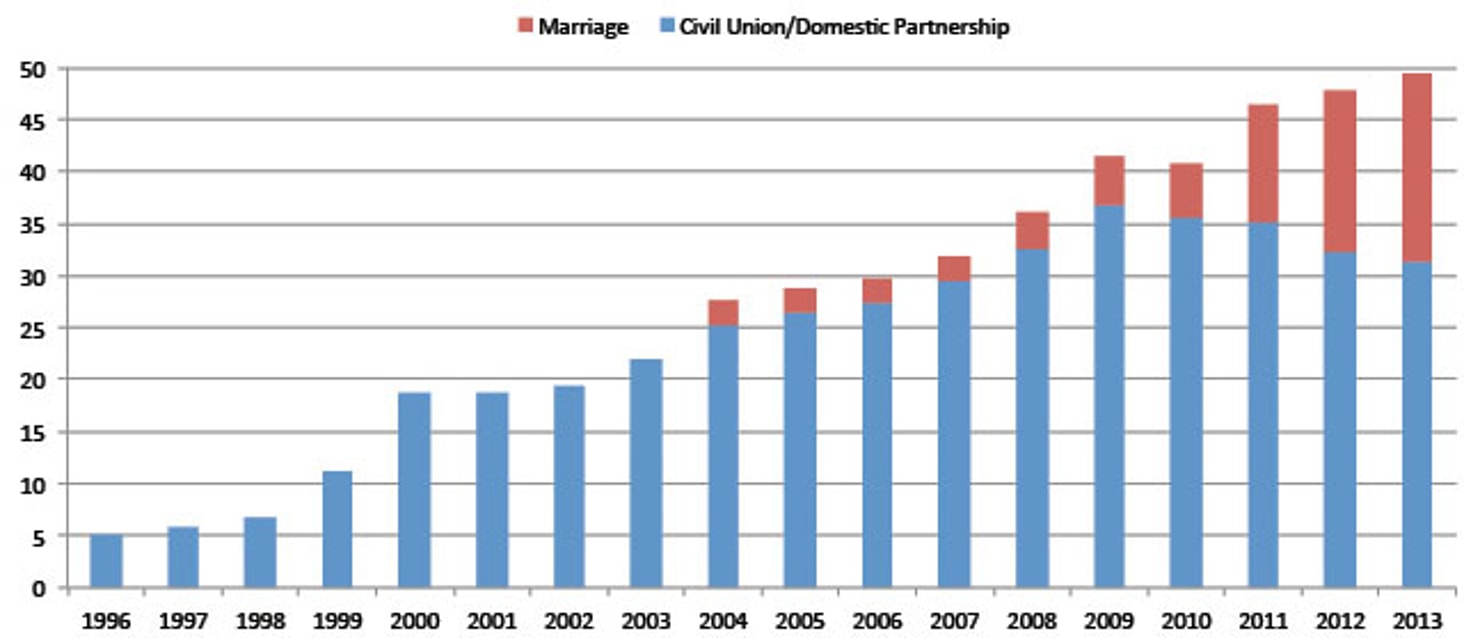
It is notable that the overall percentage of people living in a relationship recognition jurisdiction has increased less than 2 points since our 2012 report and just over 3 points since the 2011 tally. This slow growth belies the fact that the number of marriage states has doubled, the losing streak for marriage at the ballot box was broken spectacularly with a full sweep of four victories in November, and the Supreme Court may act this month to strike down the law that started it all—the Defense of Marriage Act. The modesty of the total increase in relationship recognition jurisdictions illustrates that most of the recent progress has been made in moving states and jurisdictions from lower levels of relationship recognition to marriage. Of the 4 new marriage states, 3 had already offered domestic partnerships or civil unions to gay couples in their jurisdiction. Colorado, the newest civil union state, had previously offered domestic partnerships. This indicates that the stepping stones of domestic partnership and civil union laws have been and continue to be crucial to our nation’s journey towards allowing all committed gay couples to marry. These interim laws provide legal protections in states where there otherwise would be none, and rather than thwarting progress towards marriage, they serve as an impetus to continue moving forward.
But this data also provides a cautionary tale. Although progress is sweeping the nation, it is not doing so equally across every state and region. For advocates, there is more work to be done to ensure that gay couples in states and cities with no recognition of any kind are protected. And given the historical trend laid out above, the best way to achieve that goal may be to continue to push for levels of relationship recognition that fall short of marriage—especially since support for at least some level of recognition is now at supermajority levels even in the reddest states.
Change #2
Americans’ attitudes towards gay couples are more positive than ever and are shifting more rapidly than could ever have been anticipated.
Attitudes toward relationship recognition in general, and marriage in particular, have been shifting at lightning speed in recent years. When DOMA was passed 17 years ago, only 27% of the country believed gay couples should be allowed to marry.7 Now, a recent Washington Post poll showed 58% of Americans supporting marriage for gay couples.8 Underlying that change, the belief that gay and lesbian relations are morally acceptable has increased 19 points in the last 12 years to its highest level in history—59%.9
Last fall, Third Way partnered with Georgia State University Professor Greg Lewis to analyze this shift in public opinion. Using data from 98 national surveys performed between 2004 and 2011, what we found was staggering: overall, support for marriage increased 16 points during that 7-year time frame, with major shifts across every demographic group including political party, ideology, religion, religiosity, education level, region of the country, race, and gender. Moderates moved more quickly on the issue than any other group, gaining 21 points in support for marriage between 2004 and 2011. And even the slowest moving group—Evangelical Protestants—gained 8 points in support, increasing at a striking rate of more than a point per year.10
This analysis also discredited the conventional wisdom that increased support for marriage is merely the result of younger voters replacing older ones. By examining more than 128,000 responses collected over a period of 7 years, we found that 75% of the increase in support for marriage has actually been due to people changing their minds on the issue—not simply a generational shift.11 We found this to be the case in Washington State as well; we polled that state in 2009 and again immediately following the successful vote for marriage in November 2012 and found that 1 in 5 Washingtonians who voted for marriage at the ballot box had decided to support marriage in just the last 3 years.12 That is an incredible rate of change, and one that is being replicated across the country.
Change #3
An avalanche of political support has descended from the White House, Congress, leaders in both political parties, and powerful donors.
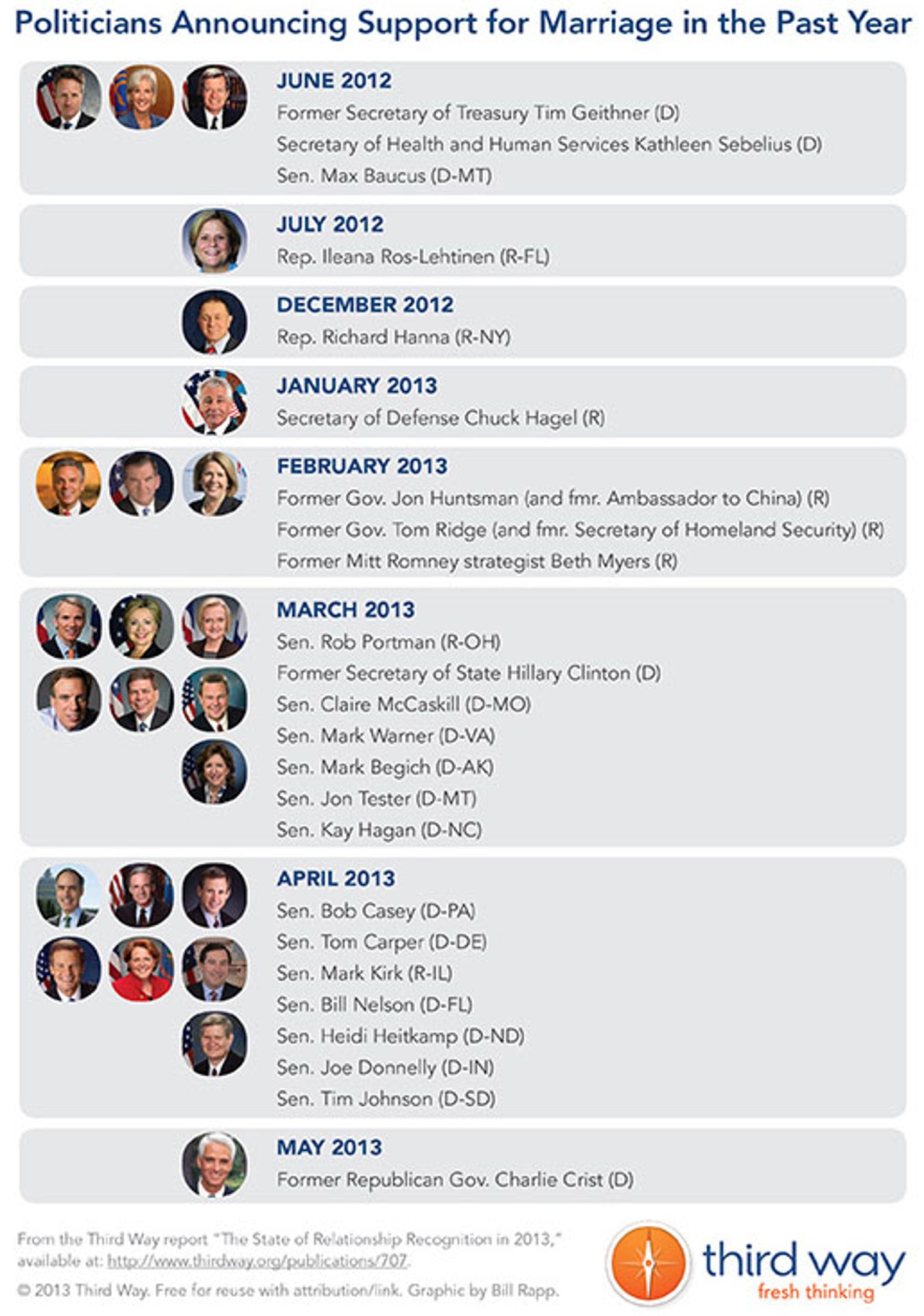
The last year has seen a remarkable and growing avalanche of political support for relationship recognition—both broadly and for marriage in particular. In the last year, 14 Senators and 5 sitting or former Cabinet Secretaries have come out in support of marriage, including members of both political parties and those representing very red states. Thirteen moderate Senators announced their support for the first time in the months of March and April alone as the Supreme Court heard arguments in the DOMA and Proposition 8 cases: Senators Rob Portman (R-OH), Claire McCaskill (D-MO), Mark Warner (D-VA), Mark Begich (D-AK), Jon Tester (D-MT), Kay Hagan (D-NC), Bob Casey (D-PA), Tom Carper (D-DE), Mark Kirk (R-IL), Bill Nelson (D-FL), Heidi Heitkamp (D-ND), Joe Donnelly (D-IN), and Tim Johnson (D-SD).13 The Democratic Party is now firmly in the marriage camp: the sitting President and Vice President and all but 3 Senators in the Democratic Caucus support marriage publicly.14 And in 2012, the Democrats became the first major political party to write support for marriage of gay and lesbian couples into their platform.15 In 2016, the bar will undoubtedly be even higher as many of those with presidential ambitions in the Democratic Party have not only come out in support of marriage but championed it and spearheaded the campaigns to pass it in their own states.
And in a move no one would have anticipated when DOMA was first passed, Republicans are now becoming the party of civil unions. While in the past civil unions were the popular stance of many moderate Democrats, the majority of civil union supporters today consider themselves conservative. Sixty-three percent of Republicans support civil unions or other laws that would grant gay couples many of the same rights as marriage.16 And in just one example of an event that has now become commonplace, when debating the Minnesota state marriage bill (which would eventually become law), it was Republican lawmakers who introduced a civil union alternative.17 The fact that marriage opponents are now championing civil unions as the best answer to the relationship recognition question would certainly have boggled the mind in 2004, when Democratic Presidential nominee John Kerry was maligned for that same position.
In addition to their newly fervent embrace of civil unions, over the last year some Republicans have moved even further in their support, as Senators Rob Portman (R-OH) and Mark Kirk (R-IL) became the first ever sitting Republican Senators to support marriage for gay couples.18 Perhaps just as influential as these Senators’ support was the response from their party: when asked about Senator Portman’s new position, RNC Chairman Reince Priebus said, “I think that there isn’t anyone in this room, Republican, Democrat, in the middle, that doesn’t think that Rob Portman, for example, is a good conservative Republican. He is. And we know that."19 Senator Flake, who himself does not support marriage for gay couples, told Meet the Press that it is “inevitable” that a future Republican presidential candidate will be pro-marriage, and that “he’ll receive Republican support, or she will."20 Over 100 prominent Republicans signed an amicus brief to the Supreme Court supporting marriage for gay couples in the case challenging the constitutionality of Proposition 8, California’s marriage ban, including former Presidential candidate Jon Huntsman, former RNC Chair Ken Mehlman, and conservative political commentator David Frum.21 Today, more than half of Republicans under the age of 50 support marriage, including 81% of the coveted 18-29 year-old Republican demographic.22 And several of Governor Mitt Romney’s biggest donors have also invested significant funds towards passing marriage for gay couples at the state level—for the first time in 2012 even forming a political action committee to support pro-marriage Republicans in their primaries and general elections.23
Change #4
Unprecedented victories for marriage have been won at the ballot box and in the legislatures.
This last year will go down in the history books as a turning point on marriage laws—marking the first time victories spanned both ballot boxes and legislatures and did so across the country. In November 2012, for the first time in history, marriage advocates won all 4 statewide ballot initiatives, relegating the past record of 32 losses to the dustbin of history. Thanks to voters, gay people in Washington, Maine, and Maryland can now marry the person they love. Minnesota voters not only successfully fought back a constitutional ban on marriage in November, but they built on that momentum to pass marriage legislatively in the spring. And they weren’t the only state legislature to pass a marriage law—in the month of May, Governors in Rhode Island and Delaware also signed marriage into law after seeing it passed by their respective state legislatures. That same month, a new civil union law went into effect in Colorado. And 8 new localities established domestic partnership registries in the last year in Florida, Arizona, and Ohio. Having officially made inroads in the Midwest, the Rocky Mountains, and the South, state-wide relationship recognition laws now span every corner of the country.24
Our post-election polling in Washington State illustrated that the November 2012 marriage victories brought together a much broader coalition than simply liberal base voters. Support was remarkably high among centrist voters, with 66% of moderates and 59% of Independents voting for marriage. Of moderate and conservative Democrats, 79% voted in favor of marriage for gay couples, as did 38% of liberal and moderate Republicans. Compared to our 2009 poll in that state, moderates had increased their support for marriage by 33 points, while Independents increased by 21 points over the course of 3 years.25
Additionally, marriage support seems to now be a plus, not a minus, in a candidate’s column among swing voters. A full 30% of moderate voters in our Washington State poll said they were more likely to vote for a state legislator who supports marriage, while only 14% were less likely to do so.26 This data point was confirmed by our in-depth electoral analysis with Freedom to Marry which documented a new normal: pro-marriage legislators win elections. An incredible 97% of state legislators who voted for marriage and ran for reelection in 2012 won, compared to a nationwide incumbent success rate of 90%. Of the 196 legislators who voted in favor of state marriage laws between the 2010 and 2012 elections, 141 were reelected, 50 did not run (because they were not up for reelection, resigned, retired, or ran for another public office), and only 5 lost.* And of those 5 who lost, 2 were under investigation for corruption or misuse of taxpayer dollars. This support for pro-marriage legislators spanned urban and rural districts and led to re-election for all but 1 pro-marriage Democrat (whose district actually voted for marriage in the statewide ballot initiative) as well as more than 85% of pro-marriage Republicans.27
* This analysis did not include legislators from New Jersey or Maryland, both of which passed marriage legislation in 2012, because neither body was up for re-election in November 2012.
Change #5
This month, Supreme Court decisions could remake the landscape for gay couples across the nation.
While the last year has seen monumental changes in relationship recognition, the most significant may come early this summer should the United States Supreme Court strike down the Defense of Marriage Act (DOMA) or California’s ban on marriage for gay couples as unconstitutional.
DOMA currently prohibits the federal government from recognizing any gay or lesbian couple’s marriage—even if that marriage is legal in their own state. Since it was passed in 1996, DOMA has required the government to essentially un-marry gay couples for the purposes of all federal laws, including taxes, Social Security, immigration, veterans benefits, and many more. If the Supreme Court strikes down this law as unconstitutional, which many believe it will do, the decision would have a powerful effect on the state of relationship recognition laws across the United States. Gay couples who marry and live in states where their marriage is legal would no longer have to file separate tax returns or pay hundreds of thousands of dollars in estate tax penalties, like the plaintiff in the DOMA case, Edie Windsor, did. Even those couples who live in states that do not recognize their marriages would benefit from federal recognition—for example, they could get married in a state that does allow it and then be able to petition for their spouse through the federal immigration system. Most importantly of all, a decision striking down DOMA would end the discriminatory two-tiered marriage system currently in place. As Justice Ginsburg described it during oral arguments, under DOMA “there are two kinds of marriage: full marriage and the skim milk marriage."28 In a world without DOMA, marriages of committed gay couples would finally be recognized by the federal government as the legal and valid marriages that they are.
What the Court will decide in the Proposition 8 case, regarding California’s ban on marriage for gay couples, is much more contested in the legal community. It seems very unlikely that the Court will identify a nationwide constitutional right to marry for gay Americans across the country. But the Justices could hand down a ruling that says a state may not distinguish between relationships in name alone—and in doing so essentially legalize marriage in the 7 states with civil union or domestic partnership laws that offer the same state protections as marriage. More likely, based on the discussion at the oral arguments, is an outcome that strikes down Proposition 8 but only extends marriage to gay couples in the state of California. This could occur in at least three ways: by dismissing the case on the basis that those who appealed have no standing (legal right) to oppose Proposition 8, by dismissing the case as improvidently granted (saying they should not have taken it in the first place), or by drafting a narrow decision striking down the law but limiting it to the particular circumstances of Proposition 8’s passage, as did the appeals court in that case.
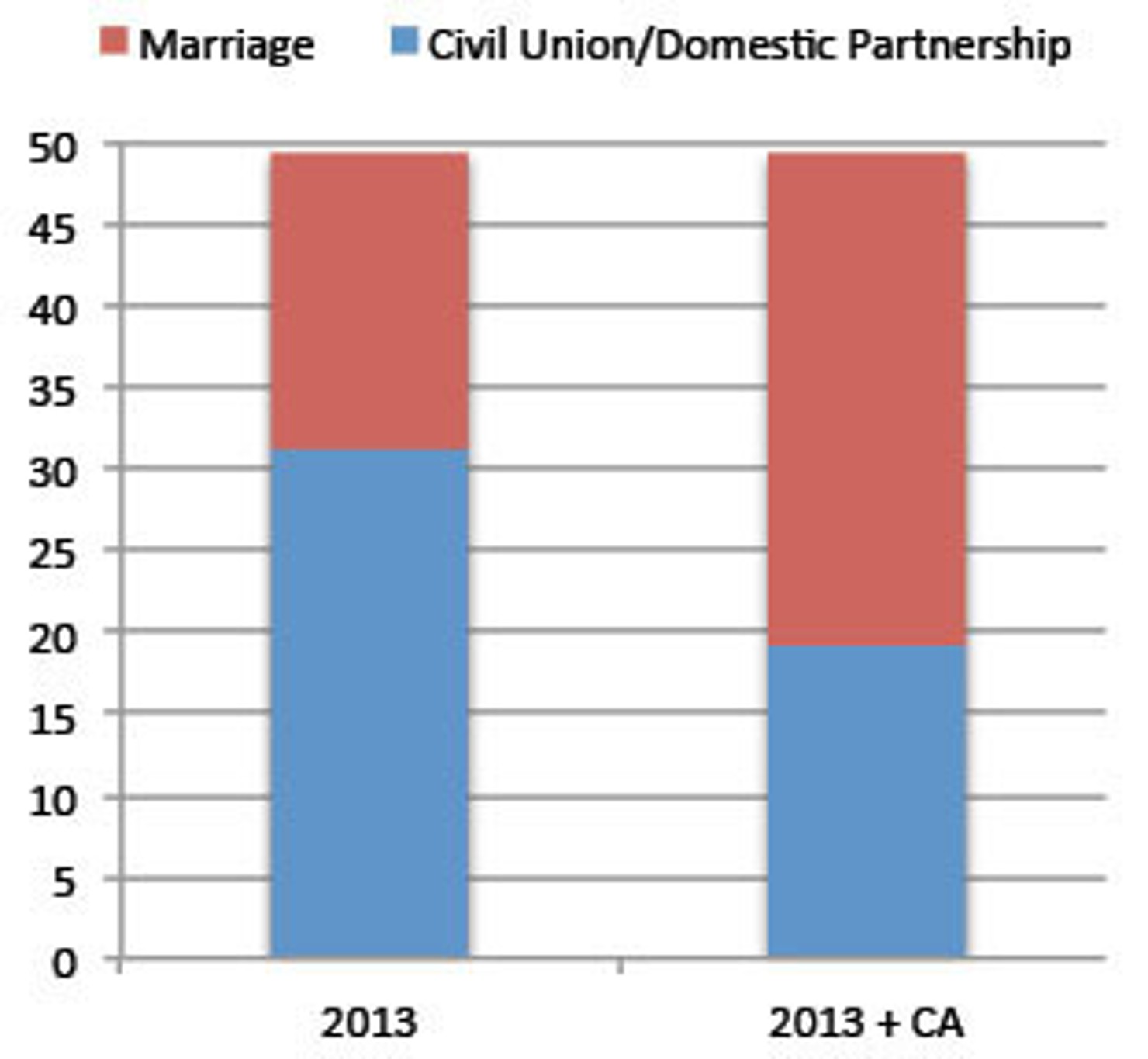
If the Court finds that it is unconstitutional to relegate gay couples to civil unions or domestic partnerships equivalent to marriage in everything but name, marriage would become legal in Colorado, Hawaii, Illinois, New Jersey, California, Nevada, and Oregon. In that scenario, 41.5% of the country would live in state where gay couples could legally marry. Even if the Court instead limits its ruling to just California, the state’s more than 37 million residents would have the opportunity to marry the person they love, increasing the percentage of the US population living in a marriage state to more than 30%.
Breakdown of U.S. Population Living in Jurisdictions with Relationship Recognition Laws if the Supreme Court Strikes Down Proposition 829
2013 | 2013 + California | |
Living in a state that allows gay couples to marry | 18.2% | 30.3% |
Living in a state with a civil union/domestic partnership law that purports to give all the state protections of marriage | 23.3% | 11.2% |
Living in a state with lower level domestic partnership benefits | 1.8% | 1.8% |
No statewide protections but living in a city or county that has domestic partnerships | 6.2% | 6.2% |
Total living in a state or locality with a relationship recognition law | 49.5% | 49.5% |
Percentage of U.S. Population Living in Jurisdictions with Relationship Recognition Currently and if Proposition 8 is Struck Down30
Many voices have weighed in to try to influence the Court’s decisions in these cases. The Obama Administration has asked the Court to strike down both DOMA and Proposition 8 as unconstitutional. Both the federal government and the state of California have declined to defend their discriminatory laws in court. One hundred and seventy two Members of the House of Representatives and 40 Senators have signed an amicus brief to the Court asking the Justices to strike down DOMA (although the Republican-led House is still leading and funding that law’s legal defense), and as mentioned above more than 100 prominent Republicans submitted a brief calling on the Court to strike down Proposition 8. With the gains we have seen in public opinion, political support, and state-level progress over the last year, the Court should rest assured that the country is ready to relegate DOMA and Proposition 8 to history and move forward towards the day that all committed couples can marry.
Conclusion
Seventeen years after Congress passed the Defense of Marriage Act, our country is in a far different place. Half of all Americans live in a jurisdiction with some kind of relationship recognition for gay couples, while more than half (58%) believe gay and lesbian couples should be allowed to marry. Support for marriage is increasing at a rapid rate across demographic groups, and it is now at its highest point ever, thanks largely to changing hearts and minds. An avalanche of political support has made Democrats the party of marriage, while Republicans are quickly becoming the party of civil unions—a huge step from where they were in 1996 or even 2004. Policymakers going forward will have to decide which degree of relationship recognition to support, because opposing any kind will no longer be a politically viable option.
November 6, 2012, was a history-making day at the ballot box: marriage advocates won in every state that voted on marriage laws, erasing the memory of the previously unbroken losing streak, and the public re-elected the first sitting president to support marriage for gay couples. Today, 12 states allow gay couples to marry—twice as many as did by this time last year. And later this month, the Supreme Court will have the opportunity to end the discriminatory two-tiered marriage regime inflicted by DOMA. At the rate our country is progressing, the day when all gay couples can promise lifetime commitment to each other in marriage is finally within reach: it may only be a matter of time as the nation continues to evolve in the way it views and supports gay couples and their relationships.
Appendix A:
State Relationship Recognition Laws
STATE | TYPE | LAW |
California | Domestic Partnership Registry | Cal. Fam. Code §297-297.5 |
Colorado | Civil Union | Colo. Rev. Stat. § 14-15-101 et seq |
Connecticut | Marriage | Kerrigan and Mock v. Connecticut Department of Public Health; Public Act No. 09-13 |
Delaware | Marriage | Del. Code Ann. tit. 13 §101 |
District of Columbia | Marriage | The Religious Freedom & Civil Marriage Equality Amendment Act of 2009, DC Code Sec. 46-401et seq. |
Hawaii | Civil Union | 2011 Hi. ALS 1 |
Illinois | Civil Union | Illinois Religious Freedom Protection and Civil Union Act, Public Act 96-1513 |
Iowa | Marriage | Varnum v. Brien |
Maine | Marriage | Me. Rev. Stat. Ann. tit. 19-A, sec. 650-A |
Maryland | Marriage | MD. FAMILY T. 2, Subt. 2-201 et seq |
Massachusetts | Marriage | Goodridge v. Department of Public Health |
Minnesota | Marriage | Act of the 2013 Session H.F. No. 1054 |
Nevada | Domestic Partnership Registry | NRS Title 11 Chapter 122A.010 et seq |
New Hampshire | Marriage | N.H. Rev. Stat. Ann. Title XLIII Chapter 457 Section 1-a |
New Jersey | Civil Union | Civil Union Act, P.L. 2006, Ch. 103 (2006) |
New York | Marriage | Domestic Relations Law Article 3 § 10-a. |
Oregon | Domestic Partnership Registry | Title 11 Chapter 106.300 et seq |
Rhode Island | Marriage | General Laws Title 15, Ch. 1-1 |
Vermont | Marriage | 15 V.S.A. § 8 |
Washington | Marriage | RCW 26.04.010 § 3 |
Wisconsin | Domestic Partnership Registry | Wis. Stats. 770.001 et seq |
Appendix B
Localities with Domestic Partnership Registries in States Without Recognition Laws
CITY | STATE | ORDINANCE |
Bisbee | Arizona | Bisbee City Code Article 17 |
Flagstaff | Arizona | Flagstaff City Code 14-01-001-0001 et seq |
Phoenix | Arizona | Phoenix City Code Chapter 18 Article X |
Tucson | Arizona | Ordinance 9898/ Tuscon Code 17-70 |
Eureka Springs | Arkansas | Eureka Springs Code Title 7 Chapter 60 |
Broward County | Florida | Broward County Code Part II Chapter 16 ½ Article VIII |
Clearwater | Florida | City Code Part II Subpart A Chapter 13 |
Gainesville | Florida | City Code Part II Chapter 2 Article VIII |
Key West | Florida | Key West Code of Ordinances §§38-291 through 296 |
Leon County | Florida | Leon County Code of Laws Chapter 9 Article V |
Miami-Dade County | Florida | Miami-Dade County Code Part III Chapter 11A Article IX |
Orange County | Florida | Orange County Code Part II Chapter 22 Article V |
Palm Beach County | Florida | County Code Chapter 2 Article I Section 2-6 |
Pinellas County | Florida | Pinellas County Code Part II Chapter 70 Article III |
City of Sarasota | Florida | Code of the City of Sarasota Part II Chapter 18 Article VIII |
Tampa | Florida | City Code Chapter 12 Article V |
City of Tavares | Florida | City of Tavares Code Part II Chapter 2 Article VI |
Venice | Florida | City of Venice Code Subpart A Chapter 40 Article I |
Volusia County | Florida | County Code Part II Chapter 41 Article I |
Athens-Clark County | Georgia | ACC Code §1-23-1 |
Atlanta | Georgia | Atlanta Code of Ordinances, Ch. 94, Article VII |
Fulton County | Georgia | Code of the Laws of Fulton County, Article V, Ch. 154 |
City of Lawrence | Kansas | Ch. 10, Article 2 of the Code of the City of Lawrence, Kansas, 2006 Edition |
New Orleans | Louisiana | City Code Ch. 87 |
Ann Arbor | Michigan | Ann Arbor City Code Ch. 110 §§9.85-9.95 |
Clayton | Missouri | Bill No. 6299, Clayton Municipal Code Ch. 225 Art. IV |
Columbia | Missouri | Columbia Code of Ordinances 12-72-12-77 |
Jackson County | Missouri | Civil Union Registry |
Kansas City | Missouri | Kansas City Council Resolution No. 030953 |
Olivette | Missouri | Bill No. 2676, City of Olivette Municipal Code Title 2 Ch. 245 |
St. Louis | Missouri | Saint Louis City Revised Code Ch. 8.37 |
University City | Missouri | Municipal Code Chapter 3 |
Asheville | North Carolina | Resolution No. 11-43 |
Carrboro | North Carolina | Town Code §3-2.1 |
Chapel Hill | North Carolina | Resolution 95-4-24/R-11c and Ordinance 95-4-24/O-8a |
Athens | Ohio | City of Athens, Ohio Code of Ordinances, Title 3 Ch. 3.11 |
Cleveland | Ohio | Title I, Ch. 109 |
Cleveland Heights | Ohio | Cleveland Heights Codified Ordinances Ch. 181 |
Columbus | Ohio | Columbus City Code Title II Chapter 229 |
Dayton | Ohio | City Code Title III Chapter 30 Division 4 |
Oberlin | Ohio | Ordinance No. 12-67 AC CMS |
Toledo | Ohio | City Code Part One Title One Chapter 114 |
Yellow Springs | Ohio | Ch. 632 of the Village codified ordinances |
Harrisburg | Pennsylvania | City of Harrisburg’s Ordinance 13-2008, Section 4-201.3 |
Philadelphia | Pennsylvania | Executive Order No. 2-96 |
Pittsburg | Pennsylvania | Pittsburgh Code, Title One, Administrative, Article XI Personnel, Ch. 186 |
State College Borough | Pennsylvania | Borough Code Chapter X Part G |
Travis County | Texas | Austin City Council Domestic Partner Resolution |
Salt Lake City | Utah | City Code Title 10 Chapter 3 |
Appendix C: