Making the Case: The F-35 is the Future, Not the Present, of U.S. Fighter Aircraft
Ben Freeman, Mieke Eoyang
The F-35, or Joint Strike Fighter, is America’s next-generation manned fighter jet, but this $1.5 trillion program—the most expensive weapon program ever—has been plagued by costly delays and design challenges. There is a solution to the F-35 dilemma: slow down. The threats facing the U.S. today do not require that we rush the F-35 into production. We can save billions by further testing the aircraft. In this time of budget cutting and sequestration, the issue of F-35 spending is significant. Here’s how to talk about this weapon system—and how to fix it.
- The F-35 is important, but we should cap purchases at 29 per year—rather than doubling purchases by 2016—until testing is complete.
- In the meantime, we should shift some funds from F-35 procurement to instead buy proven fighter aircraft.
The Future of Fighter Aircraft
The F-35—also known as the Joint Strike Fighter (JSF)—is on the cutting edge of aviation technology. The F-35’s capabilities, if fully realized, will best nearly all other fighter aircraft.1 But the program has been beset by delays, underperformance, and cost overruns.
With more than 2,400 F-35s planned to replace nearly all fighter aircraft in the Air Force, Navy, and Marines, the F-35 is the future of U.S. military aviation. It will also play an essential role for many U.S. allies that have already agreed to buy the plane, including: Australia, Canada, Denmark, Israel, Italy, Japan, the Netherlands, Norway, Turkey, and the United Kingdom.2
"The F-35 is comparable or better [than other fighter jets]…sometimes by a significant margin, in both air-to-air, and…the air-to-ground mission... "
— Senior F-35 test pilot for prime contractor Lockheed Martin, Februrary, 20133
The F-35 Is Still Working Out the Kinks…
The F-35’s greatest drawback is its prohibitive cost.
- The price of each plane has more than doubled.4
- The entire program is now estimated to cost a whopping $1.5 trillion.5
The F-35 is on the cutting edge of aviation technology, but it has been plagued by delays, underperformance, and cost overruns.
The F-35’s problems don’t end with its massive price tag, as the plane’s advertised capabilities differ from the actual capabilities it has proven in testing thus far.
- According to a DoD testing office report from early 2013, at the current stage of testing and development, the F-35 does not yet have “any actual combat capability."6
- The F-35 program head, Lt. Gen. Christopher Bogdan, testified in June that several technical risks to the program remain, including “the helmet mounted display system, the tailhook, the fuel dumping system, and the autonomic logistics information system."7
- Perhaps the biggest hurdle facing the F-35 is its software development. According to Bogdan, there’s a “need to improve both the speed and quality of software development to be able to catch up from previous software delays."8
Some of these issues may put F-35 pilots’ lives at risk. For example, test pilots told the DoD that the headrest is so large it impairs a pilot’s ability to look behind him, which during a dogfight “will get the pilot gunned down every time."9
...Yet the DoD Continues to Buy Them
Unfortunately, despite these serious issues, the planes’ technological immaturity, and the mere 34% of developmental testing that is complete,10 the DoD is planning to rapidly increase F-35 production.
- The number of F-35s purchased every year will jump from 29 to 42 in 2015, and by 2018 100 F-35s will be produced every year.11
- This “plan to procure 289 aircraft [more than 10% of all F-35s] for $57.8 billion before completing development flight testing” is financially risky, according to the GAO.12
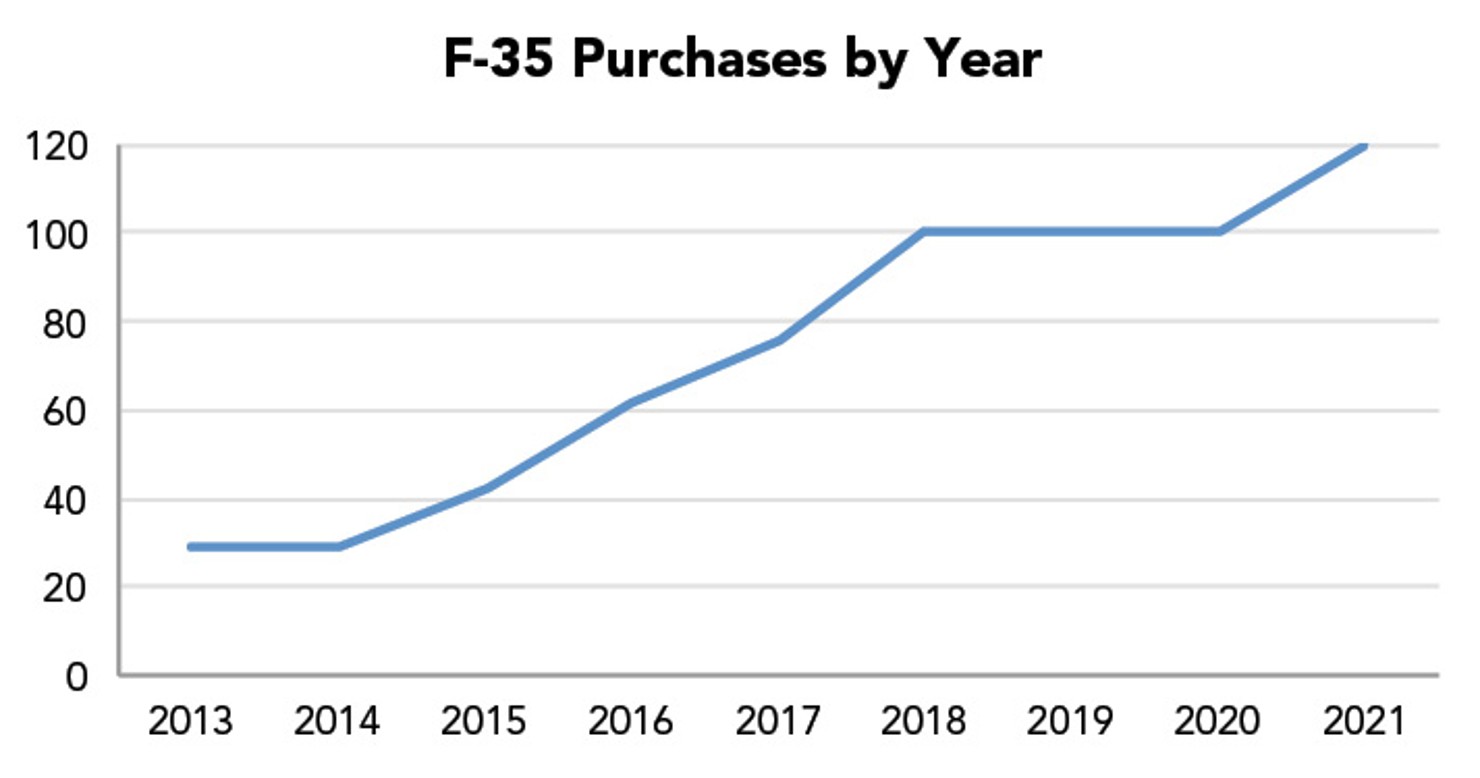
This practice known as concurrency—producing aircraft before testing and development are complete—is similar to a car company starting an assembly line before the engineers have finished testing and settled upon a final design.13
“Putting the F-35 into production years before the first test flight was acquisition malpractice…It should not have been done,” said Frank Kendall, while serving as the head of DoD procurement in February 2012.14
"Production in this program started before there was any flight testing at all, which was unprecedented in the history of aircraft…Obviously that’s a bad thing."
— DoD testing director Michael Gilmore, June, 201315
The problem is that any F-35s that are produced before testing is complete will have to be fixed once defects are discovered, as is the case with cars when a recall is issued. The more planes purchased before testing is complete, the more that have to be recalled. Unlike cars, where the manufacturer pays for the recall, American taxpayers will have to foot the bill, currently estimated at $1.7 billion.16
We wouldn’t buy a car that was produced before it was fully tested. Why would we buy a complex fighter jet that way?
There is no Need to Rush Production Given the Threats America Faces
There is no immediate threat to the U.S. that justifies buying more F-35s before testing is complete. Our current fleet of fighters is superior to any force on the planet, both in numbers and in capabilities. The Air Force has over 100 operational F-22s—the most technologically superior aircraft currently operated by any nation17—and hundreds of upgraded 4th generation aircraft that rival any foreign aircraft fleet,18 like the Navy’s F/A-18E/F Super Hornet, that are more than capable of protecting U.S. interests while the F-35 completes testing.
At roughly half the price of an F-35, the Super Hornet and other relatively inexpensive, tested aircraft are a cost-effective alternative to the expensive F-35, which is still in developmental testing. Utilizing alternatives like these also mitigates the problem of relying on one aircraft type to fulfill many missions.
The bulk of our force today [is] Super Hornets and they will be there for a long time, out until the end of the 2020s, early 2030s timeframe.
— Naval director of air warfare, Rear Admiral Bill Moran, July, 201319
In addition to quality, the U.S. has an overwhelming advantage in quantity of aircraft in the field.
- The U.S. has twice the fighter aircraft of China, Russia, or any other country in the world.20
- In addition, those countries’ 5th generation aircraft programs are years behind both the F-35 and F-22.21
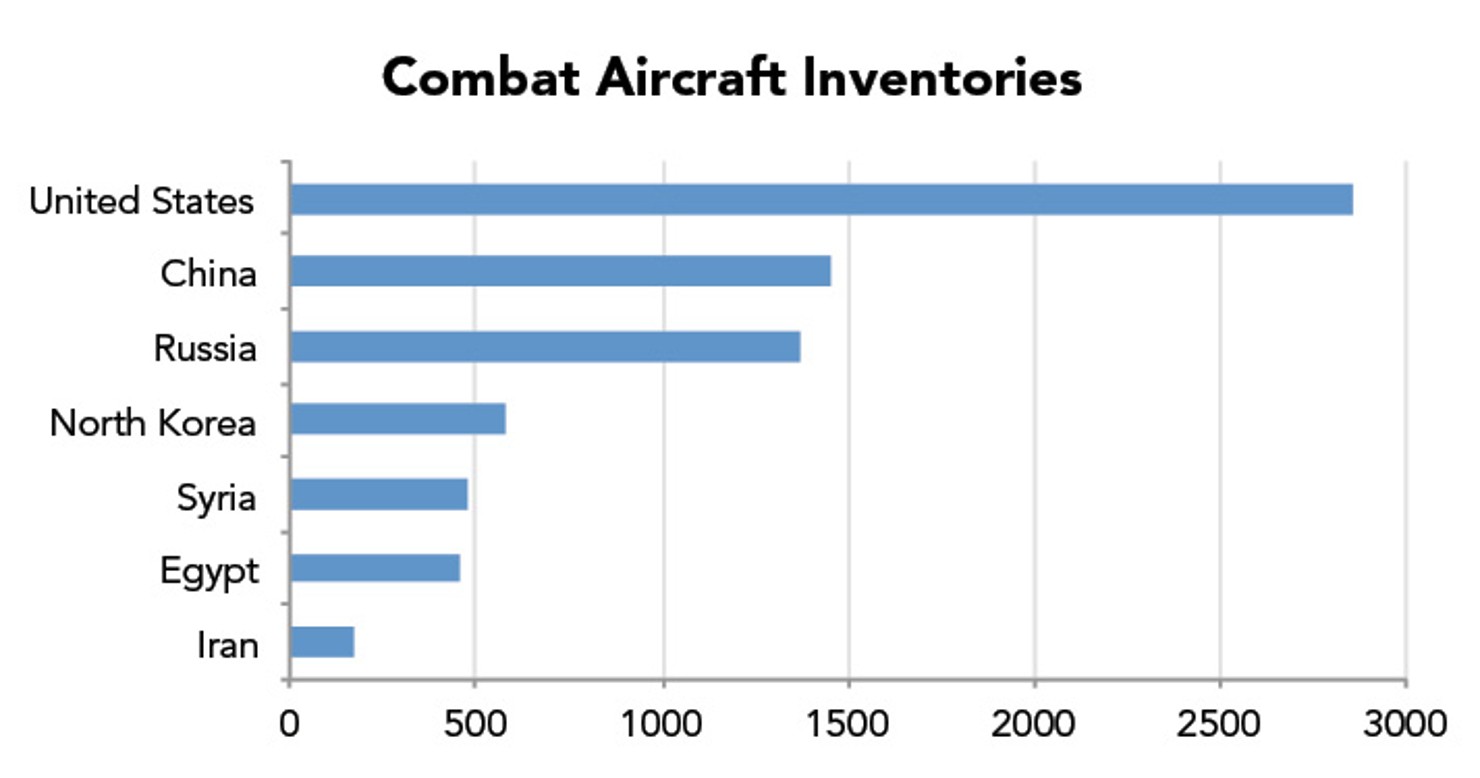
Is it a dire threat that by 2020 the United States will have only 20 times more advanced stealth fighters than China?
— Former Secretary of Defense Bob Gates, May, 201022
Slow the Program Down—Don’t Kill It
Congress should, however, reject calls to cancel the F-35 program. The current fleet of U.S. fighter aircraft is aging and will need to be replaced in the coming decades. Without it, the U.S. will face a capability gap, as the F-35—sometimes referred to as the Swiss Army knife of aircraft—is designed to replace other aircraft performing missions as diverse as air-to-air, air-to-ground, reconnaissance, and close air support for ground troops. Thus, it is imperative the F-35 program ultimately delivers a fully functional plane capable of maintaining U.S. air dominance.
We do not need F-35s today, but we will need them after they’re fully tested.
While it might also be argued that we should shutter all F-35 production lines until testing is complete, this ignores the significant costs that would be incurred from breaking the production contract and closing down—and then restarting—the production line.
Recommendations
The key to successfully acquiring this supersonic fighter jet is, ironically, to slow it down. Don’t cut corners on testing. Don’t rush production before development is complete.
In the National Defense Authorization Act for 2014, the Senate Armed Services Committee supported keeping production “flat for the past 4 years to reduce concurrency risk and allow the program to make additional progress in the testing program before ramping up production."23
Let the actual people who are going to have to use this equipment and rely on it, tell us what the problems are that need to be urgently fixed before we ramp up to full rate production.
— DoD testing director Michael Gilmore, June, 201324
Given that significant, unresolved problems have been identified during that time, and since much more testing remains, Congress should demand:
- Capping F-35 purchases at 29 per year—rather than doubling purchases by 2016—until testing is complete.
- Shifting funds from procuring F-35s to instead buying proven aircraft in order to maintain U.S. air dominance.
Conclusion
The F-35 is the future—not the present—of military aircraft. The time will come when full rate production of the F-35 is justified—after testing is complete and most of the technological challenges have been resolved.
In the interim, proven aircraft should be purchased to maintain U.S. air dominance and save taxpayers billions of dollars.
Endnotes
The F-35 is not invincible however. We will not be able to fully compare the F-35 with other aircraft until it faces them in mock or real combat. But, preliminary evidence indicates that in air-to-air combat the F-35 could be bested by the F-22 under most conditions, and under some conditions the Russian Sukhoi Su-35, the Chinese J-20, and the 4th generation Eurofighter Typhoon could pose a threat to the F-35. It is important to note, however, that air-to-air combat is just one of many missions the F-35 is designed to complete.
“F-35 Lightning II,” Resources, Lockheed Martin. Accessed July 17, 2013. Available at: https://www.f35.com/resources/faqs/category/global-security.
Dave Majumdar, “In Focus: Lockheed claims F-35 kinematics ‘better than or equal to’ Typhoon or Super Hornet,” Flightglobal, February 7, 2013. Accessed July 17, 2013. Available at: http://www.flightglobal.com/news/articles/in-focus-lockheed-claims-f-35-kinematics-better-than-or-equal-to-typhoon-or-super-hornet-382078/.
For further reading see: United States, Congress, Senate, Committee on Appropriations, Subcommittee on Defense, “F-35 Joint Strike Fighter: Restructuring Has Improved the Program, but Affordability Challenges and Other Risks Remain,” Testimony, By Michael J. Sullivan, 113th Congress, 1st Session, Government Accountability Office, June 19, 2013. Accessed July 18, 2013. Available at: http://www.gao.gov/products/GAO-13-690T; See also Jeremiah Gertler, “F-35 Joint Strike Fighter (JSF) Program,” Congressional Research Service, February 16, 2012. Accessed July 18, 2013. Available at: http://www.fas.org/sgp/crs/weapons/; See also Winslow Wheeler, “The New Era of Good Feelings,” TIME, June 3, 2013. Accessed July 18, 2013. Available at: http://nation.time.com/2013/06/03/the-new-era-of-good-f-35-feelings/.
David Francis, “The Pentagon’s Incredible $1.5 Trillion Mistake,” The Fiscal Times, February 26, 2013. Accessed July 17, 2013. Available at: http://www.thefiscaltimes.com/Articles/2013/02/26/The-Pentagons-Incredible-1-5-Trillion-Mistake.aspx#page1.
United States, Department of Defense, Office of the Secretary of Defense, “F-35A Ready For Training Operational Utility Evaluation (OUE),” February 15, 2013. Accessed July 19, 2013. Available at: http://www.pogo.org/blog/2013/03/20130306-air-forces-f-35a-not-ready-for-combat.html.
United States, Congress, Senate, Committee on Armed Services, “National Defense Authorization Act for Fiscal Year 2014 Report,” Report, 113th Congress, 1st Session, 2013. Accessed July 17, 2013. Available at: http://thomas.loc.gov/cgi-bin/cpquery/2?cp113:./temp/~TSOP4D8tJ&sid=TSOP4D8tJ&item=2&sel=TOCLIST&hd_count=2&xform_type=3&r_n=sr044.113&dbname=cp113&&refer=&&.
Bob Brewin, “Program Chief: Software Problems Could Delay F-35’s Delivery Beyond 2017,” Nextgov, April 25, 2013. Accessed July 23, 2013. Available at: http://www.nextgov.com/defense/2013/04/program-chief-software-problems-could-delay-f-35s-delivery-beyond-2017/62790/.
United States, Department of Defense, Office of the Secretary of Defense, “F-35A Ready For Training Operational Utility Evaluation (OUE),” February 15, 2013. Accessed July 19, 2013. Available at: http://www.pogo.org/blog/2013/03/20130306-air-forces-f-35a-not-ready-for-combat.html.
United States, Department of Defense, The Office of the Director, Operational Test and Evaluation, “F-35 Joint Strike Fighter (JSF),” Report, DOT&E FY2012 Annual Report, pp. 27-44, December 2012. Accessed July 17, 2013. Available at: http://www.dote.osd.mil/pub/reports/fy2012/.
United States, Department of Defense, “F-35 Joint Strike Fighter Aircraft (F-35),” Selected Acquisition Report, December 31, 2012. Accessed July 18, 2013. Available at: http://www.pogo.org/our-work/straus-military-reform-project/weapons/2013/part-2-of-f-35-cost-series.html.
United States, Government Accountability Office, “F-35 Joint Strike Fighter: Current Outlook Is Improved, but Long-Term Affordability Is a Major Concern,” Report, March 2013. Accessed July 18, 2013. Available at: http://www.gao.gov/products/GAO-13-309.
Concurrency isn’t always bad, in fact, it’s sometimes necessary to provide the warfighter with a partial fix rather than none at all. When lives are on the line, the perfect should not be the enemy of the good. For example, during the wars in Iraq and Afghanistan, Mine Resistant Ambush Protected (MRAP) vehicles were rushed into production before testing was complete because our ground troops had an immediate need for protection from roadside improvised explosive devices (IEDs). There was a clear justification for rushing the MRAP into production—it saved lives. See United States, Department of Defense, Joint Improvised Explosive Device Defeat Organization, “Mine Resistant Ambush Protected Vehicle (MRAP) saves lives,“ July 27, 2011, Video. Available at: http://www.youtube.com/watch?v=CWgN5Esy7WU.
Dave Majumdar, “Kendall: Early F-35 Production ‘Acquisition Malpractice’,” Defense News, February 6, 2012. Accessed July 17, 2013. Available at: http://www.defensenews.com/article/20120206/DEFREG02/302060003/Kendall-Early-F-35-Production-8216-Acquisition-Malpractice-8217-.
United States, Congress, Senate, Committee on Appropriations, “FY14 Joint Strike Fighter Budget,” Testimony, By Dr. J. Michael Gilmore, 113th Congress, 1st Session, June 19, 2013, Video. Accessed July 17, 2013. Available at: http://www.appropriations.senate.gov/webcasts.cfm?method=webcasts.view&id=0c0ad80c-042b-4a06-ab04-723f26bec380.
Andrea Shalal-Esa, “Exclusive: Retrofits to add $1.7 billion to cost of F-35 – GAO report,” Reuters, March 9, 2013. Accessed July 17, 2013. Available at: http://www.reuters.com/article/2013/03/10/us-lockheed-fighter-cost-idUSBRE92900320130310.
“The 5th Generation Fighter era was ushered in with the formal adoption of the USAF Lockheed F-22 Raptor air superiority platform in 2005,” Military Factory, 2013. Accessed July 22, 2013. Available at: http://www.militaryfactory.com/aircraft/5th-generation-fighter-aircraft.asp.
Dave Majumdar, “In Focus: Lockheed claims F-35 kinematics ‘better than or equal to’ Typhoon or Super Hornet,” Flightglobal, February 7, 2013. Accessed July 17, 2013. Available at: http://www.flightglobal.com/news/articles/in-focus-lockheed-claims-f-35-kinematics-better-than-or-equal-to-typhoon-or-super-hornet-382078/.
Christopher P. Cavas, “USN, Industry Seek New Concepts For 6th-generation Fighter,” Defense News, July 10, 2013. Accessed July 18, 2013. Available at: http://www.defensenews.com/article/20130710/DEFREG02/307100015/USN-Industry-Seek-New-Concepts-6th-generation-Fighter.
“Worldwide Active Fleet Share per Country,” World Air Forces 2013, Flightglobal Insight, p. 6, 2013. Accessed June 19, 2013. Available at: http://www.flightglobal.com/airspace/media/reports_pdf/world-air-forces-2013-101015.aspx.
“Worldwide Active Fleet Share per Country,” World Air Forces 2013, Flightglobal Insight, p. 6, 2013. Accessed June 19, 2013. Available at: http://www.flightglobal.com/airspace/media/reports_pdf/world-air-forces-2013-101015.aspx.
United States, Congress, Senate, Committee on Appropriations, “FY14 Joint Strike Fighter Budget,” Testimony, By Dr. J. Michael Gilmore, 113th Congress, 1st Session, June 19, 2013, Video. Accessed July 17, 2013. Available at: http://www.appropriations.senate.gov/webcasts.cfm?method=webcasts.view&id=0c0ad80c-042b-4a06-ab04-723f26bec380.
United States, Congress, Senate, Committee on Armed Services, “National Defense Authorization Act for Fiscal Year 2014 Report,” Report, 113th Congress, 1st Session, 2013. Accessed July 17, 2013. Available at: http://thomas.loc.gov/cgi-bin/cpquery/2?cp113:./temp/~TSOP4D8tJ&sid=TSOP4D8tJ&item=2&sel=TOCLIST&hd_count=2&xform_type=3&r_n=sr044.113&dbname=cp113&&refer=&&.
United States, Congress, Senate, Committee on Appropriations, “FY14 Joint Strike Fighter Budget,” Testimony, By Dr. J. Michael Gilmore, 113th Congress, 1st Session, June 19, 2013, Video. Accessed July 17, 2013. Available at: http://www.appropriations.senate.gov/webcasts.cfm?method=webcasts.view&id=0c0ad80c-042b-4a06-ab04-723f26bec380.


More in Foreign Policy
View all Foreign Policy
Making the Case: How Obama's Defense Budget Strengthens Security
Star Creep: The Costs of a Top-Heavy Military

Fuel Costs Squeeze Defense Budget
Latest Publications
Trump’s Failure in Iran: A Foolish War Waged by a Foolish President with Americans Paying the Price
Trump Is Laying the Groundwork to Attack Cuba. Democrats Should Push Back.
Democrats aren’t winning the foreign policy argument, group says (external link)
Calm in Crisis, Clear in Purpose: Americans Want a New Foreign Policy Direction
Never Miss an Update
Sign up for updates on the pragmatic, center-left ideas shaping the future of American policy.