Report Published July 29, 2026 · 9 minute read
Making Paid Leave Work: Six Design and Implementation Questions
Olivia Newman & Curran McSwigan
Paid leave debates tend to focus on the headline questions: How many weeks should workers get? Which life events should qualify? How much of a paycheck should the program replace? But as more states build and operate their own paid family and medical leave (PFML) programs, a new lesson has emerged: passing a paid leave policy is only the beginning.
The success of a program often depends on less visible decisions—how benefits are administered, coordinated with other systems, safeguarded against misuse, and made accessible to workers and employers. These implementation choices can determine whether a program is easy to use, efficient to operate, and resilient enough to earn lasting public support.
This report highlights six design and implementation questions Congress will need to answer when designing a federal PFML program. For each, we explore the tradeoffs involved and practical options for addressing them. Together, these questions illustrate a central implementation challenge: balancing consistency with flexibility, speed with oversight, and broad access with administrative simplicity.
These questions include:
- How should a national program address existing paid leave states?
- How can paid leave work for employers, especially small businesses?
- How can the program reach all workers?
- How should the program be administered?
- What should a rollout timeline look like?
- How should a program preserve public trust?
1. How Should a National Program Address Existing Paid Leave States?
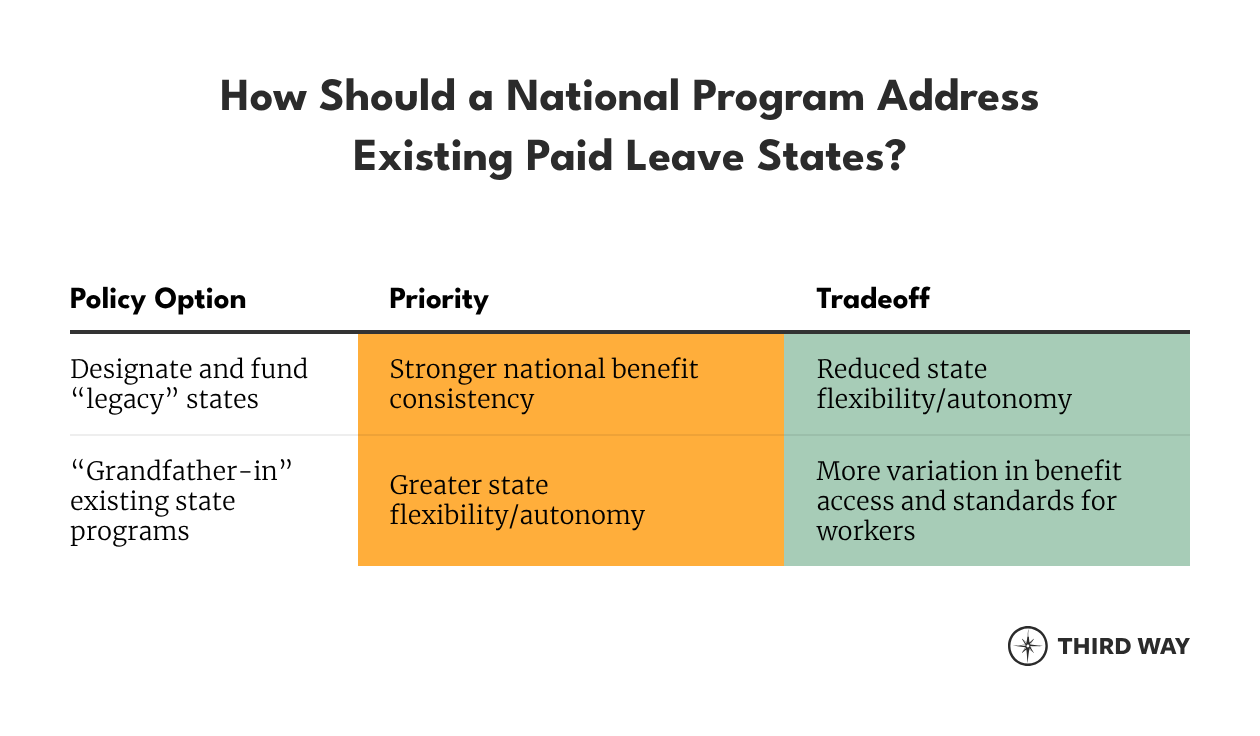
Fourteen states and Washington, DC already run social insurance-style PFML programs, with more states likely to follow.1 Any national PFML framework will need to outline how federal benefits interact with those state programs—whether by replacing, coordinating with, or working alongside them. In doing so, Congress will need to balance two competing priorities: establishing strong national standards versus giving states the flexibility to operate under their own rules.
Policy Options
1. Designate and Fund “Legacy” States
Lawmakers could deem certain states as “legacy” states. This designation would permit them to continue running their state PFML programs alongside a national one, so long as they meet or exceed the federal policy’s benefit standards.2 This approach would help ensure consistent benefit access for workers across the country while also allowing states to keep their existing initiatives. Some states, however, may need to update their programs to meet the new federal requirements.
2. “Grandfather-in” Existing State Programs
Alternatively, policymakers could give states with existing PFML programs “grandfathered” status, allowing them to keep operating under more flexible federal rules. For example, grandfathered states may not be required to raise their benefit amounts to match the federal rate.3 This would preserve more state control over PFML program design and administration. However, workers in some states may receive less generous benefits than the federal standard, leading to differences in paid leave access across the country.
2. How Can Paid Leave Work for Employers, Especially Small Businesses?
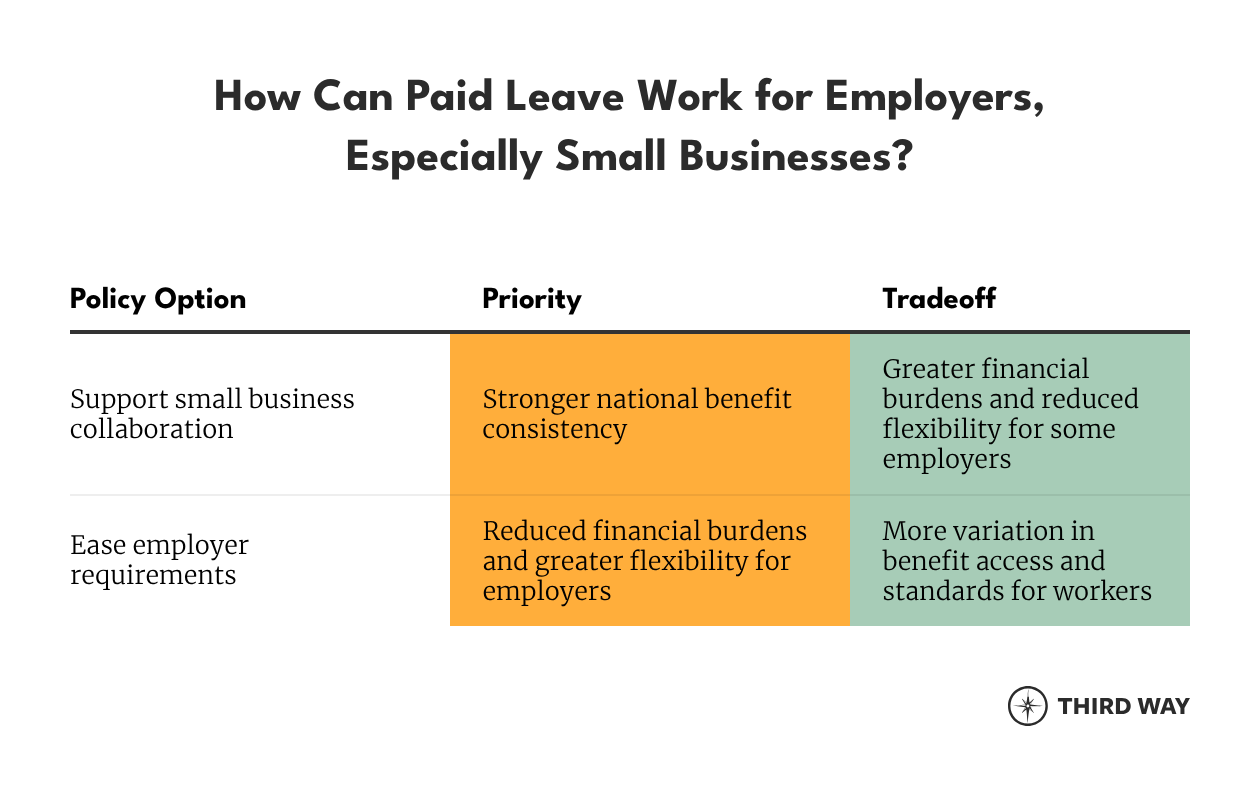
Employers already play various roles across the PFML landscape, from contributing to state social insurance programs to directly providing leave. A federal PFML program would need to determine how employers fit into the system, both as potential contributors to program financing and as providers of existing leave benefits. Not all businesses have the same capacity to absorb new costs or administrative responsibilities, and many already offer paid leave.4 As a result, policymakers will need to balance national benefit standards with the realities employers face and determine how a federal program should interact with employer-sponsored leave.
Policy Options
1. Support Small Business Collaboration
Congress could help small businesses manage paid leave costs and paperwork by incentivizing them to work together. Lawmakers could use federal funds to develop shared services networks, through which multiple businesses collaborate to outsource their administrative needs and share the cost.5 Similarly, policymakers could allow small businesses to join pooled PFML insurance plans. As members, they would share the cost of the PFML employer contribution, reducing each company’s rate.6
This approach could make it easier and less expensive for small businesses to meet federal paid leave standards and help workers access more consistent benefits nationwide. However, it may exclude employers that are not technically “small” but still struggle with costs, such as those in low-profit-margin industries like grocery stores or non-profits with tight budgets.7 Requiring these companies to comply with rigid federal PFML regulations could cause them significant financial strain.
2. Ease Employer Requirements
Lawmakers could reduce administrative burdens for all employers by simplifying certain requirements, such as mandatory reporting or staff training obligations. Doing so could maintain much-needed flexibility for employers that can’t afford to meet more rigorous regulations. However, weaker requirements could make it easier for businesses to avoid PFML compliance, potentially costing workers their benefits and creating differences in coverage across states.
3. How Can the Program Reach All Workers?
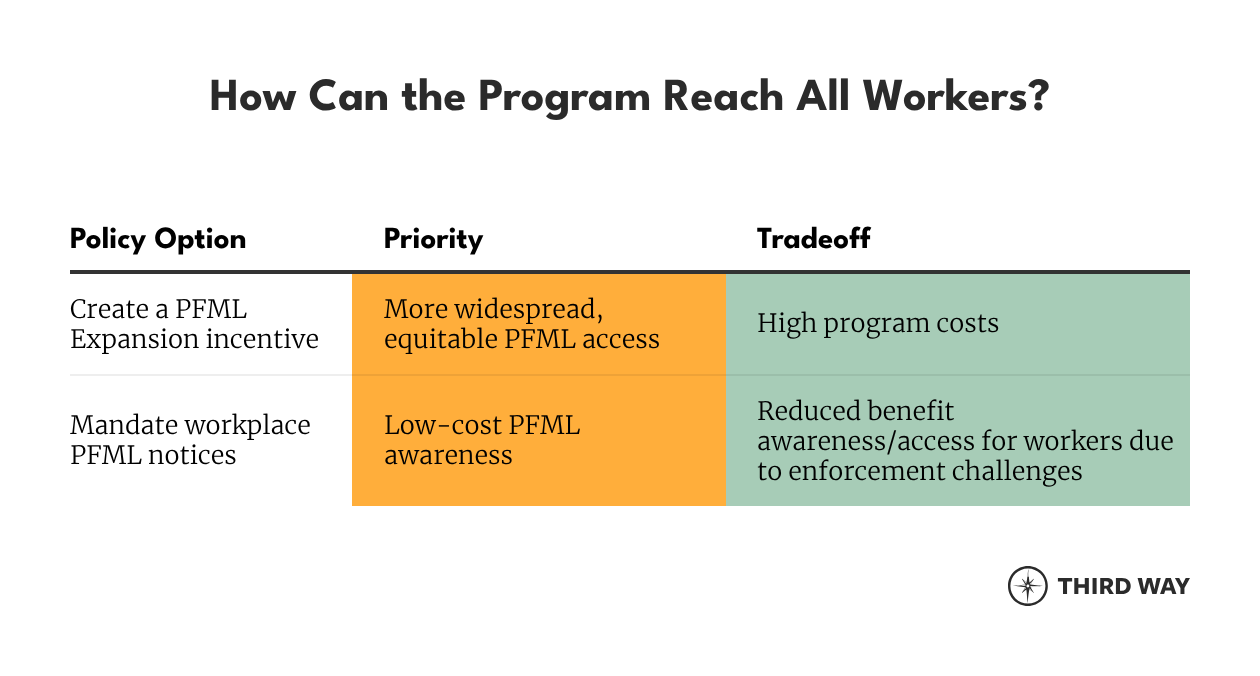
Access to paid and unpaid family and medical leave remains uneven across the country. Some workers are excluded due to restrictive eligibility requirements, while others are unaware that benefits are even available to them.8 A federal PFML policy that fails to address either challenge could leave too many workers unable to access leave. Congress will need to weigh expanding equitable access with the additional costs of broader eligibility, outreach, and administration.
Policy Options
1. Create a “PFML Expansion” Incentive
Similar to Medicaid’s expansion, Congress could provide additional funding to states that adopt eligibility rules broader than the federal standard.9 For example, states could extend coverage to workers who are often excluded from existing FMLA and PFML programs, including part-time, seasonal, and temporary employees—many of whom are women and lower earners.10 This strategy would help more workers qualify for benefits but would also require significant federal funding.
2. Mandate Workplace PFML Notices
Lawmakers could also mandate that employers post information about workers’ rights under a federal PFML policy, as is already required for minimum wage and FMLA laws.11 Doing so could increase benefit awareness at a relatively low cost. Enforcement may be challenging, though, requiring significant administrative oversight. Some employers may also ignore the requirements if the penalties for noncompliance are weak, limiting workers’ awareness of, and access to, PFML benefits.
4. How Should the Program be Administered?
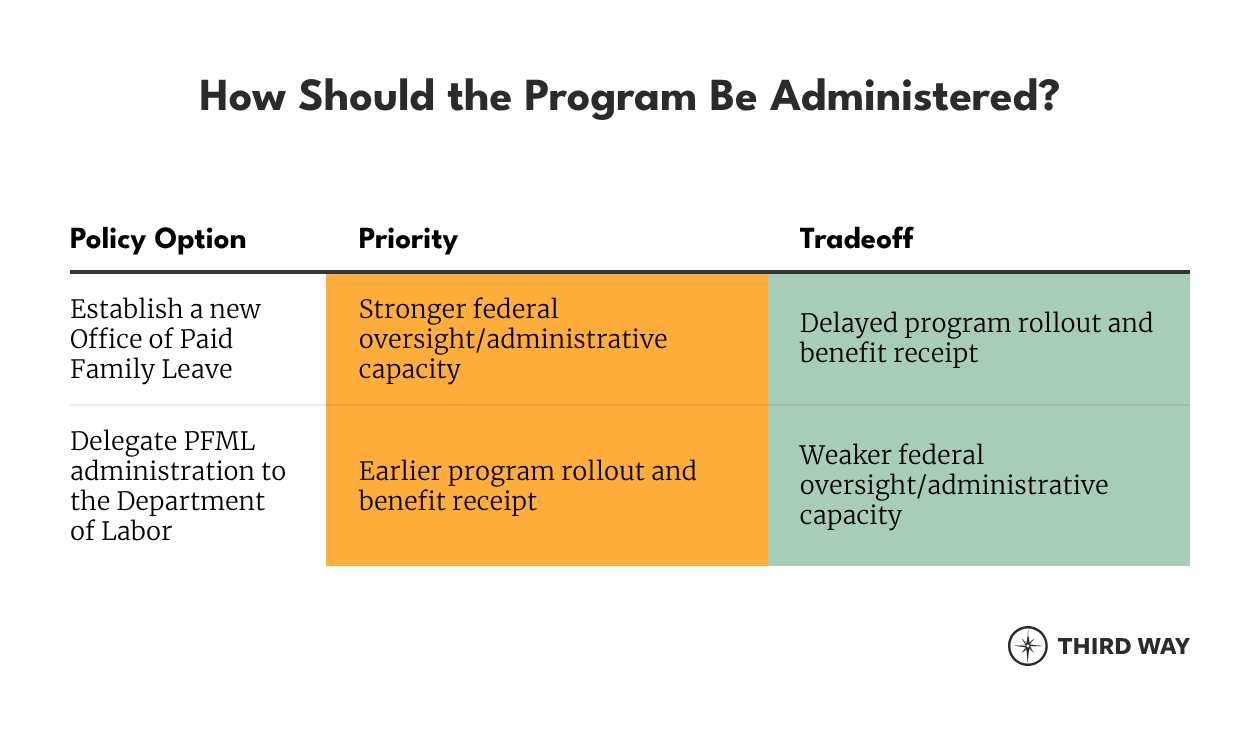
State PFML programs use a range of administrative structures to deliver benefits and oversee program operations, from standalone agencies to programs housed within state labor departments.12 In designing a federal program, Congress will need to decide whether to build a new administrative structure or rely on existing federal agencies. That choice involves a familiar tradeoff between stronger federal oversight and a faster program startup.
Policy Options
1. Establish a New Office of Paid Family Leave (OPFL)
Congress could establish a new OPFL within the Social Security Administration (SSA) to oversee the federal PFML program and coordinate benefit administration through state field offices.13 A dedicated agency would improve the program’s administrative capacity and strengthen federal oversight. However, building a new agency—including hiring staff and establishing administrative systems—will take time to complete, require funding, and could delay benefit delivery.
2. Delegate PFML Administration to the Department of Labor (DOL)
Rather than creating a new PFML office, Congress could also direct DOL to manage the program. Like the apprenticeship system, states could choose either to administer an approved PFML initiative on their own, or to have DOL fully run their program.14 Housing PFML within an existing agency could help Congress launch a federal PFML program more quickly, reducing the time workers must wait to apply for benefits. But relying on existing infrastructure could also strain DOL’s capacity and complicate federal oversight of state-level initiatives.
5. What Should a Rollout Timeline Look Like?
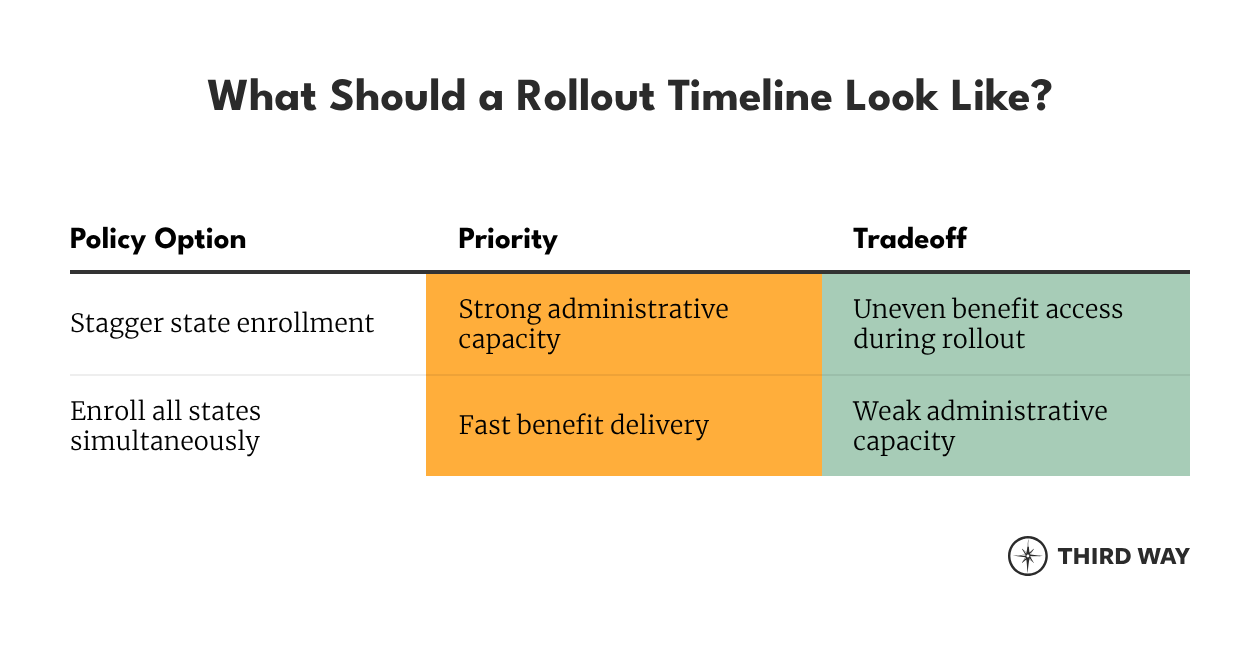
At the state level, rolling out a PFML program has taken anywhere from a few months to several years.15 Congress will need to determine the pace of federal PFML implementation, which will depend on whether they prioritize administrative capacity or fast benefit delivery.
Policy Options
1. Stagger State Enrollment
Lawmakers could create a system where states are phased gradually into the federal PFML program. This might look like enrolling 10 states annually, making the program fully operational within five years. A staggered strategy would ensure administrators have the capacity to implement federal PFML, reducing processing errors and backlogs. However, depending on when they are enrolled, workers in some states would receive benefits much later than others, creating uneven access to PFML during the rollout period.
2. Enroll All States Simultaneously
Policymakers could also enroll all states in the program at the same time, allowing workers nationwide to start participating immediately. While this method would accelerate the rollout timeline, federal administrators may not have the capacity to enroll all workers and employers across the country simultaneously. Forcing them to do so could increase processing errors and oversight challenges during the program’s rollout.
6. How Should a Program Preserve Public Trust?
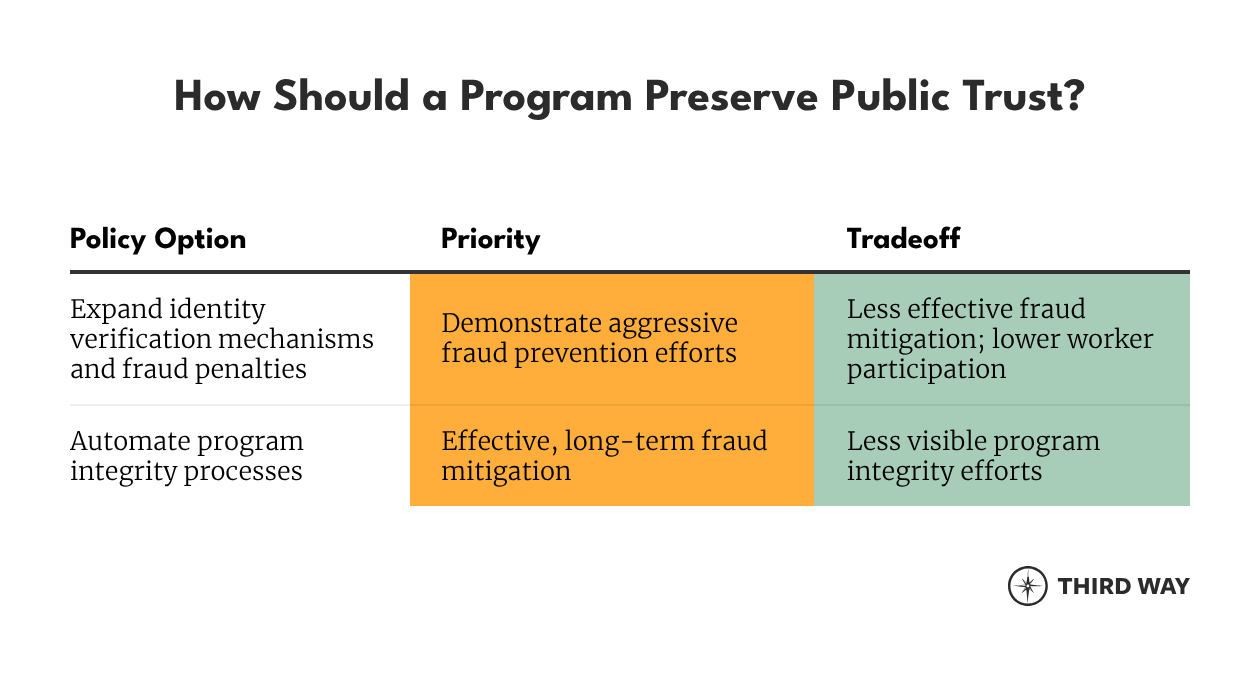
Concerns about fraud and abuse are increasingly shaping debates over public benefit and social insurance programs, and they could complicate a federal PFML rollout if left unaddressed. Congress will need to build program integrity measures into the system from the start. This will mean deciding whether to prioritize highly visible verification and enforcement measures, or system-based approaches that reduce improper payments through administrative design.
Policy Options
1. Expand Identity Verification Mechanisms and Fraud Penalties
Lawmakers could enact several visible anti-fraud safeguards for the federal PFML program, including identity verification, eligibility recertifications, and penalties for fraudulent activities. These measures signal a commitment to fraud prevention. On the other hand, stricter regulations can also increase administrative burdens for the federal government and discourage workers from using PFML. Plus, there is limited evidence that penalties like fines or citations meaningfully reduce improper benefit payments.16
2. Automate Program Integrity Processes
Policymakers could instead prioritize research-backed fraud prevention strategies, such as streamlining and automating administrative tasks for both PFML applicants and administrators. This could include simplifying eligibility rules, creating a standard, national application system, and automating data sharing across agencies like SSA.17 This approach aligns with recommendations from the Government Accountability Office (GAO) and successful fraud-prevention strategies used within other government programs.18 However, these approaches may appear less aggressive to skeptical lawmakers and the public, which could leave a federal PFML program vulnerable to harmful fraud accusations.
Conclusion
A federal paid family and medical leave program would expand access to an important economic support for millions of workers and families. But the implementation details will determine whether that promise becomes reality.
The questions explored in this report are fundamental design choices that will shape who can access benefits, how easily employers can comply with program requirements, and whether the system can earn and maintain public trust. Decisions about state coordination, employer participation, program administration, rollout, and integrity measures will influence the effectiveness of a federal PFML program as much as decisions about benefit levels or eligibility rules.
State experience offers an important lesson: successful paid leave programs depend not only on what benefits are provided, but on how they are delivered. As Congress considers a national PFML framework, addressing these implementation challenges from the outset can help ensure a federal program is accessible to workers, feasible for employers, and equipped to succeed over the long term.