Report Published May 20, 2026 · 12 minute read
Building the Map: A Federal Policy Agenda to Fix America’s Credentialing System

Takeaways
- America’s credentialing system leaves workers to navigate more than one million credentials with little clarity about which ones actually lead to better jobs.
- States are already building the infrastructure for a more transparent and connected credentialing system, but federal policy has not kept pace in scaling and aligning those efforts.
- Federal policymakers can make the credentialing market easier to navigate by aligning quality measures, improving career guidance, standardizing credential data, and simplifying how workers access training funds.
With over 1.1 million credentials available in the United States, learners have no shortage of options. But America’s credentialing system is failing to provide a clear answer to a basic question workers face every day: "What comes next, and how do I get there?"
Right now, navigating the credentialing system feels less like following a map and more like piecing together directions from half-faded road signs. Even highly motivated workers are left guessing which path leads to opportunity and which leads to a dead end.
The components of a better map are already being built. States are developing credential registries, digital marketplaces, and other innovative ways to connect learning and work. However, these efforts remain disconnected and smaller in scale.
At the same time, the conditions for broader reform are aligning. Policymakers are developing regulations formulated around the eligibility of short-term credentials for federal aid through the Workforce Pell program, while states continue to advance new initiatives. And the bipartisan support for many Workforce Innovation and Opportunity Act (WIOA) priorities, including training accounts and support for learners, remains strong. The federal role isn’t to redraw the map but connect it—ensuring what works in some places works everywhere.
By focusing on four strategic areas—navigation, translation, validation, and financing—the federal government can turn today’s credentialing landscape from an unmarked road into a reliable map workers can actually follow.
Fixing Navigation: Helping Workers See What’s Ahead
Goal: Establish outcome-based career navigation as a core federal workforce service.
The information workers need to make informed career choices is currently scattered across disconnected databases, job postings, and program websites. Unlike in higher education—where advising and support systems are built in—those pursuing non-degree pathways are largely left to navigate these choices on their own.1 That’s why the federal government should shift from funding simple activity metrics to supporting human-centered, data-driven navigation.
Policy 1: Create a dedicated career navigation stream in WIOA reauthorization.
Even though WIOA Title I includes annual appropriations for employment services, there is no specific funding for career navigation tools.2 This forces workers to often rely on word-of-mouth or unverified online searches when it comes to understanding what is out there. Some states are building career navigation platforms to help workers compare credential costs, completion times, and employment outcomes. But many workers still need human guidance to make sense of the data.
Congress should authorize specific funding for trained navigators to be placed within American Job Centers who can help workers interpret complex labor market data and connect choices to their specific economic circumstances. This would make career guidance a core workforce service, not an optional add-on. Accountability for these roles should be tied to worker outcome data rather than just program enrollment counts. Additionally, there are still significant evidence gaps in understanding how to best scale efforts that connect individuals to high-quality career opportunities. Also investing in understanding what navigation tools best support learners should be a priority for policymakers.3
Policy 2: Build a national, interoperable credential data infrastructure anchored in state registries.
A registry that only lists programs is merely a directory. High-value registries define the competencies learners gain, show how credentials stack into career pathways, demonstrate outcomes associated with the program, and link that data to employer demand. The Connecting Talent to Opportunity Challenge, launched in 2025, begins to set this standard by requiring states to build more connected talent marketplaces. Yet, its reach is limited due to insufficient funding.4
The current pilot-based infrastructure must evolve into a scalable national system. To do this, policymakers should require that all federally funded credential and workforce data systems meet common standards for machine readability, interoperability, and skills transparency. This means programs would be required to publish credential data in a consistent format that allows workers, employers, and policymakers to easily compare options across systems and align them with employer demand.5 The Department of Education (ED), in coordination with the Department of Labor (DoL), should either condition or incentivize funding for states based on their participation in this shared data infrastructure.
States Are Showing What Effective Career Navigation Looks Like
States are already building more promising ways to help workers navigate credential choices. Mississippi has placed career coaches in 90% of public high schools, connecting students to real-time labor market data and high-demand career pathways. Alabama’s Talent Triad links 19 state agencies to give workers a unified view of their credentials, skills, and job opportunities.
These efforts demonstrate what strong navigation requires: coordinated data systems paired with human support to help workers interpret their options. Federal policy can scale these models by making outcome-based career navigation a core workforce service.6
Fixing Translation: Speaking the Same Language
Goal: Standardize credential data to create a common language for skills.
A credential earned in one system often carries a different meaning in another because providers, employers, and workers use inconsistent language to describe skills. As a result, hiring managers often default to degrees they recognize, weakening the job prospects for non-degree credential holders.7 When credentials don’t talk to one another, learners also end up paying a “mobility tax” to make up credits lost between institutions. And that’s if they end up returning to their training at all.
Policy 1: Make open data standards the default for federal workforce and education funding.
The Departments of Education and Labor should prioritize funding for programs that publish credential information using machine-readable, open standards like the Credential Transparency Description Language (CTDL). CTDL is an open data standard that allows providers to describe credentials in a way that employers, institutions, and state systems all understand.8 While 30 states already use these standards voluntarily, federal agencies should establish a clear expectation that interoperability will become a condition of program eligibility for all new applicants within three to five years. This would shift from an opt-in structure to a shared expectation, ensuring this credential data is transparent and comparable on a national scale.
Policy 2: Invest in portable, worker-owned Learning and Employment Records (LERs).
Federal investment should support the development of secure, worker-owned digital records that allow verified skills and credentials to follow the individual across jobs, educational institutions, and state lines. Rather than building new systems altogether, federal policymakers should support infrastructure built on existing open standards—such as W3C Verifiable Credentials or Open Badges 3.0. These are specifications based upon standards developed and maintained by partners within their respective fields to maintain a threshold of quality.9 Building upon these efforts will ensure credentials are portable—so workers don’t have to start over when they move or change jobs.
States Are Creating a Common Language for Skills
States are leading the shift toward interoperable credential data. Texas is building a statewide Credential Library, while Montana has embedded CTDL into its credentialing infrastructure through the STARS Act. Alabama is using these standards to connect credential data directly to funding decisions. Together, these efforts show how a shared language can make credentials transparent, comparable, and usable across systems.10
Fixing Validation: Answering “Is it Worth it?”
Goal: Align quality signals and outcome reporting across federal agencies.
No single system can answer whether a credential leads to a better job. The Department of Labor (DoL) holds wage data, the Department of Education (ED) tracks completion, the Department of Veterans Affairs (VA) tracks beneficiary outcomes—but these systems do not connect. At the same time, existing validation systems, including state Eligible Training Provider Lists (ETPLs) and Pell eligibility, operate with conflicting criteria. This leaves workers to decode which credentials deliver real value. To provide a reliable "return on investment" signal, the federal government must standardize how quality and outcomes are measured across the workforce landscape.
Policy 1: Establish a common federal standard for outcomes-based data.
ED and DoL should replace the existing patchwork of agency-specific reporting with a single, publicly accessible standard that allows learners to compare programs meaningfully. ED and DoL should create a shared minimum standard across key metrics—including program completion, employment outcomes, and median earnings—that applies to all federally funded credential programs. This data should also be released publicly, including clear links to where these metrics can be found. It should also be standardized to easily compare different programs or providers. Achieving this could look a lot like the highly popular College Scorecard model already used for degree-granting institutions. WIOA could extend this reporting infrastructure to exist across all federally funded workforce programs.
Policy 2: Create federal quality reciprocity across programs.
A credential that meets the quality threshold in one federal system shouldn’t have to prove itself all over again. ED, DoL, and VA should reduce redundant approval processes for high-performing providers by sharing quality assessment data and developing compatible criteria. A potential concern is that in situations where one agencies’ value list may define a credential of value at a lower standard than another, the lower standard prevails. To ensure a high quality threshold is maintained from agency to agency, each should designate a reciprocity coordinator that maps its criteria against the others, and reconcile where changes need to be made. This will narrow the gap between what is “WIOA eligible” vs. “VA approved” and ensure that if there are any agency discrepancies, they are rooted in a clear rationale.
Policy 3: Build Workforce Pell on existing state quality frameworks.
As Workforce Pell rolls out, policymakers should be focusing on how best to support states as they look to comply with new federal rules.11 Several states have made it a priority to push forward frameworks for quality credentials focused on clear definitions and a comprehensive view on value.12 Allowing states with already established credential of value frameworks that meet key criteria to move forward would avoid duplicative review processes and prevent these states from having to start from scratch. This will accelerate implementation timelines as states aren’t forced to reinvent the wheel, all while using Workforce Pell as a way to raise the bar on existing state quality frameworks.
States Are Defining What Quality Looks Like
States are not waiting for federal alignment to define credential quality. Alabama’s Compendium of Valuable Credentials uses employer-led advisory groups to evaluate programs based on labor market demand, earnings outcomes, and occupational alignment. West Virginia has similarly built long-standing short-term credential approval processes tied to state funding. These models show how clear, outcome-based standards can give workers a more reliable signal of value.13
Fixing Financing: Reducing Bureaucracy and Barriers
Goal: Coordinate federal funding rules to follow the learner, not the program.
Fragmented federal rules prevent workers from braiding together different funding streams—such as WIOA, Pell, and VA benefits—to cover the cost of training. Different programs cover different costs and rarely align. When funding for targeted, high-value short-term credentials becomes too difficult to navigate, learners often turn toward longer, more expensive programs. Aligning funding streams around learners, while keeping a focus on programs meeting key metrics, will help mitigate these impacts.
Policy 1: Eliminate barriers that prevent learners from tapping different funding sources.
Right now, WIOA, Pell, and VA programs use conflicting rules with varying definitions, reimbursement timelines, and program approval criteria. Policymakers should focus on making these programs compatible enough that a worker can use multiple funding sources simultaneously without needing a specialist to navigate the bureaucracy . The Departments of Labor, Education, and Veterans Affairs should start that overhaul by convening a task force to align their rules and definitions to unlock funding for learners.
Policy 2: Pilot and evaluate learner-attached funding models.
Federal programs should test mechanisms that allow workers to direct training dollars toward the specific credentials they need. This can build on existing models like the U.S. Chamber of Commerce Foundation’s Skill Savings Accounts which creates employer-funded resources that workers can direct toward training when needed.14 This type of "learner-attached" fund provides a framework for a larger national effort that ensures public investment follows the individual’s career needs rather than being restricted to rigid program categories. To ensure dollars are being directed toward high-quality programs and credentials, state funding could be dependent on them meeting key standards and outcomes-based metrics. Policymakers could also embed this approach into WIOA’s existing Individual Training Account (ITA) mechanisms, to minimize the legislative lift. This ensures public funding supports worker choice—not rigid program categories.
States Are Demonstrating Flexible, Learner-Centered Financing
States and local workforce systems are finding ways to make fragmented funding work. In Southern Nevada, Workforce Connections have turned multiple federal, state, and local funding streams into a single coordinated structure with unified reporting requirements. This approach reduces administrative burden while unlocking funding that is aligned to workers’ needs.
Where to Start
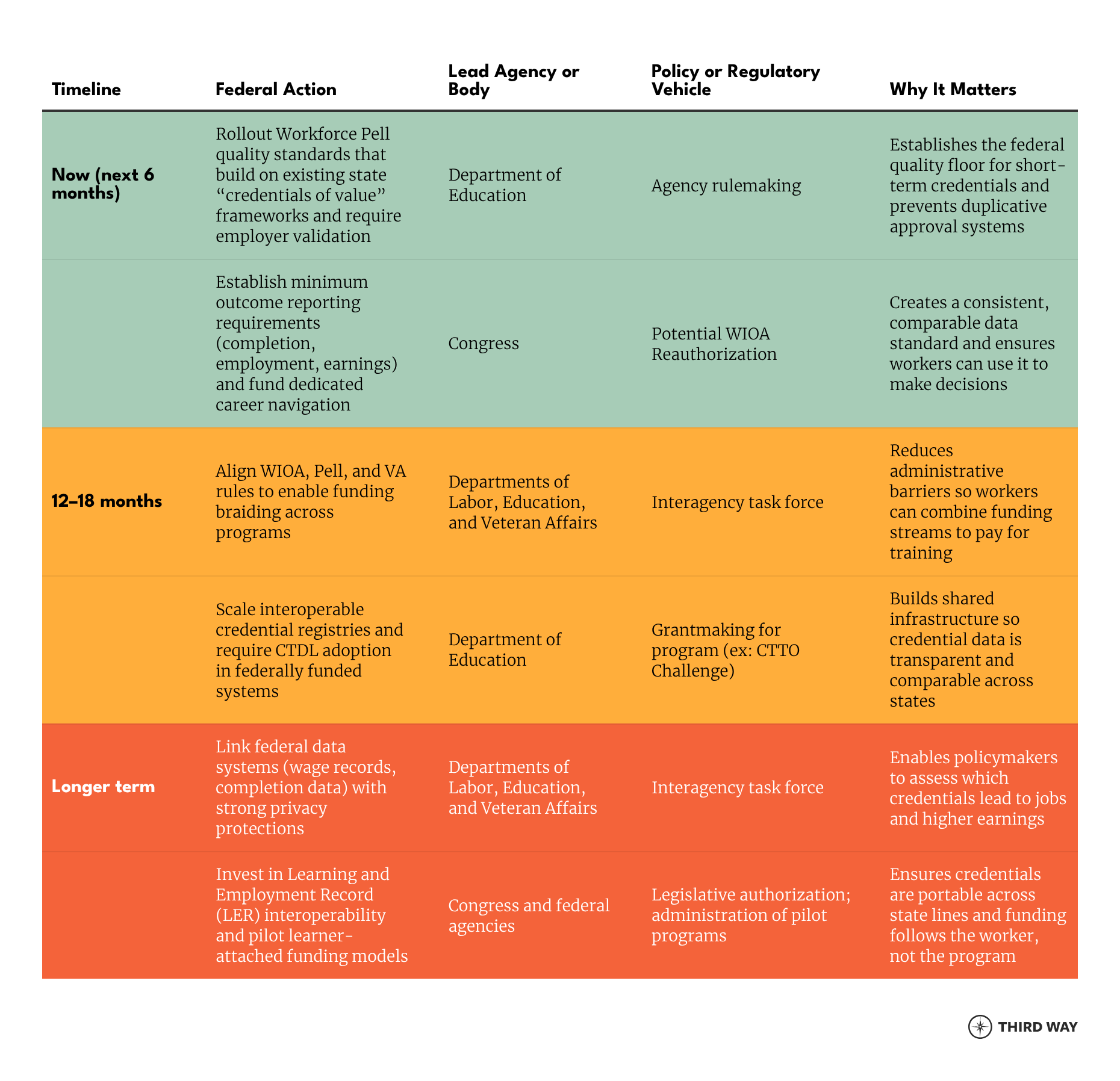
Policymakers do not need to act on everything at once. The table below outlines actions legislators can take now and in the long term.
Conclusion
Constructing a better map for America’s credentialing system is already well underway. States are creating registries, defining quality, and testing new models for data sharing and funding. But as strong as these efforts are, they often remain disconnected and difficult to scale. Federal policymakers don’t need to come in and create a whole new credentialing system. Rather, their role is to connect and strengthen what already exists. That means setting common data standards, aligning quality signals, building interoperable systems, and ensuring funding works in tandem, not opposition. If executed correctly, these reforms will give workers something they currently lack: confidence that the time and money they invest in a credential will lead to a better job.