A $5,000 College Tuition Tax Cut
Anne Kim, Tess Stovall
To succeed in today’s economy, college is a must. But it’s a necessity that’s priced like a luxury. College costs have risen faster than inflation for each of the past 27 years. The American Opportunity Tax Credit included in the American Recovery and Reinvestment Act took a big step forward in ensuring that college remains attainable for middle-class families. Congress should build on this success with a new $5,000 college tuition tax cut that will help families fulfill their dream of sending their kids to school without draining their life savings.
The Problem
Families are facing college tuition sticker shock
Parents know that it has never been more essential to send their children to college than it is today. But doing the right thing has never been so costly.
College costs are skyrocketing.
The cost of going to a public university has risen 80% in just the past 10 years.1 In 2009-2010, the average bill for just one year of tuition, fees, room and board at a public university was $15,213,2 and for private schools, the annual average college bill was $35,636.3 Among families who save for college, the median total amount saved is about $10,000—not enough for even one year’s bills.4
Students are becoming increasingly burdened by debt.
Two out of three college students today are graduating with student debt, versus fewer than half in 1993.5 And today’s graduates are borrowing much more than students did in the past. In 2007, students who borrowed graduated with an average debt of $23,000,6 compared to just $9,272 in 1993.7 This doesn’t include borrowing by parents.
While college costs have spiraled higher, the need for a degree has become greater.
The typical college graduate has an annual salary of $48,097, while the typical high-school graduate’s is $27,963.8 This means that, over the course of a career, the typical college graduate will earn $1 million more than someone with just a high school diploma.9 In fact, male high school graduates earn no more today than they did 30 years ago, while salaries for male college graduates have risen 30% in real dollars over the same time period.10
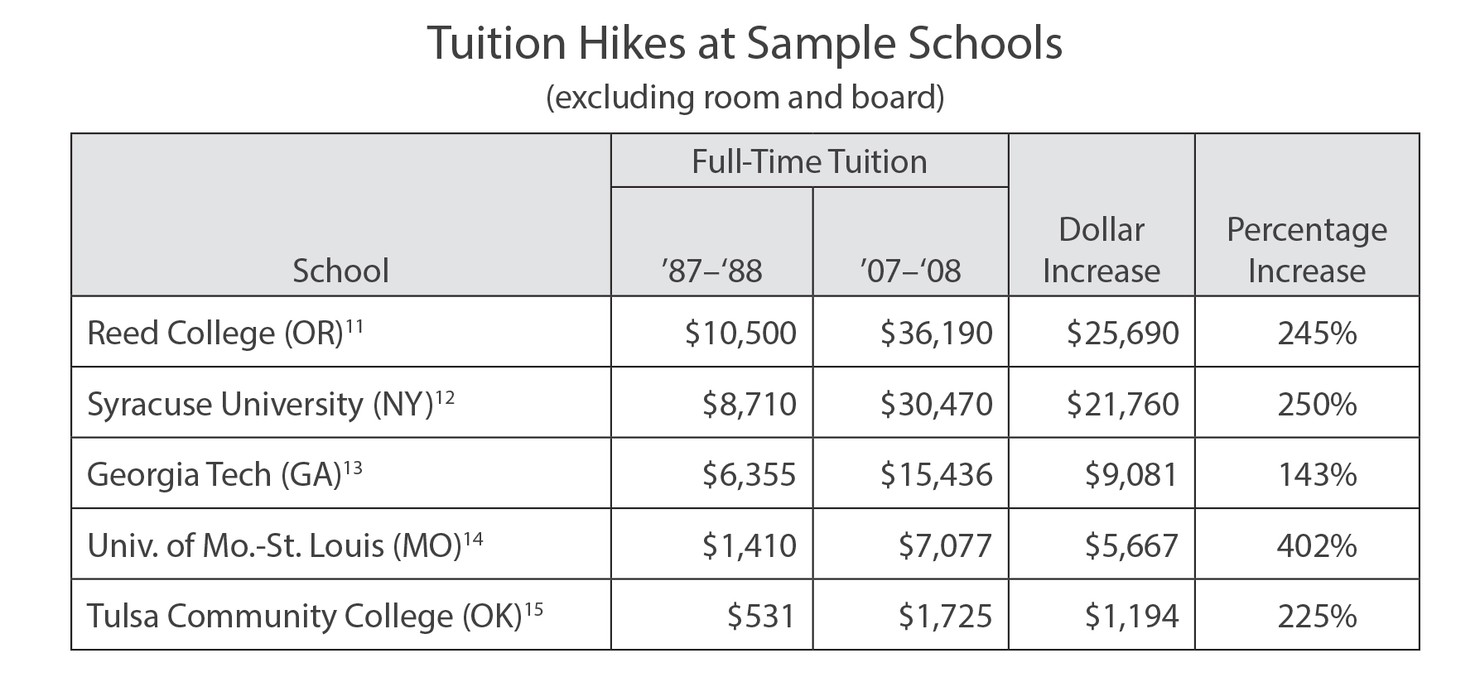
Chart endnotes: 11 12 13 14 15
The Solution
A generous new college tuition tax cut
Third Way proposes a generous new college tuition tax cut in the form of a $5,000 credit toward the costs of college tuition, fees and books for families earning up to $200,000.
Families would get substantially more help than under current law.
This credit would be generous:
- Families would receive a non-refundable credit equal to 50% of the first $10,000 they pay in college tuition per student.
- The maximum credit would be $5,000 per student per year for up to four years of post-secondary education.
This proposal would help the families who have seen their children’s college savings depleted.
Many parents are doing the right thing and saving for college. Over 60% of parents reported they are saving for their children’s future college expenses,16 and nearly one-third are putting their money away in a 529 plan where the funds can be withdrawn tax-free if they are used for higher education expenses. However during the recent economic decline, many parents who have been doing the right thing have seen the balances in their 529 accounts significantly depleted. The total amount of assets in 529 accounts dropped over 20% from the fourth quarter of 2007 to the fourth quarter of 2008 according to the College Savings Foundation.17 This proposal would help families who’ve seen a large chunk of their children’s college savings disappear in the last year to still send their kids to college.
This proposal would help simplify the tax code.
This credit would replace and expand existing education tax credits and deductions, such as the American Opportunity Tax Credit (AOTC), which expires in 2010, and the Lifetime Learning Credit, which carry different and potentially confusing rules and eligibility requirements. In fact, a 2008 Government Accountability Office report found that nearly 30% of eligible tax filers did not maximize their potential education tax benefits with the multiple tax credits under current law.18 A single, simple, super-sized credit would ensure that all families with a student in school can generously benefit. (See the Appendix to this document, which compares existing credits.)
This proposal would be affordable.
This proposal would cost an estimated $8.8 billion per year in incremental costs (over and above current spending for existing college tuition tax breaks).19 The incremental five-year cost is estimated to be $48.6 billion, and the estimated incremental ten-year cost would be $110.7 billion.
The Rollout
Ideas for launching and publicizing the college tuition tax cut
- Hold a press conference at a local high school with college-bound seniors and their parents or at a local university with college students and their families.
- Release a short report documenting the rise in tuition costs at five area colleges and universities from 1989–1990 to 2009–2010. Include an estimate of what college costs will be in 15 years if prices continue to increase at the current rate and cast the results in terms of what the parents of today’s preschoolers will be facing.
Critiques & Responses
The College Tuition Tax Cut
It’s too expensive.
Few investments are more important than ensuring that every young person who aspires to college has the opportunity to attend. A middle class parent sending two kids to a state college faces over $100,000 in bills. At best, their child is able to borrow money and begin his or her working life $23,000 in debt. Doing the right thing shouldn’t hurt so much.
Moreover, this is the right investment for America. In today’s economy, the countries that succeed will be the countries that graduate more young people from college and graduate school. We can’t let college costs hold us back from continuing to be the most innovative economy in the world.
A college tuition tax credit was included in the American Recovery and Reinvestment Act. Why do we need another one?
The American Opportunity Tax Credit provides an important and much-needed tax benefit to families trying to cope with the rising cost of college. However, the tax credit is temporary, expiring in 2010. This proposal builds on the progress made by the American Opportunity Tax Credit to ensure that it’s easier for families to receive a tax credit that will help make paying for college more affordable through 2010 and beyond.
More aid will cause college tuition to rise.
This is the reason conservatives cite for wanting to cut college aid. They can’t be more wrong. The greatest college aid program in US history—the GI Bill—had no impact on tuition prices.20 Moreover, college tuition rates have far outpaced increases in federal student loan funding.21
Nobody really pays the sticker price.
Going to college shouldn’t be like buying a used car. It’s true that some of the most prestigious and high-priced universities are starting to give more scholarships and aid to middle income people. That’s good. But it’s a drop in the bucket; and for most families—the price you pay is the price that is advertised.
Appendix
Detailed Comparison of College Tax Credit to Current Law
Under current law, families have three major options for coping with college expenses: a tuition tax deduction, the American Opportunity Tax Credit and the Lifetime Learning Credit. Taxpayers may choose only one of these options. The proposed credit would replace and expand these existing benefits with a single, simple and generous credit.

Endnotes
College Board, “Trends in College Pricing 2009,” available at http://www.trends-collegeboard.com/college_pricing/pdf/2009_Trends_College_Pricing.pdf.
College Board, “Trends in College Pricing 2009,” available at http://www.trends-collegeboard.com/college_pricing/pdf/2009_Trends_College_Pricing.pdf.
College Board, “Trends in College Pricing 2009,” available at http://www.trends-collegeboard.com/college_pricing/pdf/2009_Trends_College_Pricing.pdf.
Investment Company Institute, “Profile of Households Saving for College,” 2003, available at http://www.ici.org/pdf/rpt_03_college_saving.pdf.
Project on Student Debt, “High Hopes, Big Debts”, available at
http://projectonstudentdebt.org/files/pub/High_Hopes_Big_Debts.pdf. See also Berkner, L., et al., “2003-04 National Postsecondary Student Aid Study (NPSAS:04) Undergraduate Financial Aid Estimates for 2003-04 by Type of Institution,” National Center for Education Statistics, available at http://nces.ed.gov/fastfacts/display.asp?id=31.Project on Student Debt, “Student Debt and the Class of 2007,” October 2008, available at http://projectonstudentdebt.org/files/pub/classof2007.pdf.
U.S. PIRG Educational Fund, “Student Debt and Consumer Costs in the Minneapolis-St. Paul Area,” July 2006, available at https://www.uspirg.org/uploads/lJ/LB/lJLB6-BF1KZZsujgdPNTgw/StudentDebtMN.pdf.
U.S. Census Bureau, Current Population Survey, “Educational Attainment --People 25 Years Old and Over, by Total Money Earnings in 2007, Work Experience in 2007, Age, Race, Hispanic Origin, and Sex,” available at http://www.census.gov/hhes/www/cpstables/032009/perinc/new03_001.htm.
Baum, S. and Ma, J., “Education Pays: 2007,” The College Board, available at http://www.collegeboard.com/prod_downloads/about/news_info/cbsenior/yr2007/ed-pays-2007.pdf.
Anne Kim, Adam Solomon, Bernard L. Schwartz, Jim Kessler and Steve Rose, The New Rules Economy: A Policy Framework for the 21st Century, Third Way, February 2007.
http://web.reed.edu/apply/tuition.html, personal communication with school officials.
http://admissions.syr.edu/faq/facts.cfm?CFID=855589&CFTOKEN=17053217#howmuch, personal communication with school officials.
http://www.finaid.gatech.edu/costs/budgets/index0708.php, personal communication with school officials.
http://www.umsl.edu/services/finance/fee_sch.htm, personal communication with school officials.
http://www.tulsacc.edu/page.asp?durki=3584, personal communication with school officials.
Fidelity Investments, “Fidelity College Savings Indicator Finds Parents Are Projected to Meet Only 21 Percent of Future College Costs—Three Point Decrease from One Year Ago,” News Release, October 1, 2008, available at http://content.members.fidelity.com/Inside_Fidelity/fullStory/1,,7640,00.html.
College Savings Foundation, “529 Assets Decline in 4Q of 2008,” March 2, 2009, available at http://www.collegesavingsfoundation.org/pdf/CSFPR4Q2008FinalwCharts.pdf.
