Report Published October 16, 2026 · 7 minute read
Democrats: Reject Vouchers, Embrace Family Agency in Public Education

Democrats are at a crossroads on school choice. Path A: Defend the status quo, recycle decades-old talking points about how traditional public school structures are the only option, and treat “choice” as taboo. Path B: Embrace innovation, listen to parents and students seeking more modern opportunities, and rethink what it looks like for families to have meaningful options to find the best fit for their children within the public school system.
The national conversation on school choice has been dominated on one side by Republicans evangelizing its benefits, and on the other by Democrats emphasizing the negative impacts and outcomes of vouchers—which are real and well-documented.1 Meanwhile, parents are clear in their desire for greater agency to meet their child’s unique needs. Here’s where the nuance comes in: parents want agency, but that doesn’t always mean they want to uproot their child and send them to a private school. While support for school choice has increased over time, it consistently ranks as a lower priority than strong academic programs, personalized learning plans, access to mental health services, and investments in local public schools.2 Recent polling from the National Parents Union asked parents how they would use potential scholarship funds, and only 9% said they’d use the extra money for private school tuition. Parents are sending the message that they want more and better options right where they are.3
School choice is not new, it’s not just about sending kids to another school, and it’s not the one-step solution to our nation’s education challenges. But by letting Republicans own the whole concept, Democrats are missing out on the opportunity to uplift proven models that empower parents to be the key decisionmakers in their child’s education, all without leaving their public school district or community.
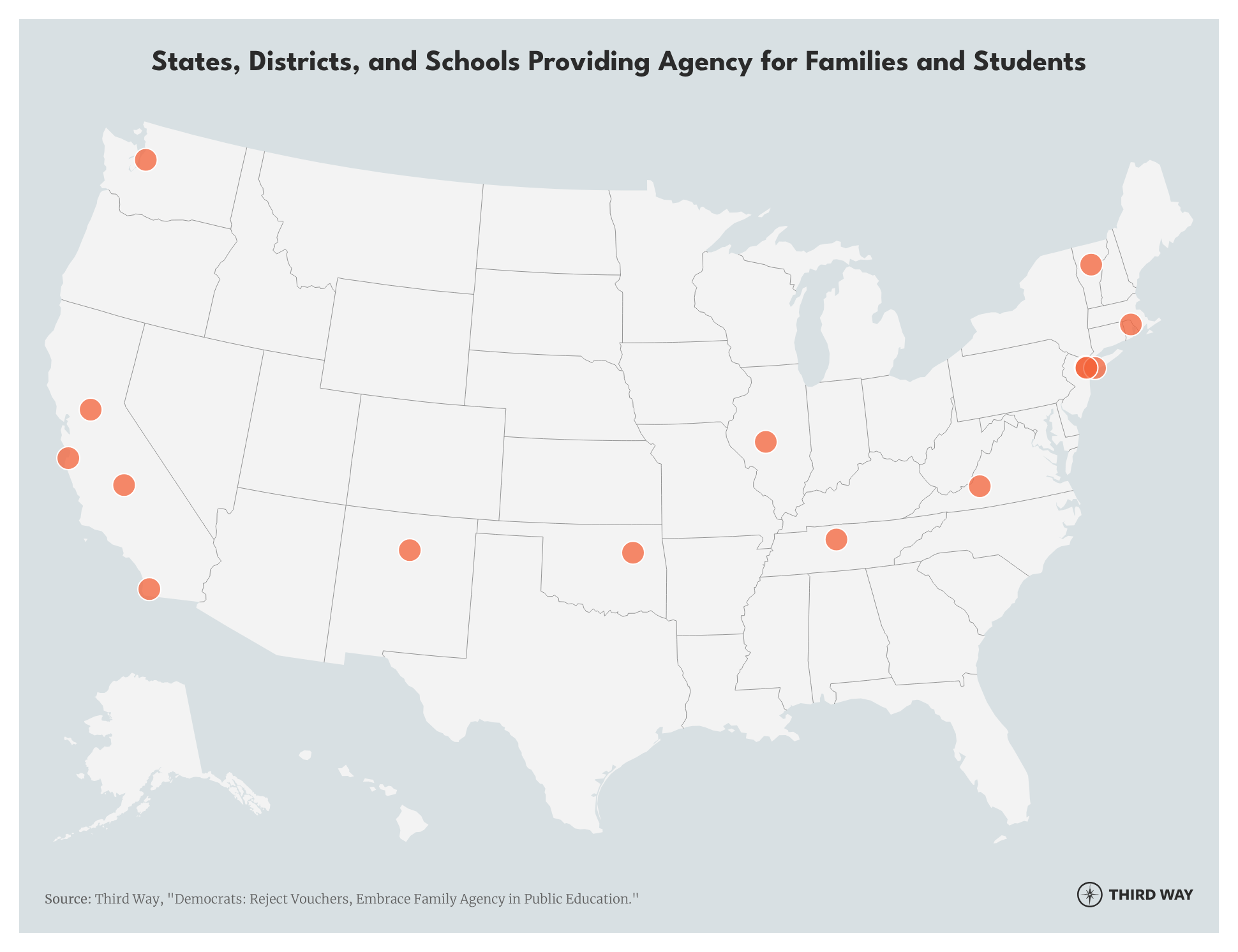
And there is good news! Across the country, schools and districts are embracing ways to give parents and families agency, in many cases under a name other than “school choice.” These models provide a menu of options that schools have crafted, tested, and fine-tuned. They show Democrats what Path B can look like in practice: a public education system that gives families meaningful choices while expanding access to additional ways for students to learn and thrive.
What Are Effective Public School Choice Options?
As schools and programs have evolved and grown, “school choice” carries different meanings for different people. There is an important distinction between public school choice programs that are easily accessible to families seeking more options and private school choice systems that limit access to a select few. Public school choice programs empower families to choose a school beyond their assigned geographic zone, offering opportunities for parents to find the learning environment that best fits their child’s needs and abilities.
In cases where parents do want to explore other schools, research shows that the most effective public school choice programs feature universal enrollment, allowing all families to select their desired school.4 These options can resonate with families who, for decades, have awarded high praise to their community’s public schools but may be looking for a specific environment where their children can thrive. State policymakers and public school district leaders have done the hard work to create programs that meet students’ needs and respond to parents and families through the following policies:
- Intradistrict public school choice gives students the option to enroll in schools other than their assigned school within their zoned public school district. Districts have adopted this option in various forms. New York City Public Schools uses a centralized system that enables families to explore options across the district, beyond their neighborhood schools.5
- Interdistrict public school choice provides the opportunity for students to attend any public school across the state. Colorado is known for this flexibility, where students can use an application process to attend a public school outside their district boundaries.6
- Magnet schools offer specialized programs—for example, science, technology, engineering, and mathematics (STEM), fine and performing arts, or career and technical education (CTE)—for students who want to pursue particular interests or postsecondary options. Magnet schools operate within both intradistrict and interdistrict public school choice programs and often have set admission requirements. Wake County Public Schools in North Carolina offers an extensive array of magnet schools through a weighted lottery system that is designed to promote school integration.7
- Charter schools serve as public school options independent of the public school district. Charter school models vary widely, but the most effective are well-regulated, transparent about student outcomes, and have robust accountability systems. In Washington, D.C., an independent authorizer oversees each charter school’s policies and practices, including the services they provide to multilingual learners and students with disabilities.8
But there are also many other ways that public schools give families and students agency that don’t currently fit under the technical “school choice” definition. From academic recovery programs to competency-based and advanced curricula, these efforts create new opportunities within schools, providing students with personalized learning in the communities where they already live and attend school.
Yes, and: YES, Most Students Attend Public Schools, AND Families Want More Opportunities
Despite the rapid expansion of statewide school choice policies and national headlines pushing private school alternatives, parents have not rushed to move their children to new schools. Nationwide, 90% of students still attend public schools. Even in states with universal school choice, where every student can use public funds to attend a private school, private school enrollment is only slightly higher—around 14% versus the nationwide 10%.9
It’s not a shock that parents and voters across the country strongly support funding public schools and consistently reject measures to expand universal voucher programs.10 They know that already-wealthy families take advantage of these programs, vouchers don’t actually make private schools affordable, and over time they can leave public schools in unstable financial situations.11 So, when parents indicate growing demands for more options in their children’s education, they’re not just asking for access to private schools. Tens of thousands of families in states with broad school choice policies have chosen to use their voucher money on academic support for their child rather than private school tuition.12 Democrats can continue to reject voucher policies while emphasizing the importance of parental agency in their children’s education.
How Public Schools Are Giving Families Agency
Effective public school choice initiatives that give parents the agency they seek do so by harnessing innovation, strengthening academic foundations, and providing connections to community resources that complement educational efforts. Dozens of models have emerged to address modern demands and deliver options to personalize what learning looks like. Though there are overlaps in the programs’ purposes and impacts, the approaches are bucketed into three primary domains:
- Innovation Models offer tailored opportunities to engage students at the intersection of their present interests and their future goals, creating avenues for customized support at all levels.
- Scholastic Success Models bolster in-school and district-wide programming focused on fundamental academic skill-building, ranging from long-term academic recovery to advanced coursework.
- Community Connection Models center schools as community hubs, linking students and families with a broader range of resources, services, and programming.
Conclusion
Democrats can no longer stick to the status quo; they must offer families agency hand-in-hand with their sustained support for public schools. While Republicans have made school choice the headline of their K-12 education reforms, it’s not the only way to meet students and parents where they are. Public school choice offers opportunities and agency for families, and Democrats should champion these forms of choice that empower parents to make the best decision for their child without having to leave their community or district. Through innovative practices, a focus on academic foundations, and intentional connections to community, public schools have developed a range of models that meet today’s demands and provide new options that families seek. Democrats should choose Path B: elevate public school models that expand opportunities and scale pathways for families to find the best fit for their children.