Climate & Energy Communications Cheat Sheet 9/28/18

This has been an intense week and a week in which climate and energy news might have fallen off your radar. In the midst of Climate Week NYC, President Macron urged the US and other countries to re-engage in the Paris Climate Agreement during the United Nations General Assembly, the fate of nuclear projects hung in the balance, and a new report was released that shows the social costs of climate change.
Whiplash
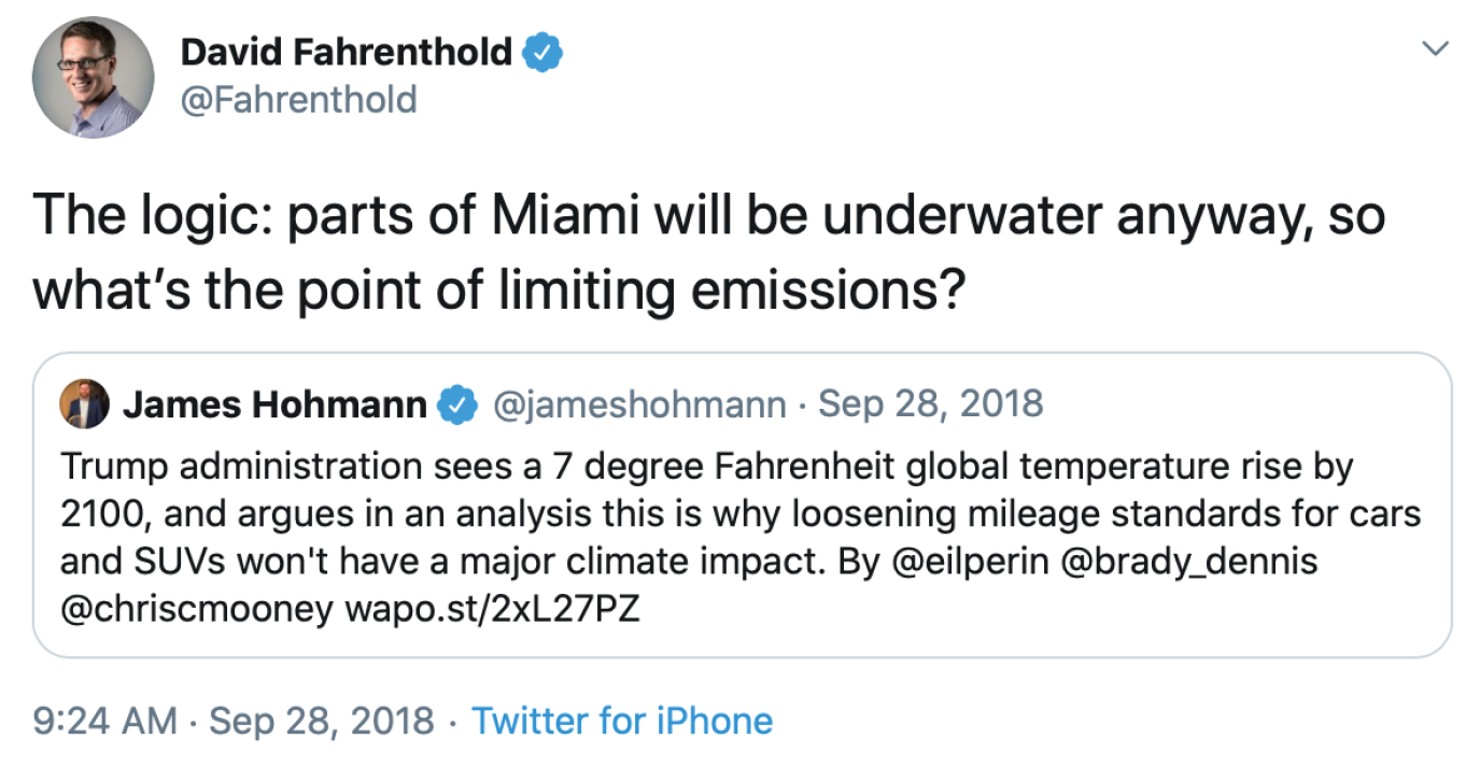
In July 2018, the National Highway Traffic Safety Administration (NHTSA) quietly released The Safer Affordable Fuel-Efficient (SAFE) Vehicles Rule for the Model Year 2021–2026 Passenger Cars and Light Trucks draft environmental impact statement, which states that on its current course we will see a rise of 7 degrees Fahrenheit/4 degrees Celsius in the Earth’s temperature by 2100. This will prove catastrophic in fueling climate change and extreme weather events causing parts of Manhattan and Miami to be underwater. Once again, we see the Trump administration sitting idly by, not working to mitigate the problem, but instead diminishing progress made on this front over the last several years.
Just In
Today, Juliet Eilperin, Brady Dennis and Chris Mooney of The Washington Post report on the draft environmental impact statement from NHTSA.
French Pressure
While most of the news from the United Nations General Assembly concerned President Trump’s political posturing toward China and Canada, French President Emmanuel Macron issued this warning, "Let's stop signing trade agreements with those who don't comply with the Paris Agreement." While Macron did not directly call out the United States and President Trump for his withdrawal from the agreement, that was the obvious implication. As President Trump moves forward renegotiating trade agreements, he should be aware of the dangerous consequences those policies have on climate.
ICYMI
In 2016 The Commonwealth, a peer-reviewed publication, published a study by Aaron Cosbey about the trade implications of the Paris Climate Agreement.
Talking Points
- The Paris Climate Agreement was a starting point for countries to curtail their greenhouse gas emissions. The next step is to make these cuts more ambitious and ensure they are enforced fairly. That requires the largest global carbon emitters, namely the US, to come to the table, engage, and commit.
- France, the United Kingdom, Germany, and others have acknowledged the threat of climate change and are serious about policy solutions. President Macron issued a gentle warning, many of our other trading partners may not.
- Many local and state governments have picked up the baton to address climate change. California is factoring in climate concerns and impacts when deciding who it will purchase certain goods from with their Buy Clean Act. This could likely become a trend in other parts of the world, those who fail to take climate seriously could get locked out of lucrative markets, potentially creating enormous climate and economic gains.
Why Climate Advocates Should Care About Nuclear
Transatomic, a leading advanced nuclear company, has shut down operations this week and made their research open source, so other nuclear innovators can build on the work they’ve done. While it’s disappointing news, it should not cast a negative aspersion on the growing advanced nuclear industry. If the US continues to invest in and deploy advanced nuclear we will be able to aggressively reduce emissions.
A recent study released by MIT showed the challenges nuclear projects face and what can be done for them to overcome these obstacles.
ICYMI
James Temple of MIT Tech Review reports on the genesis of Transatomic and the challenges it faced including insight from Third Way’s Josh Freed on what this means for the advanced nuclear industry.
Talking Points
- Advanced nuclear is an important part of the future US energy mix and it will help us be more ambitious and aggressive in reaching climate targets.
- The closure of Transatomic is disappointing, but not at all surprising in a young, dynamic sector with more than70 projects under development in North America.
- This is exactly what should happen when you have many people testing many different technologies and business models in pursuit of a new market and a common goal.
- A handful of companies will continue to emerge as the leaders in advanced nuclear and attract more talent, capital, and interest from potential domestic and international customers.
Must Read
Umair Irfan of Vox reports on a new study that was published in Nature Climate Change on Monday that found that due to the uneven burden of climate change the US economy “stands to pay one of the highest prices in the world for its emissions.”


Downloads
Latest Publications
On Permitting Reform: How To Talk About BAAJA
Past the Pump: How Americans are Footing the Costs of Trump’s War of Choice
EIA is Under Attack. That’s Dangerous for the Entire Energy Sector.
On the Grid: PERMIT Me to Celebrate
Never Miss an Update
Sign up for updates on the pragmatic, center-left ideas shaping the future of American policy.