Memo Published April 14, 2026 · 4 minute read
What CBO Says About Social Security
Social Security is one of our nation’s greatest achievements: a bedrock program that helps millions of Americans retire with dignity and economic security. But the latest Congressional Budget Office (CBO) report sounds an alarm—the main Social Security trust fund is projected to reach insolvency in 2032. What once felt distant is now a real and looming challenge for the next president. If Congress fails to act, beneficiaries will face an automatic cut of roughly one-quarter of their benefits. This is not alarmism. It is arithmetic.
Key Facts About Social Security’s Finances
Social Security’s Old-Age and Survivors Insurance (OASI) program is financed through payroll taxes and its trust fund.1 When tax revenues exceed the cost of benefits, the surplus is credited to the trust fund and invested in Treasury securities. When benefits exceed incoming revenue, those securities are redeemed to cover the gap. In short, the trust fund reflects past surpluses plus interest earned over time.
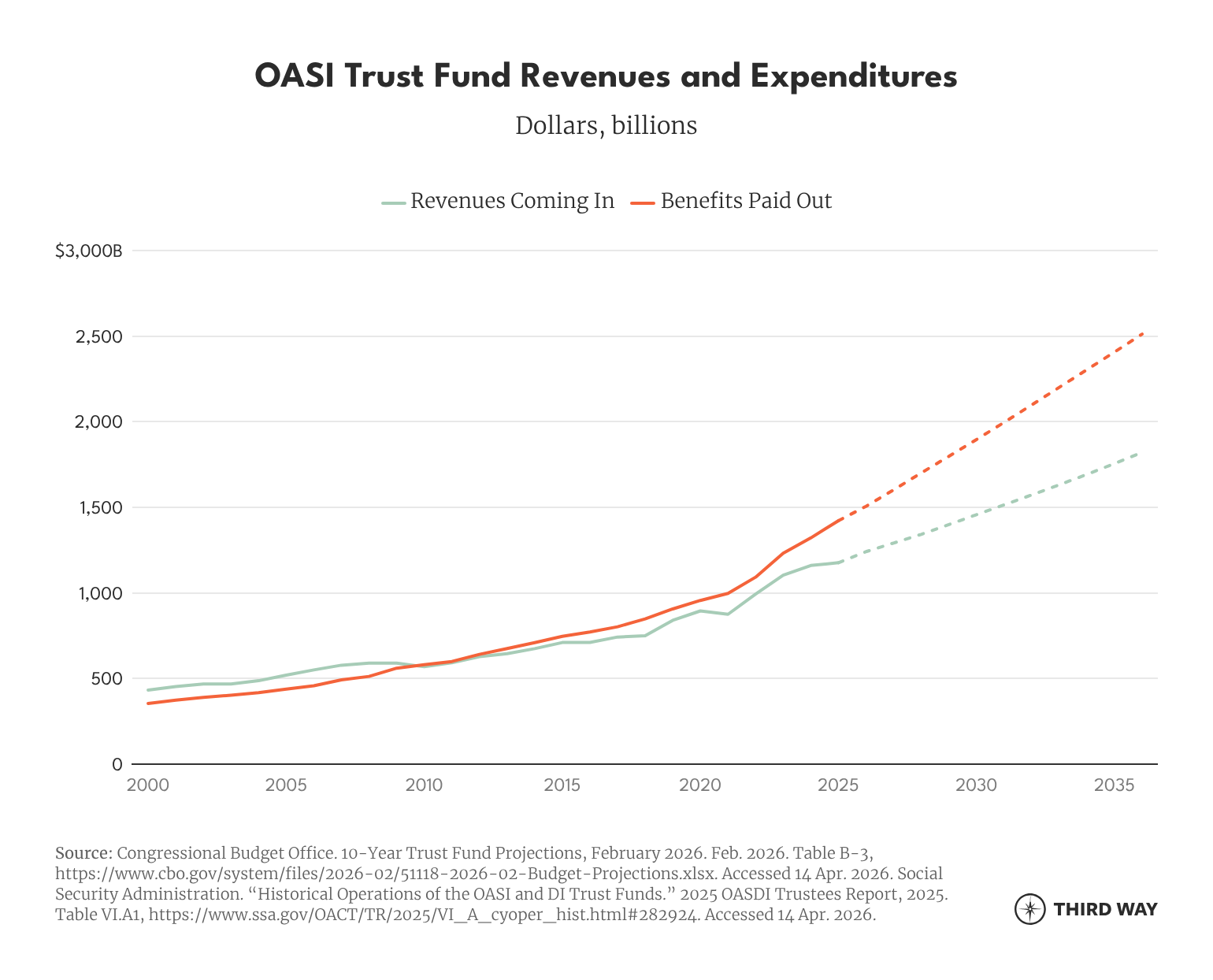
That gap is no longer theoretical: Social Security’s OASI trust fund has run annual cash-flow deficits since 2010.2 That’s because benefits have been growing faster than income—roughly 5% annual growth for costs versus about 4% for payroll tax revenue.3 In 2026, benefit payments are expected to be $207 billion more than collected revenue.4 The OASI trust fund is expected to run out of money, or reach insolvency, in 2032.5 Because CBO’s budget baseline must assume benefits are paid in full even after insolvency, it estimates Social Security’s budget deficit will reach $691 billion in 2036.6
Understanding Insolvency
“Insolvency” does not mean Social Security disappears. It means OASI could only pay benefits up to the level supported by incoming revenues. Once the trust fund is exhausted, full scheduled benefits could not legally be paid.7 CBO estimates that payable benefits would be about 28% below scheduled levels after exhaustion. In plain English, that means an automatic across-the-board cut unless Congress intervenes. Such a cut would be costly for seniors. The Urban Institute estimates that a two-earner couple of modest means reaching full retirement age in 2032 would receive $776,000 in lifetime benefits. A 28% haircut would reduce those lifetime benefits to about $559,000—less than the estimated $632,000 they would have paid in lifetime taxes, measured in 2025 dollars. 8
There is no painless version of that moment. For example, to close a gap of that size immediately through payroll taxes alone would require roughly a 30% increase in the payroll tax (from 12.4% to about 16.1%).
Congressional Action
When the trust fund nears exhaustion, Congress will face intense pressure to avoid an abrupt benefit cut. Congress may look to authorize transfers from the Treasury’s General Fund rather than rely solely on tax increases, benefit reductions, or some combination of the two.
The general fund (which is where most federal tax revenue is deposited) finances three-quarters of federal spending that is not supported by a dedicated funding source.9 A bailout of this kind would weaken the principle that Social Security is primarily self-financed through dedicated contributions, undermining a core feature of the program’s design for 90 years. It would also force Social Security into more direct competition with other national priorities inside the broader federal budget.
Some will point out that the Disability Insurance (DI) trust fund—the other part of the Social Security program—remains solvent longer than OASI. That is true. The DI program, which supports individuals with severe disabilities that prevent them from working, is expected to have a modest yet growing surplus.10 Transferring money between the two trust funds would not solve OASI’s long-term issue, though. While it could provide more than a marginal, short-term reprieve, using DI reserves would weaken the long-term financial position of a program with its own vulnerable population of beneficiaries.
The annual Social Security Trustees Report, typically released in the spring, will provide another update on the program’s outlook. But the core reality remains: Social Security is indispensable and in trouble. Policymakers should not minimize its fiscal challenges or defer the conversation yet again. Establishing a Social Security Commission would begin the process of restoring the program’s financial footing. Time is not on our side. For Social Security, denial is not a defense—it is a path to a more painful reckoning.