The State of Relationship Recognition in North Carolina
On May 8th, the people of North Carolina will vote on whether to amend their constitution by adding the following phrase:
Marriage between one man and one woman is the only domestic legal union that shall be valid or recognized in this state.
State law already prohibits gay and lesbian couples from marrying in the North Carolina, so the only effect of this change would be to call into question dozens of existing ways that gay and lesbian relationships are already legally recognized by cities, counties, employers, and courts across the state. The amendment’s broad and ambiguous phrase “only domestic legal union” is unprecedented in state law, and even the official explanation of the amendment on the ballot notes:
The term “domestic legal union” used in the amendment is not defined in North Carolina law. There is debate among legal experts about how this proposed constitutional amendment may impact North Carolina law as it relates to unmarried couples of same or opposite sex and same sex couples legally married in another state, particularly in regard to employment-related benefits for domestic partners; domestic violence laws; child custody and visitation rights; and end-of-life arrangements. The courts will ultimately make those decisions.1
Both our country and the state of North Carolina have been shifting rapidly on the issue of relationship recognition for gay and lesbian couples. There are three ways in which North Carolina has made significant progress towards recognizing the relationships of gay couples in recent years, and the proposed amendment flies in the face of all three developments:
- A majority of North Carolinians now favor legal recognition for gay couples;
- Cities and counties across the state have begun to recognize gay couples; and,
- Many major companies based in North Carolina already offer domestic partnership benefits
1) A majority of North Carolinians now favor legal recognition for gay couples.
While polls have shown that likely primary voters in North Carolina currently favor the proposed amendment, it seems those views are based on misperceptions about what the amendment would actually do. In a recent poll by Public Policy Polling, 28% of likely primary voters thought the amendment only banned marriage for gay couples, while only 31% knew that it would actually outlaw both civil unions and marriage in the state, as well as calling into question a whole host of other legal ways gay and lesbian couples are currently recognized.2 Another 34% said they simply didn’t know what the amendment would do.
However, when asked whether they favor legal recognition for gay couples, the majority of likely primary voters in North Carolina support recognizing those relationships, with only 45% opposed. Twenty-six percent say they support marriage for gay couples, while another 25% support civil unions. When they are informed that the amendment would actually make both marriage and civil unions illegal in North Carolina, likely primary voters are split on the amendment: 41% in favor, 42% opposed.
And the total number of North Carolinians who support relationship recognition for gay couples is likely substantially higher than these polls indicate, given that they surveyed only likely primary voters (the amendment will be on the ballot on primary day in the state). Those voters are substantially more conservative than the state at large. While moderates made up a plurality of voters in the state in the last Presidential election, conservatives make up a majority of likely primary voters in recent polls.3
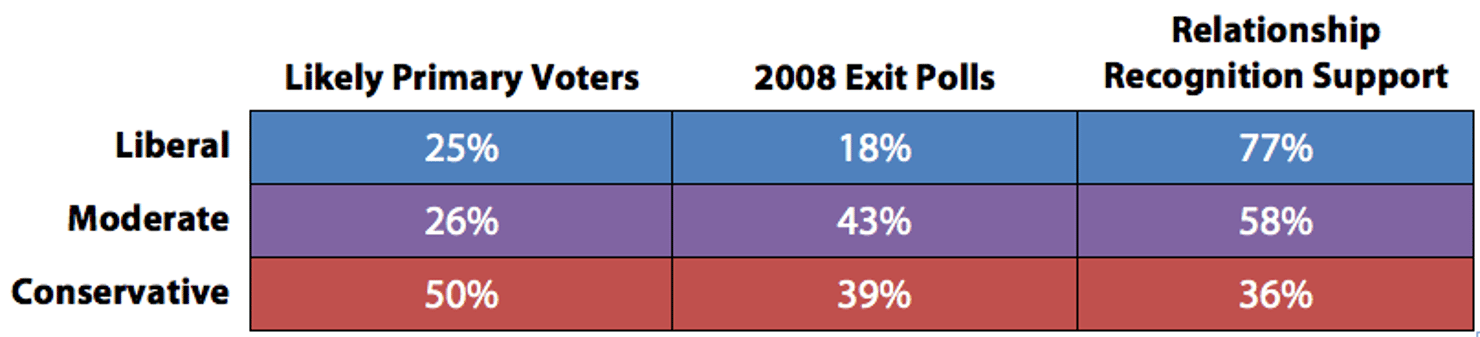
Even with this more conservative electorate, polls show a majority of likely primary voters support legal recognition for gay couples, implying that support for recognition of those relationships is substantially higher among North Carolinians generally. In fact, a recent poll of all North Carolina residents found that 67% supported some level of legal recognition for gay and lesbian couples. And 61% said they would oppose an amendment that banned domestic partnerships, civil unions, and marriage for gay couples, as the proposed amendment would do.4 Clearly, the amendment’s broad reach runs counter to public support for relationship recognition for gay couples in the state.
2) Cities and counties across the state have begun to recognize gay couples.
At least 8 jurisdictions across North Carolina already offer legal recognition and protections to gay couples—all of which could be wiped away by passage of the proposed amendment. Four of these jurisdictions also offer domestic partnership protections to unmarried opposite-sex couples, and passage of the amendment would jeopardize those protections as well.
There are two distinct ways that cities and counties in North Carolina have recognized the relationships of gay and lesbian couples within their jurisdictions. The towns of Chapel Hill and Carrboro and the City of Asheville have created domestic partnership registries which offer some level of legal recognition to gay couples in those cities. Secondly, these three towns are joined by two additional cities and three counties in North Carolina in offering domestic partnership benefits to their own employees. The result is a small but crucial network of protections for gay couples across the state. Finally, some of these jurisdictions offer domestic partnership recognition and benefits to opposite-sex couples as well—protections that would also be jeopardized by passage of the amendment.5 6 7 8 9 10 11 12
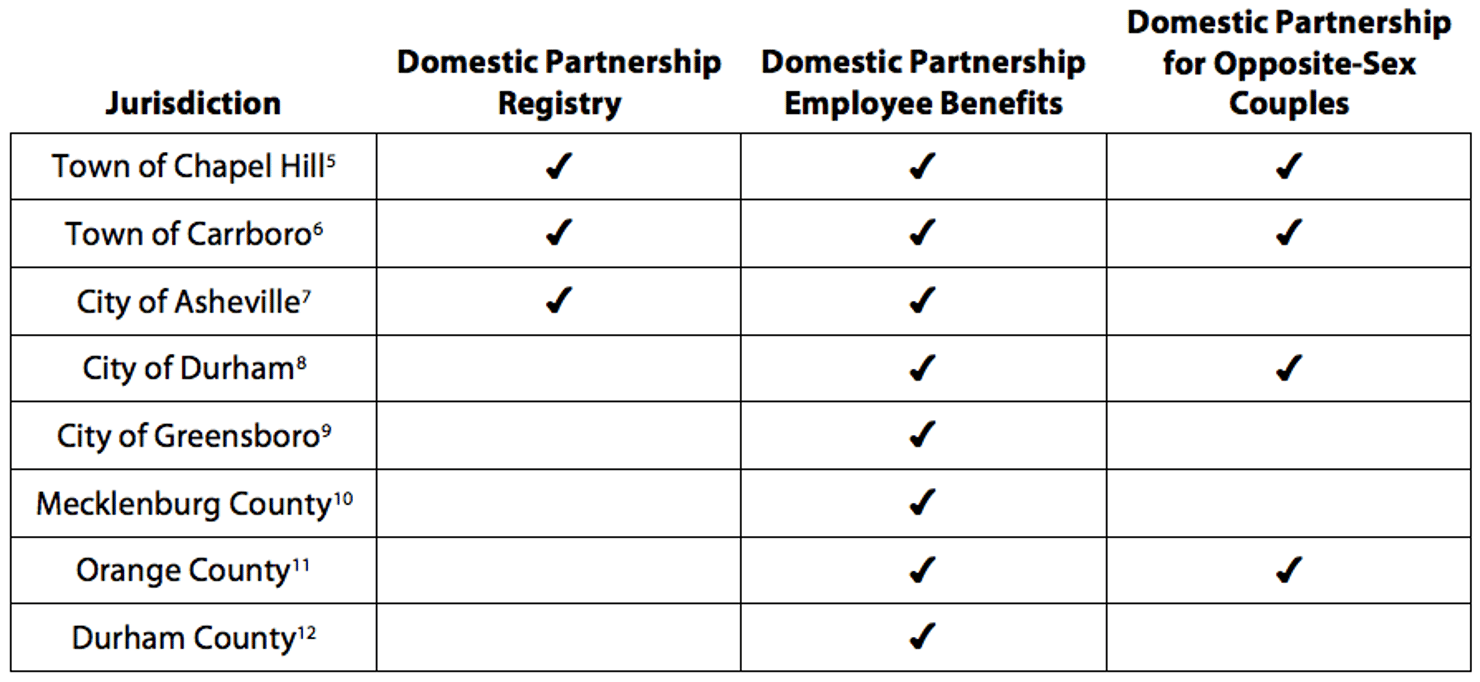
In total, approximately 1.7 million North Carolinians live in a jurisdiction that provides some level of legal recognition to gay and lesbian couples—about 18% of the state’s population as a whole. And all of these protections could be ended by the passage of the broad and ambiguous proposed constitutional amendment. That’s why the leaders of nearly all of these cities and counties have already spoken up to urge voters in the state to reject the proposed amendment and protect their local policies from being invalidated.13
3) Many major companies based in North Carolina already offer domestic partnership benefits.
In addition to the increase in support for relationship recognition among the public in North Carolina—which is now over a majority—and the protections passed by cities and counties throughout the state, a third trend shows how out of step the proposed amendment is with both North Carolinian values and warming attitudes towards relationship recognition for gay couples. Major businesses from across the state already provide domestic partnership benefits to their gay employees, including all five of the largest North Carolina based companies: Bank of America, Lowe’s, Duke Energy, BB&T, and Reynolds American.14 Business leaders across the state have spoken up in opposition to the amendment as harming their ability to recruit and retain employees. Seventy-six CEOs from across North Carolina sent a letter opposing the amendment during the legislative debate,15 and Duke Energy CEO Jim Rogers put it this way, “This is the 21st century, and we’re competing with people around the world. We’ve got to be inclusive and open.”16
Chapel Hill-Carrboro Chamber of Commerce President Aaron Nelson echoed that sentiment, saying, “We're trying to grow an economy and make North Carolina attractive to businesses that want to grow here and want to relocate here, and this amendment sends us in the exact opposite direction.”17 But he also worried that the vague nature of the amendment’s language could directly threaten the freedom of private corporations to offer domestic partnership benefits in the state:
"This could have a dramatic impact on private enterprise. This says 'the only legal union recognized in the state of North Carolina,' not 'by the State of North Carolina.' Conceivably it could have all sorts of impacts...it seems pretty clear to us that some future insurance commissioner could say that (private) same-sex benefits are no longer legal in the state."18
These business leaders see the proposed amendment as out of step with their best practices and limiting their ability to compete in the marketplace.
Conclusion
The proposed constitutional amendment defining marriage between a man and a woman as “the only domestic legal union that shall be valid or recognized in this state” is broad, vague, and at odds with the evolution of public opinion, local policies, and good business practice in North Carolina. Its passage could jeopardize a multitude of protections that are already in place across the state, including municipal domestic partnership registries, domestic partnership benefits for public employees in cities and counties, and even protections and employee benefits offered by North Carolina’s private employers. Legal scholars have noted that the proposed amendment may even call into question basic judicial protections for domestic violence victims and interfere with hospital visitation or end-of-life decisions.
This unprecedented language and reach have motivated even the strongest opponents of marriage for gay couples to speak out against the amendment. David Blakenhorn, who testified as one of the two expert witnesses for the defenders of Proposition 8 in the recent Perry v. Brown case in California, recently coauthored an opinion piece opposing North Carolina’s amendment along with Elizabeth Marquardt, saying:
“If you disdain gay and lesbian persons, and don’t care whether they and their families remain permanently outside of the protection of our laws, such a policy might be your cup of tea. But it’s not our view, and we doubt that it’s the view of most North Carolinians.”19
North Carolina voters, business leaders, and local officials agree: outlawing every level of recognition for gay and lesbian couples in their state goes too far.
Endnotes
Constitutional Amendments Publication Commission, “Official Explanation of Proposed Amendment,” WFMY News 2, April 18, 2012. Accessed April 23, 2012. Available at: http://www.digtriad.com/assetpool/documents/120418052503_Offical%20Explanation%20of%20Amendment[1].pdf.
“N.C. Marriage Amendment Up 20, Close if Voters Informed,” Poll, Public Policy Polling, March 29, 2012. Accessed April 23, 2012. Available at: http://www.publicpolicypolling.com/pdf/2011/PPP_Release_NC_032912.pdf.
“Exit Polls, U.S. Senate: North Carolina,” CNN, November 2008. Accessed April 23, 2012. Available at: http://www.cnn.com/ELECTION/2008/results/polls/#val=NCS01p1.
Poll, Elon University, April 2, 2012. Accessed April 23, 2012. Available at: http://www.elon.edu/docs/e-web/elonpoll/040212_Methodology.pdf.
Town of Chapel Hill, Council Resolution, “Domestic Partnership,” 95-4-24/R-11c, April 24, 1995. Accessed April 23, 2012. Available at: http://www.ci.chapel-hill.nc.us/index.aspx?page=375.
Carrboro Town Code, “Administration,” Chapter 3, Article 1, Section 3-2.1. Available at: http://www.ci.carrboro.nc.us/tc/PDFs/TownCode/TownCodeCh03.pdf; See also Carrboro Town Code, “Personnel Policy,” Chapter 4, Amended June 21, 2005. Accessed April 23, 2012. Available at: http://www.ci.carrboro.nc.us/tc/PDFs/TownCode/TownCodeCh04.pdf.
Asheville City Clerk. Accessed April 23, 2012. Available at: http://www.ashevillenc.gov/Departments/CityClerk.aspx.
The Board of County Commissioners, Durham, North Carolina, Minutes, September 2, 2003. Accessed April 23, 2012. Available at: http://www.durhamcountync.gov/departments/bocc/Agendas/Archives/2003/9-2-03.html.
Diane M. Juffras, “May North Carolina Local Government Employers Offer Domestic Partner Benefits?” Public Employment Law Bulletin, No. 37, November 2009, p. 1. Accessed April 23, 2012. Available at: http://sogpubs.unc.edu/electronicversions/pdfs/pelb37.pdf.
“Mecklenburg County HR Policy,” Mecklenburg County, p. 30. Accessed April 23, 2012. Available at: http://charmeck.org/mecklenburg/county/HR/Documents/HRPolicy.pdf.
“Benefits for Domestic Partners—Implementation and Personnel Ordinance Revisions,” Orange County Board of Commissioners, September 21, 2004. Accessed April 23, 2012. Available at: http://www.co.orange.nc.us/occlerks/0409215d.pdf.
Durham County Government Benefits Overview. Accessed April 23, 2012. Available at: http://www.co.durham.nc.us/departments/hrsv/Documents/WebsiteBenefitsOverview.pdf.
“Local Leaders from Jurisdictions with Domestic Partner Benefits Ask State Lawmakers to Oppose the Anti-Gay Constitutional Amendment,” Press Release, Equality North Carolina, September 11, 2011. Accessed April 23, 2012. Available at: http://equalitync.org/news1/local-leaders-from-jurisdictions-with-domestic-partner-benefits-ask-state-lawmakers-to-oppose-the-anti-gay-constitutional-amendment.
“Businesses Against Amendment One,” Protect All North Carolina Families. Accessed April 23, 2012. Available at: http://www.protectncfamilies.org/content/business-against-amendment-one.
Lynn Bonner, “N.C. House OKs Amendment Banning Gay Marriage,” The News & Observer, September 13, 2011. Modified September 21, 2011. Accessed April 23, 2012. Available at: http://www.newsobserver.com/2011/09/13/1483783/house-oks-amendment-banning-gay.html.
Tim Funk, “Duke Energy CEO Rogers Compares Marriage Amendment to South’s Old Racist Jim Crow Laws,” The Charlotte Observer, April 13, 2012. Accessed April 23, 2012. Available at: http://www.charlotteobserver.com/2012/04/13/3170919/duke-energy-ceo-rogers-compares.html.
Aaron Keck, “For CH/C Chamber, An Emphatic No on Amendment 1,” Chapelboro, March 28, 2012. Accessed April 23, 2012. Available at: http://www.chapelboro.com/pages/12677614.php?.
Aaron Keck, “For CH/C Chamber, An Emphatic No on Amendment 1,” Chapelboro, March 28, 2012. Accessed April 23, 2012. Available at: http://www.chapelboro.com/pages/12677614.php?.
David Blakenhorn and Elizabeth Marquardt, “Amendment Goes Too Far,” Op-ed, The News & Observer, April 11, 2012. Accessed April 23, 2012. Available at: http://www.newsobserver.com/2012/04/11/1992920/amendment-goes-too-far.html.

More from Third Way

How to Change Your Public Position on Marriage
Recognition Rising
