Memo Published August 6, 2026 · 6 minute read
The Overlooked Housing Crisis in Rural America
In Van Buren County, Tennessee, halfway between the growing cities of Nashville and Knoxville, one housing official knows a family living in a horse barn.1 Other families crowd into RVs and manufactured housing, including one family of 11 sharing a three-bedroom mobile home.2 Their stories reflect a growing challenge across rural America. Between 2018 and 2024, Van Buren County’s population grew 15.7%, while average home prices more than doubled.3 As population growth outpaces housing construction, rural families are increasingly priced out of places once considered affordable.
Van Buren County is not an outlier. Our analysis finds that fast-growing rural counties now face some of the nation’s most severe housing affordability pressures. Despite approving new housing units at rates comparable to urban counties, post-pandemic population growth has outpaced their ability to bring new homes to market.
Despite these growing pressures, housing policy discussions in Washington remain overwhelmingly focused on urban places. Fast-growing rural counties face a distinct housing affordability crisis driven by post-pandemic migration and rural building constraints—challenges that current housing debates often overlook.
What Is Happening In The Rural Housing Market?
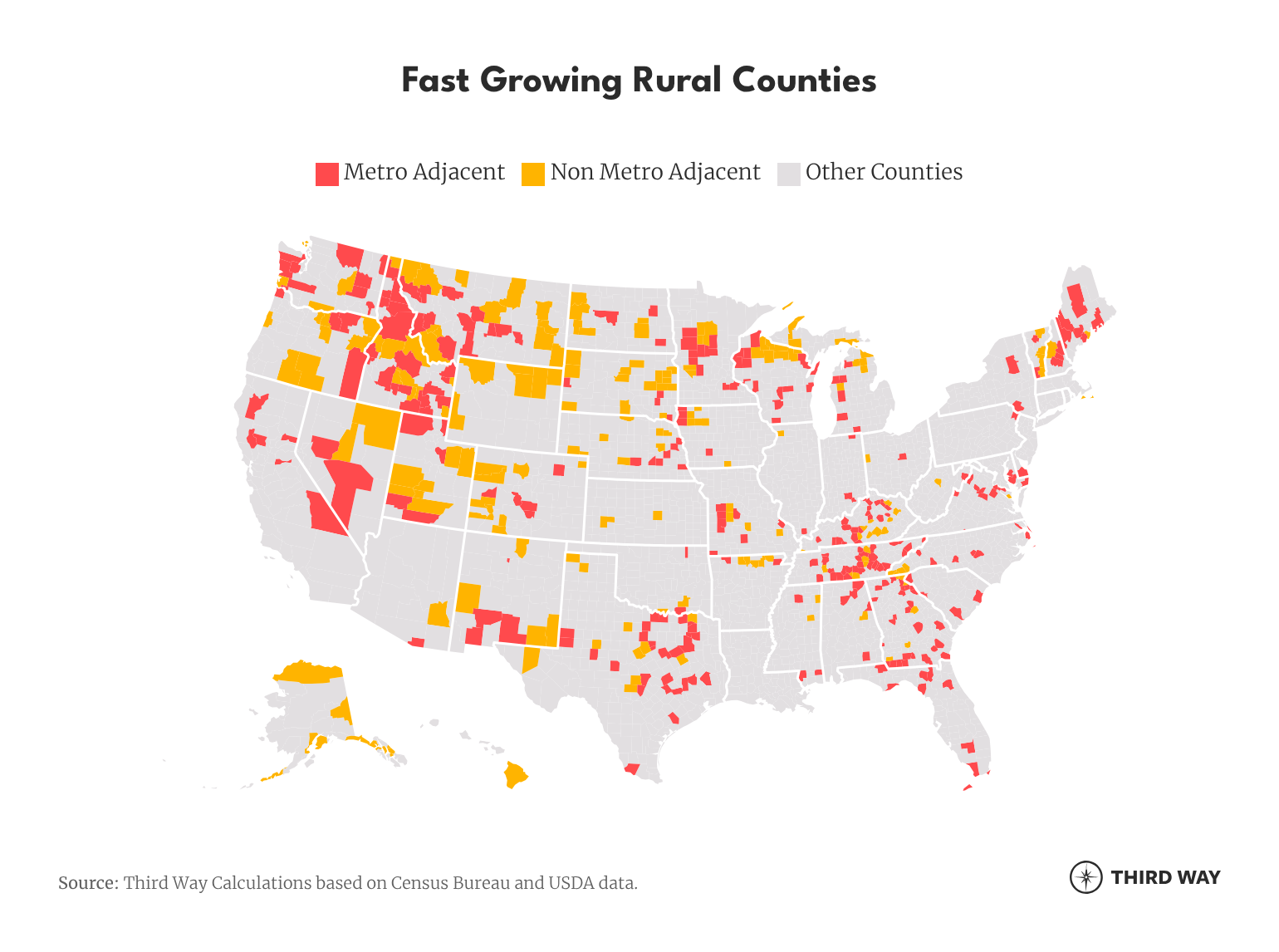
Fast-growing rural counties generally fall into two categories:
- Non-Metro Adjacent: Amenity-rich rural counties located farther from metropolitan areas that became especially attractive to remote workers and retirees during and after the pandemic.4 A number of these are located in Idaho, Montana, and Wyoming.
- Metro Adjacent: Rural counties adjacent to metropolitan areas that grew as workers sought more affordable housing outside major cities. Many of these are also in the Northwest, or surround metro areas in the South like Dallas, Nashville, and Knoxville.
For this analysis, we define “fast-growing” rural counties as the top quarter of rural counties that experienced the fastest population growth between 2018 and 2024.
One way to measure how housing markets respond to rising demand is by examining construction permits for new residential units. While rural counties overall issue about half as many new residential building permits as urban counties, fast-growing rural counties have been authorizing new housing at rates comparable to their urban counterparts.5
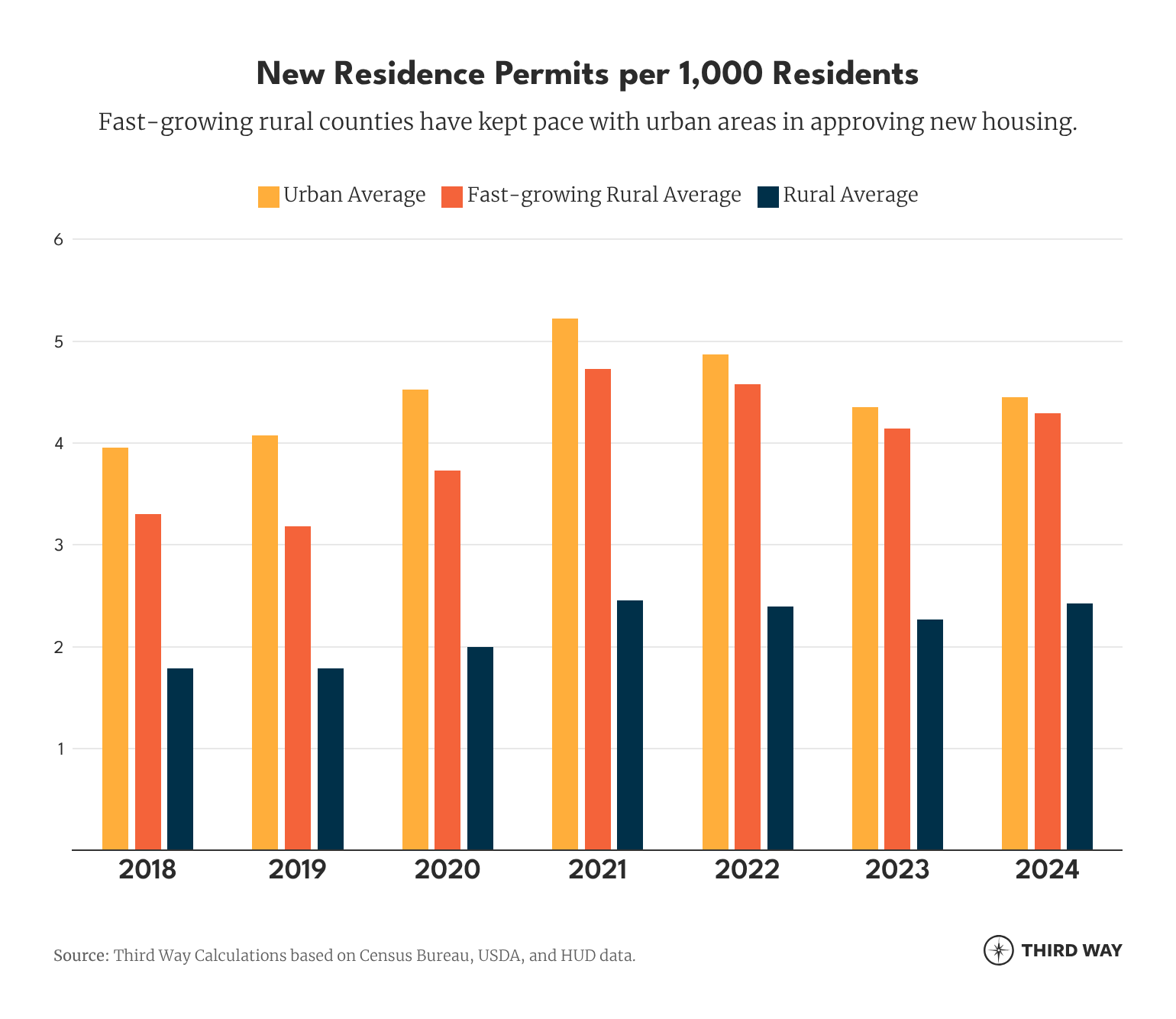
This trend suggests that fast-growing rural counties have attempted to respond to rising demand through additional construction. But permit issuance alone does not indicate whether housing supply is keeping pace with demand. Rural construction often faces infrastructure constraints and limited investment, meaning projects take longer to reach the market.6 As a result, permit activity may overstate how quickly communities are growing their housing supply.
Despite issuing new housing permits at rates comparable to urban counties, fast-growing rural counties face greater housing affordability pressures. To measure this, we created a “housing pain” index that compares home price growth with wage growth over time. This captures how far housing costs are outpacing workers’ earnings. By this measure, fast-growing rural counties face substantially greater housing pressure than both urban counties and other rural counties.7
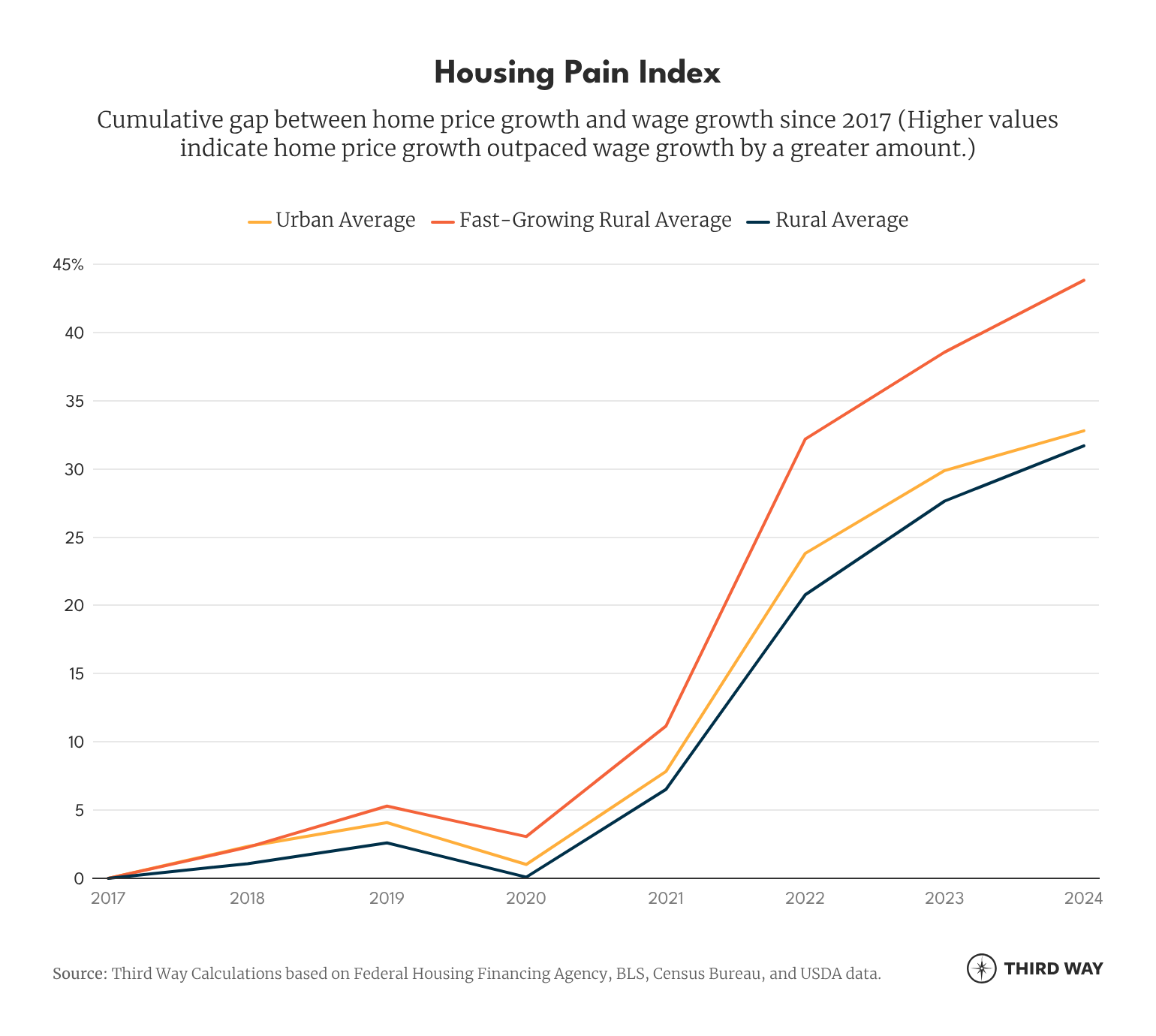
This divergence in fast-growing rural counties has been driven primarily by skyrocketing housing costs rather than stagnating wages. Salaries continued to grow by about 5% to 7% annually after 2019, but home prices increased at more than twice that pace, posting double-digit gains each year over the same period.8 By 2024, home prices had risen more than 40 percentage points faster than wages, relative to their 2017 levels.9
The impact of the post-pandemic population surge on these markets is clear: some of the nation’s tightest housing markets are now found in fast-growing rural counties. Demand has soared, while supply remains constrained despite significant authorization for new housing construction.
Why Is This Affordability Gap Opening Up?
Two factors help explain why housing affordability is deteriorating so quickly in fast-growing rural counties.
First, remote work has reshaped housing demand. Higher rates of remote work have been linked to population growth in non-metro counties.10 Remote workers tend to be high-income and college-educated, often giving them more purchasing power than local workers.11 As remote workers relocate to these rural communities, they increase competition for an already limited supply of housing and place upward pressure on housing costs.12 Research suggests that remote work accounted for more than half of the 18.9% increase in US home prices between 2019 and 2023.13 In many fast-growing rural counties, its impact may be even more pronounced.
Second, rural communities face steep obstacles to building enough new homes. While fast-growing rural counties issue new housing permits at a similar rate as urban counties, turning permits into completed houses is more difficult and expensive. Housing construction in rural areas generally occurs at a smaller scale, making projects more expensive to undertake, which discourages private investment.14 In addition, added costs from infrastructure expansions, transportation costs, and labor shortages can slow down new housing development.15 Together, these obstacles make it hard for rural communities to turn housing demand into housing supply.
The consequences of these affordability pressures are increasingly evident in fast-growing rural communities. Housing shortages make it harder for workers to find suitable housing near their jobs.16 As employers struggle to attract and retain essential workers, hospital beds sit empty and classrooms go unused.17 Families in these areas are increasingly forced into overcrowded living conditions, as housing supply fails to keep up with community needs.18
To be clear, population growth can greatly benefit rural communities, many of which faced years of decline before the pandemic. But without policies that support sufficient housing supply, long-time residents and their families will feel the strain in communities they helped build.
Conclusion
Policymakers must recognize that the rural housing crisis is not simply a smaller version of the urban one. Even though fast-growing rural counties are approving new housing units at rates comparable to urban counties, housing affordability has deteriorated much more rapidly. Post-pandemic migration has fueled much of the increased housing demand in these rural areas, while building constraints limit how quickly housing can be constructed to meet that demand. As a result, what were once some of the most affordable places in the country now have some of the tightest housing markets.
These challenges require solutions tailored to the realities of rural housing markets. Policy responses could include opening unused federal land to residential development, investing in modular construction or manufactured homes, and reducing other barriers to new construction.19 The choice is clear: support policies that enable fast-growing rural communities to build needed housing, or watch affordability slip further out of reach for the people who keep these communities running.