Memo Published May 5, 2026 · 6 minute read
The 60% Moderate Imperative
Takeaways
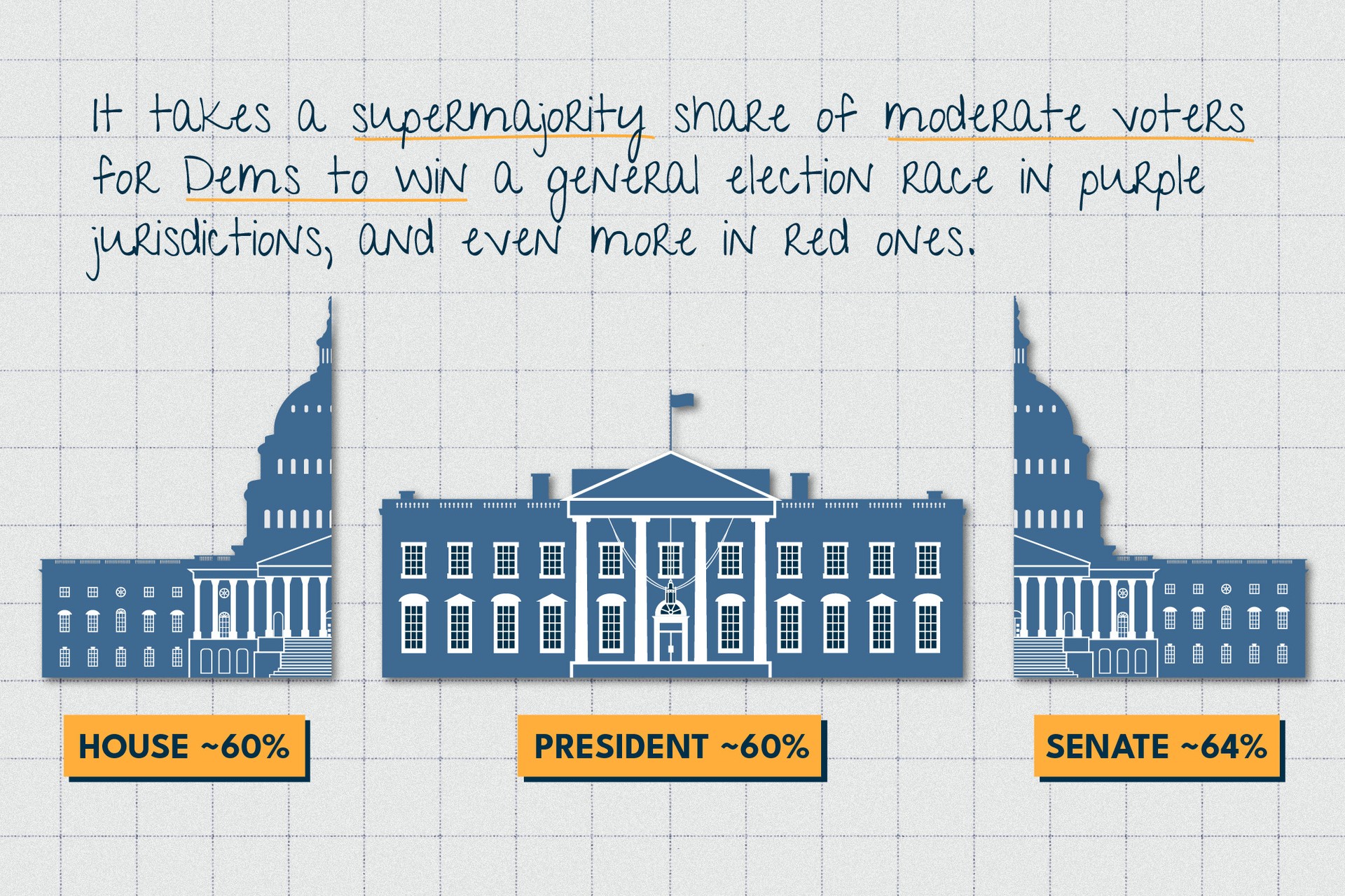
It’s primary season which means intramural fighting among Democrats. But winning a primary in the spring only to lose the general as an out-of-touch progressive in the fall does no one any favors. Even in a primary Democrats must be mindful of the 60% imperative: It takes a supermajority share of moderate voters to win a general election race in purple jurisdictions, and even more in red ones.
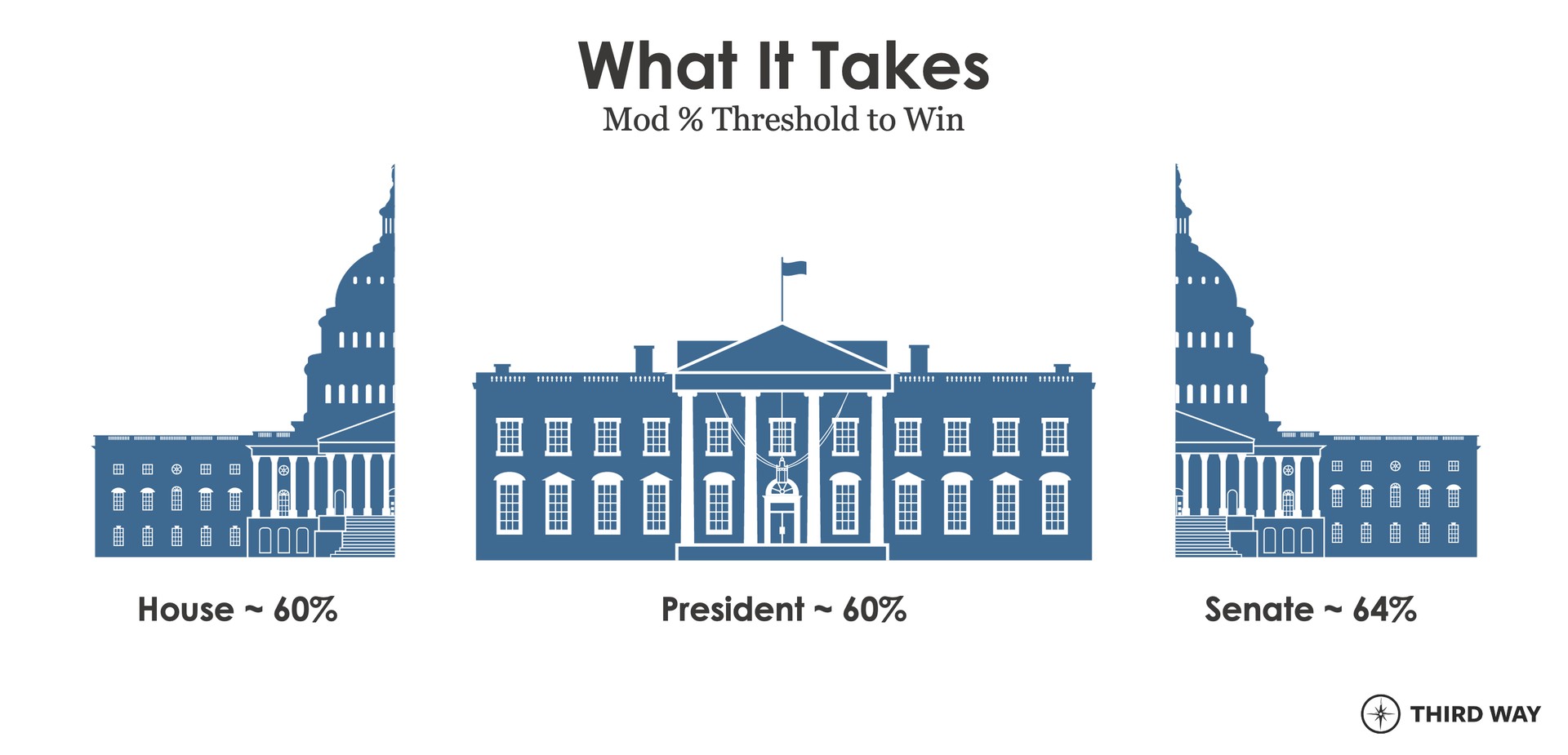
- 60% is the minimum threshold of moderates necessary for Democrats to win the White House and the House. The Senate threshold is steeper—64% is needed to retake the majority.
- Don’t kid yourself that the electorate is changing. Conservatives outnumbered liberals by 3 to 2 in 2024, just as they outnumbered liberals by 3 to 2 from 2004 to 2024.
- Combatative centrists are a winning model in purple and red states, exciting both moderate and liberal general election voters with Governors Mikie Sherrill and Abigail Spanberger in 2025 and Senators Ruben Gallego and Elissa Slotkin in 2024 winning and overperforming other Democrats.
Winning a majority of moderate voters is not enough for Democrats to take the White House, the Senate, or the House.
Kamala Harris won moderates by +16, Hillary Clinton by +11, and John Kerry by +9. They all lost. In 2024, Jon Tester won moderates by +40, Bob Casey by +23, and Sherrod Brown by +22. It was not enough in Montana, Pennsylvania, and Ohio. Across the nation, House Democratic candidates were +14 with moderates.1 Not enough to make Hakeem Jeffries Speaker of the House.
The winning threshold is 60%, at least for the White House and House. Democrats have only won the White House one time since 1980 without reaching 60% of moderate support—Barack Obama in 2012, who was helped by winning a bigger slice of conservatives than typical Democrats. The Senate bar is even higher, closer to two-thirds.
Why is the moderate voter bar so high for Democrats today, yesterday, and tomorrow?
America’s Asymmetric and Static Electorate
The answer: Conservatives outnumber liberals by 3 to 2 in the national electorate. That may not be true in Massachusetts, where the ratio is far more favorable for Democrats; or Montana where the ratio is far worse, but it is true nationally and in most must-win states and districts.
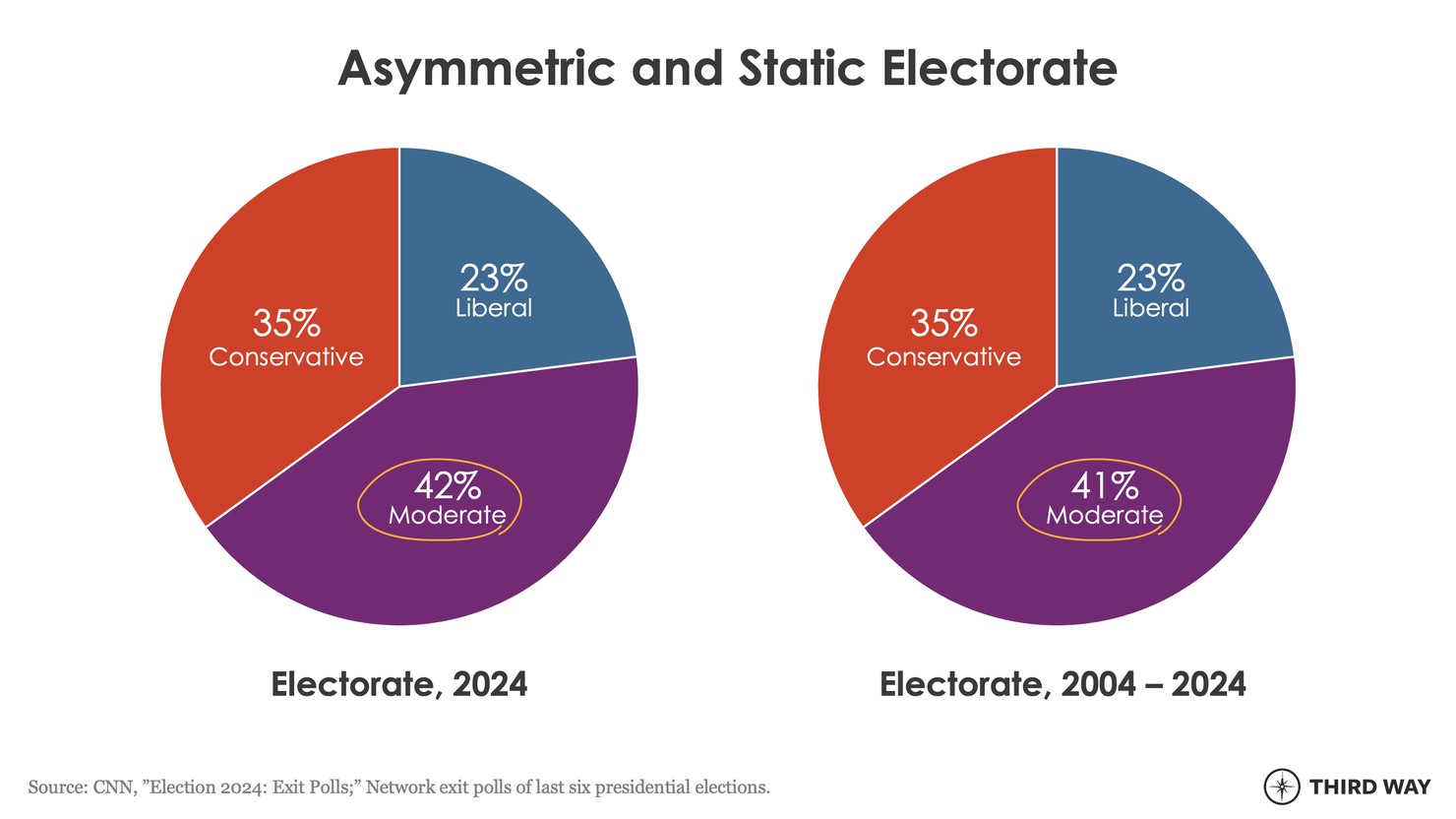
In 2024, conservatives made up 35%, liberals 23%, and moderates 42% of the electorate, according to network exit polls.2 Typically, a Democrat wins 90% of self-described liberals and Republicans 90% of self-described conservatives, leaving Democratic candidates the difficult task of winning a big chunk of that purples slice.
Electorates change, some argue. Not really. The ideological breakdown has been largely static over the last six presidential elections. The 2028 electorate will look a lot like the 2004 to 2024 electorate, a plurality moderate with conservatives taking the silver and liberals far behind with the bronze. A winning Democratic coalition must attract many more moderates than a winning Republican coalition in the decisive swing states. Liberal voters make up a smaller share of the electorate in nearly every battleground state relative to the national average.3
This dynamic is why our coalition is often arguing and the Republican coalition is typically lurching to the right.
The Moderate Threshold is Highest in the Senate
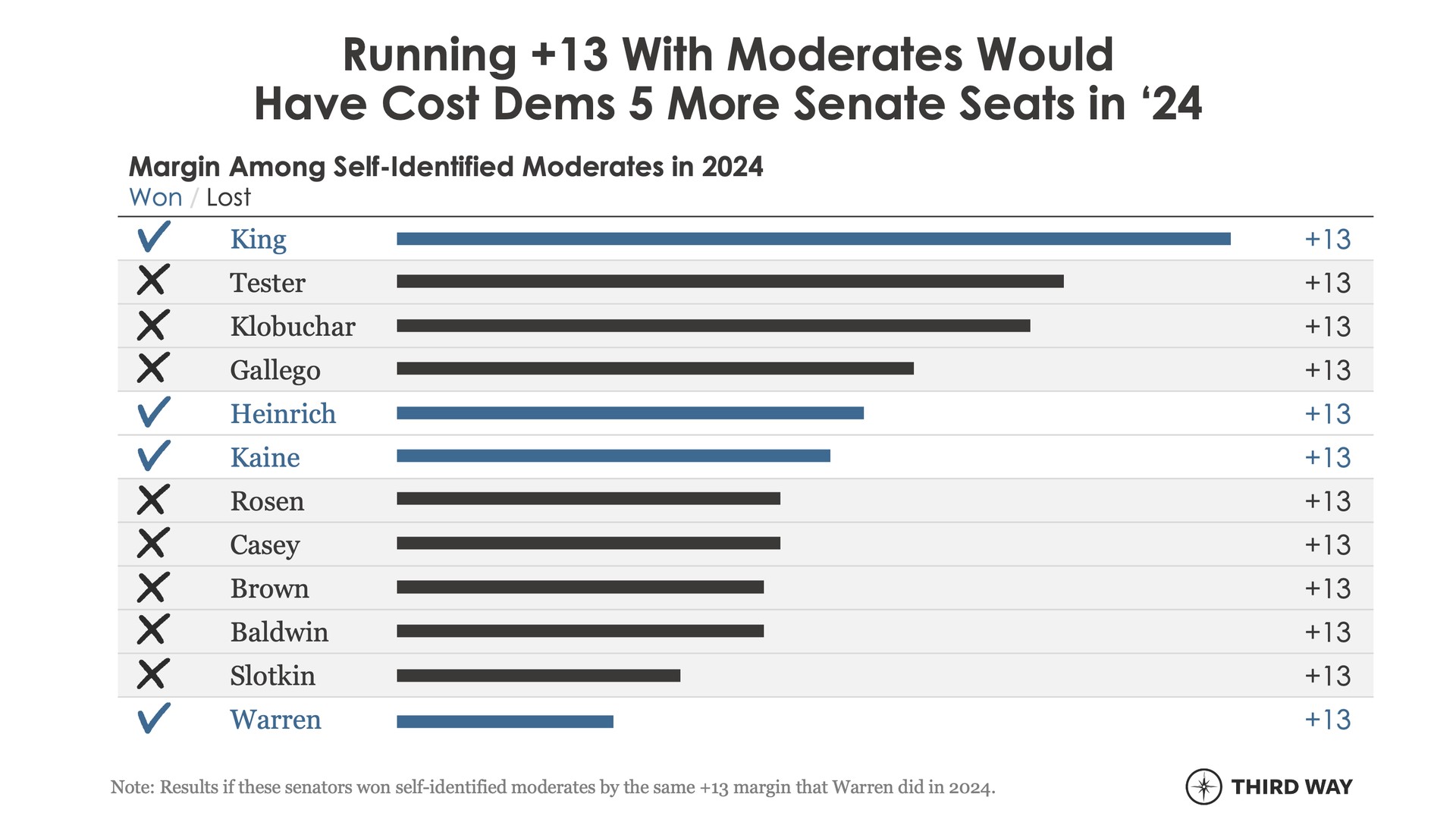
We compiled a selection of 12 Senate races from 2024 where a Democratic incumbent was running or Democrats were contesting an open and winnable seat. The number on the right was how that Democrat fared among self-identified moderates, according to exit polls.
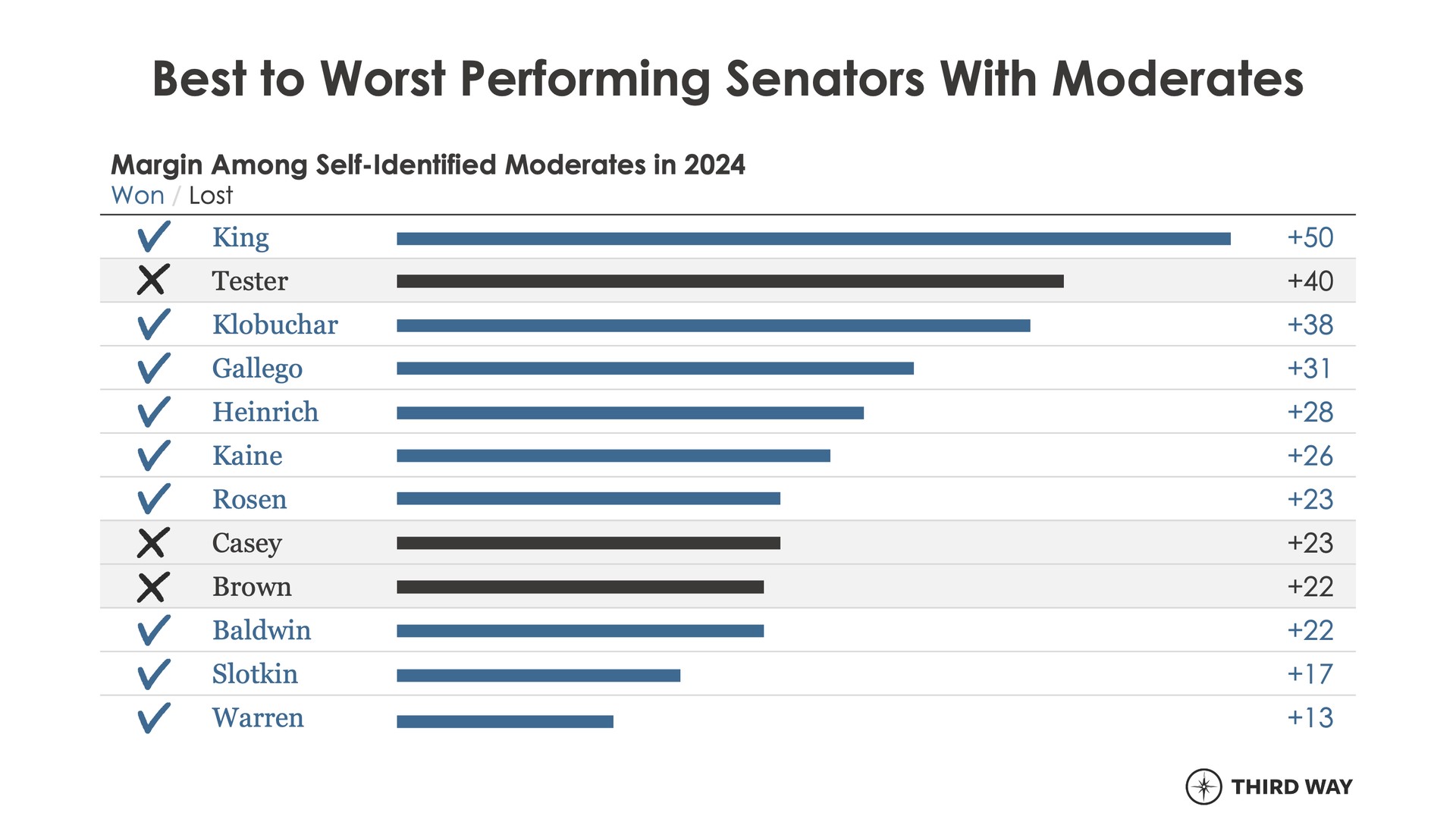
Angus King was the champ, going +50 with moderates and winning Maine with ease. Jon Tester’s +40 wasn’t enough to hold Montana. Elissa Slotkin’s +17 was enough to win Michigan by a scant 0.3%.
At the bottom of this list sits Elizabeth Warren, whose +13 performance among moderates was enough to win Massachusetts by 20 points. This is not a knock on Senator Warren, but she has a luxury few Democrats possess: winning moderates by a ho-hum 56-43% margin to score a blowout win.
Let’s take that luxury one step further. If all the Democratic senate candidates listed above won moderates by the Warren margin of +13, Dems would go from winning 9 of 12 races to just 4 of 12. We’d be at 42 seats in the Senate right now. And what if all Democratic candidates for Senate won moderates by 56-43% in all 50 states going forward? Democrats would eventually have 36 Senate seats to Republicans’ 64. We’d have all the states Harris won minus New Hampshire.
Of course, Democrats’ performance will vary among moderates in their respective states depending on who they are, their biography, the positions they take, and the relative strengths and weaknesses of the party brand. But if you are looking for the magic moderate number necessary to get to 50 seats, it is 64%. If every Democrat in every state won 64% of the moderate vote, we would win the 19 Harris states plus PA, MI, WI, NV, GA, and NC.
Democrats’ Combative Centrist Model
Last November, three exciting Democrats won marquee races with each winning more than 50% of the total popular vote in their jurisdiction. Mikie Sherrill won New Jersey’s governorship with 62% of the moderate vote. That’s a great performance among moderates and nationally that would be enough to win the White House and the House. We’d fall two seats short in the Senate with North Carolina coming off the map.
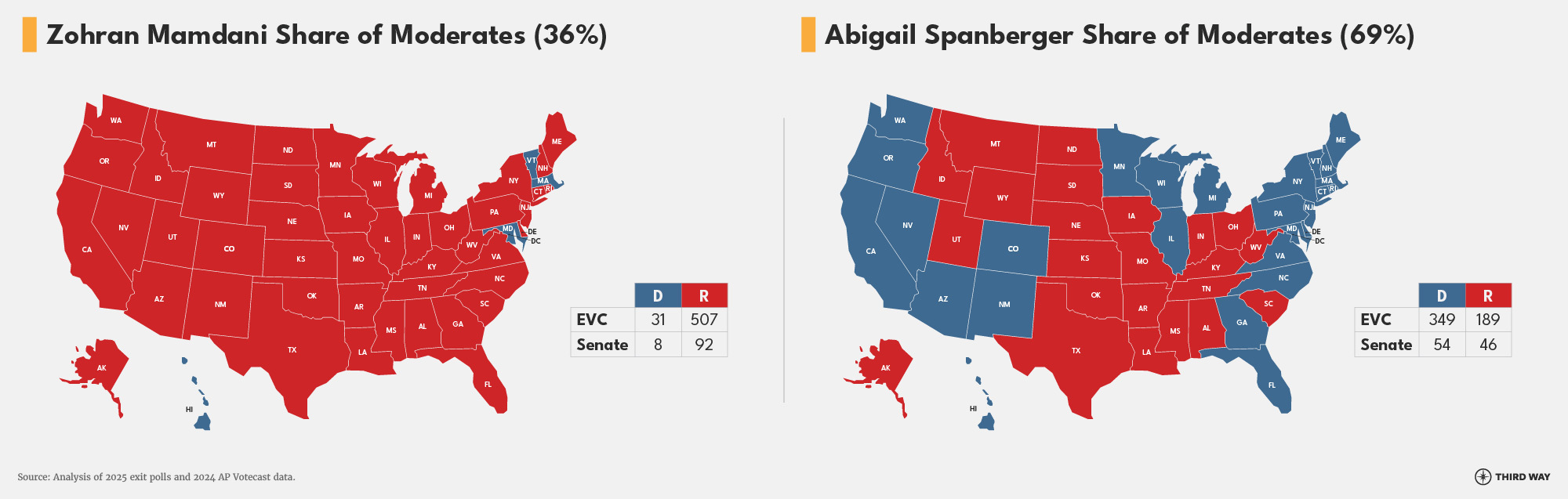
Abigail Spanberger took 69% of moderates in Virginia. Do that everywhere and Democrats have an electoral college blowout, a sizable House majority, and a 54-46 edge in the Senate by capturing Arizona and Florida.
Zohran Mamdani was young, exciting, and captured the imagination as well. But he won New York City with just 36% of moderates. That was enough to win more than half of New Yorkers, but if this is how all Senate Democrats perform into the future, Republicans would hold a 92-8 lead.
Spanberger and Sherill ran aggressive, pugnacious, energetic, and optimistic campaigns. Voters from the left and center of their states came out enthusiastically for both of them. There has been much talk about how Mamdani spurred record turnout in New York City. Turnout was actually higher by a sliver in New Jersey and Virginia. Their campaigns and the style they brought to it were similar to two exciting Democratic Senate races from 2024: Arizona’s Ruben Gallego and Michigan’s Elissa Slotkin. There is a criticism of moderates that has some elements of truth that they can lack excitement. No one can argue that about these four and several others.
What It Takes
Sherrill, Spanberger, and Mamdani all ran fantastic campaigns to win tough races. Spanberger flipped Virginia from red to blue. Sherrill won in a state that moved sharply towards Trump and was following an unpopular governor of her own party. Mamdani came from nowhere to first in a crowded field. Mamdani’s demeanor and optimism may translate, but his coalition of voters does not. It works in only a handful of places. The gold standards are Governors Sherrill and Spanberger, combative centrist Democrats who energized both progressives and the ideological middle. Because when it comes to what it takes to win… it takes a lot of moderates.