Memo Published November 5, 2025 · 7 minute read
Ten Reasons Why Mamdani Politics Won’t Win Outside of NYC
Third Way
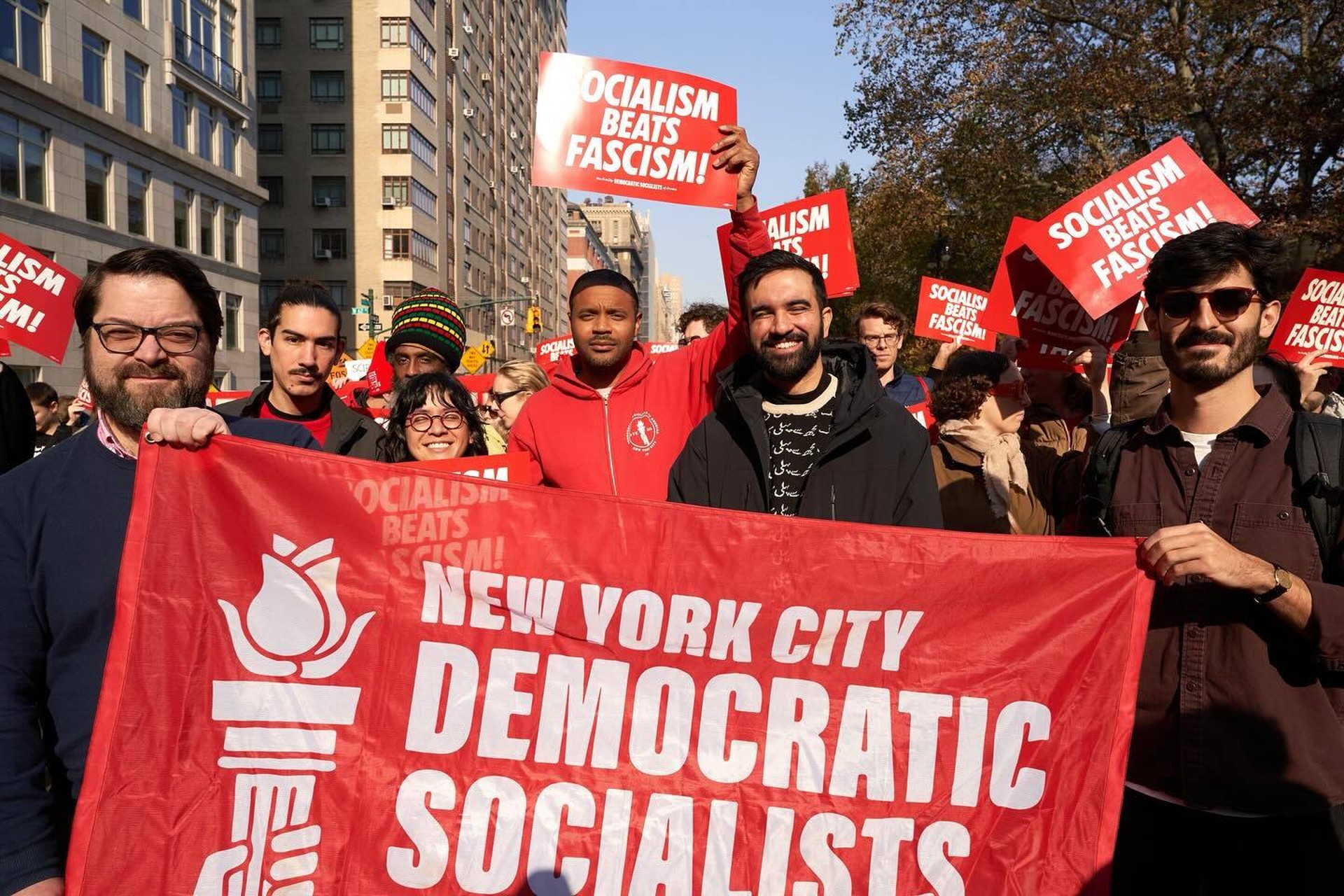
We congratulate Mayor-elect Mamdani on his win and wish him well in office. But because Mamdani is a national figure drawing enormous attention, Democrats in districts and states not awash in blue will be forced to answer for him, and many commentators are concluding that his win can serve as a model for how Democrats should run in competitive races. There are some lessons all Democrats can learn from Mamdani’s campaign tactics, which were excellent and broadly applicable. His policies and message, which are radical and politically toxic outside the deep blue confines of New York City, do not translate.
So yes, Democrats should seek to emulate his relaxed, hip, and relatable style, his social media savvy, and his laser-like focus on a handful of simple, sticky promises voters could understand and remember.
But Mamdani’s policy ideas, and the platform of the Democratic Socialists of America (DSA) which he has failed to repudiate, were drawn from the far left and are deeply unpopular in the red and purple places Democrats must win to retake Congress and the White House.
We therefore urge Democrats at all levels to resist the pressure to align with Mamdani’s politics and agenda, and we offer ten key points to make to interest groups, donors, and activists about why doing so will fail in tough races:
- New York City is a deep blue outlier: Democrats outnumber Republicans by 40 points. A whopping 66% of New York City voters identified as Democrats and leaned towards the Democratic Party this mayoral election (22 points more than the rest of the country), while just 25% leaned Republican (24 points less than elsewhere). And while Mamdani may be popular among his NYC base, he remains one of the most unpopular Democrats in the country, with a net approval of -14 nationwide.
- Mamdani underperformed Harris: Early estimates show that Mamdani won 50% of the vote, underperforming Kamala Harris’s 68% by 18 points. If the Mamdani brand of politics can’t overperform in a place like New York, it certainly won’t work in the far more conservative battleground areas.
- The DSA platform is extreme and is a Republican ad maker’s dream: Just a glance at the DSA platform makes clear how politically toxic it would be to any voter not deeply in the sway of socialist ideology. It includes, among many other things, “free[ing] all people from involuntary confinement” (i.e., closing all prisons and releasing ALL prisoners), “disarm[ing] law enforcement officers,” “abolish[ing] the U.S. Senate,” and “the nationalization of businesses.” Republicans used the “defund the police” slogan to win seats up and down the ballot in 2020 and beyond, and the DSA agenda could prove far more politically lethal. Indeed, the Mayor-elect’s affiliation with the DSA is already being weaponized against his fellow Democrats, as Republicans have declared him to be their “single most effective foil” as they seek to paint Democrats across the country as radicals.
- Even Mamdani had to run away from their most radical ideas: Despite calling himself “a proud DSA member,” Mamdani refused to campaign on most of their toxic ideas. He distanced himself from the DSA platform, saying that if a policy is not on his website, then it “is not a policy that I am running on.” Mamdani then renounced his past views on policing, reversing his position on “defund the police” and saying he will keep the NYPD force staffed at its current levels. If a DSA member like Mamdani felt it was a political imperative to move to the center even in a deep blue city, a similar candidate running in a redder electorate would certainly not be viable.
- Mamdani relied on a highly educated, high-income electorate to win, but Democrats need to make inroads with working-class voters: Early estimates show that Mamdani won 55% of college-educated voters and 38% of working-class voters. Democrats have maxed out with college-educated voters and hemorrhaged working-class voters cycle after cycle. Fifty-eight percent of working-class voters now say the Democratic Party has moved too far left, and just 34% say that Democrats are in touch with the working class. Moving toward the Mamdani-DSA politics would make this bad situation dramatically worse.
- Mainstream Democrats ran authentic campaigns and won big without being socialists: Two moderate Democrats, Abigail Spanberger (VA) and Mikie Sherrill (NJ) delivered historic victories in key gubernatorial races, with Spanberger flipping Virginia from red to blue. Both faced electorates far more competitive than New York City and secured double-digit wins, overperforming Harris' margins in their respective states. While they shared Mamdani’s focus on addressing affordability, both Spanberger and Sherrill did so with ideas and narratives drawn from the center left, not the far left.
- The far left doesn’t flip swing seats: Mamdani didn’t flip the mayor’s office from red to blue, he managed to not lose a safe seat. That’s because the far left simply doesn’t win tough general election races. Since 2018, far-left candidates have not flipped a single House seat from red to blue, while the moderate NewDems have been the majority- makers, flipping 50 seats. And in 2024, Democratic Socialist candidates represented just 1% of all congressional winners in the primaries, none of which were competitive in the general election.
- Democratic voters outside NYC are not socialists: Just 5% of likely 2028 Democratic primary voters nationwide are self-identified “socialists;” 61% of Democrats likely to vote in the Presidential primary prefer reforming capitalism over moving toward a socialist system; 65% prefer reforming the U.S. immigration system over decriminalizing the border or abolishing ICE; and 84% prefer taking on price gouging and tariffs over creating government-owned grocery stores.
- Democratic voters want candidates who can win rather than those who are ideologically pure: Too many candidates now believe that going farther left will help them win primary votes, and they decide the general election math can be sorted out later. This is a severe miscalculation. Unlike Republicans, Democratic primary voters choose electable candidates by a 22-point margin over those who are ideologically progressive. Meanwhile, buckling under the far left’s pressure campaign, as Kamala Harris did in 2019, allows Republicans to brand candidates as “dangerously liberal.”
- Democratic voters want the party to become more moderate: Forty-five percent of Democrats and Democratic-leaning independents want the party to become more ideologically moderate, a figure that is up 11 points since 2021. Meanwhile, the desire for a more liberal party has declined five points to 29%.
There are two fundamental projects underway in Democratic politics. The project of the far left, led by national figures like Bernie Sanders and AOC, is to make blue places bluer. We leave it to others to determine if Mamdani’s approach is their new blueprint.
But vastly more important is the project of the center left, which is to win seats away from Republicans and put a check on Trump and MAGA. We now have more than a decade of proof that the far left’s approach not only cannot advance this project, it can make it significantly harder. So, for those committed to this second project—the only means of saving the country from the right-wing extremists—ideas like the ones that Mamdani ran on can only get in the way.