Memo Published November 3, 2010 · Updated November 3, 2010 · 3 minute read
Red Shift: Moderates in 2010
Anne Kim & Jonathan Cowan
The results of 2010 answer two questions for Democrats: Is America center-left or has the center left?
As Democrats reel from stunning defeats in the House and the Senate, some have begun to argue that underperformance and lack of turnout among the liberal base are responsible for these losses.
But exit poll data tell a clearer story. Democrats lost the House and key seats in the Senate due to a combination of two things: 1) a dramatic shift among moderates toward conservatism and 2) from underperformance by Democratic candidates among moderates, not liberals, compared to previous elections.1
Here’s what the data say:
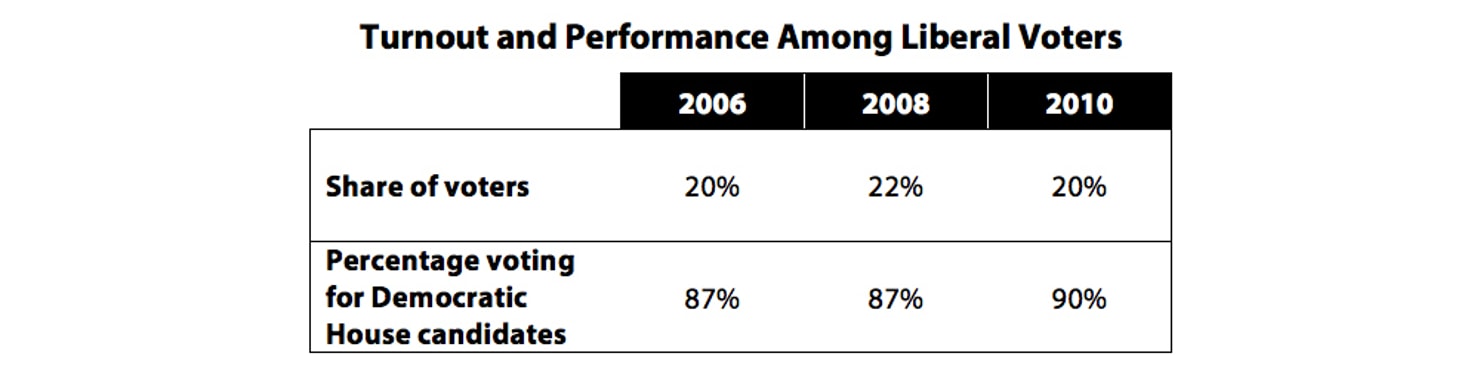
Democrats lost the House even though they turned out their liberal base and overperformed with liberals in comparison to 2006 and 2008.
According to national exit polls for House races, liberal turnout in 2010 exactly matched turnout in the last mid-term election in 2006. In both cases, liberals made up 20% of voters. House Democratic candidates in 2010 also won 90% of the liberal vote, a 3-point improvement compared to their performance among liberals in both 2006 and 2008, when 87% of liberals voted for Democratic House candidates
Moderates fled to red.
Historically, 47% of voters have called themselves moderates, while 33% have been conservatives.2 But in 2010, for the first time since exit surveys began asking the ideology question in1976, conservatives outnumbered moderates.
The share of moderate voters in 2010 plummeted by 8-points in comparison to 2006, when the last mid-terms were held. In 2010, 39% of voters were moderates, while 41% identified themselves as conservative
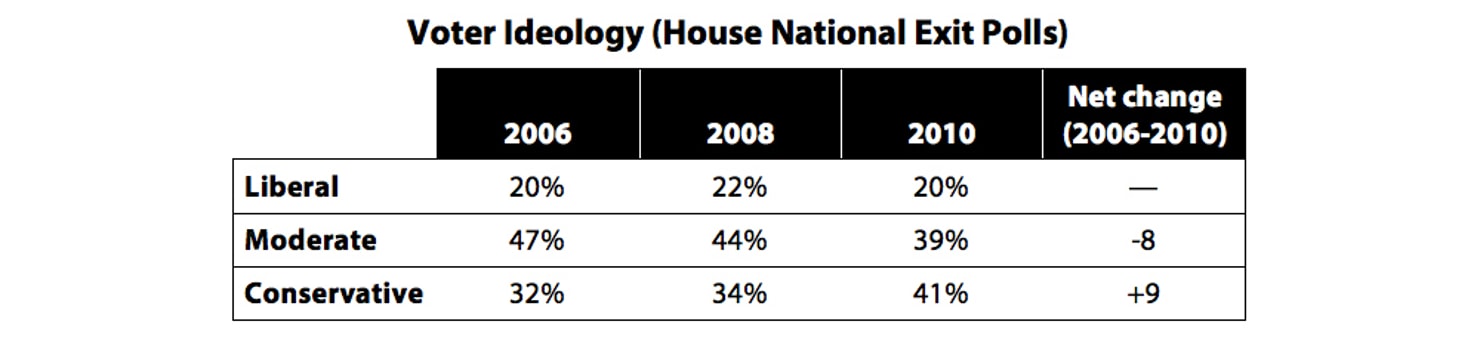
This dramatic red shift meant two things for Democrats in 2010: 1) that overperformance with liberals was not enough to make up for the moderate cross-over to the conservative base; and 2) Democrats had to overperform with moderates in 2010, which they failed to do.
Democratic House candidates underperformed with moderates, compared to past elections.
In contrast to Independent voters, who decisively ended their flirtation with Democrats this cycle by voting 55% to 39% in favor of Republican candidates, a majority of moderate voters still stuck with Democratic House and Senate candidates.
Nevertheless, Democratic House candidates and candidates in key Senate races underperformed compared to 2006 and 2008. And because of the larger conservative base noted above, Democrats needed far more than a bare majority of moderates to win. In fact, because of the ideological composition of most states, Democrats must win 60% or more of moderates to win a seat.
In 2010, Democratic House candidates won 55% of moderate voters, compared to 61% in 2008 and 60% in 2006.
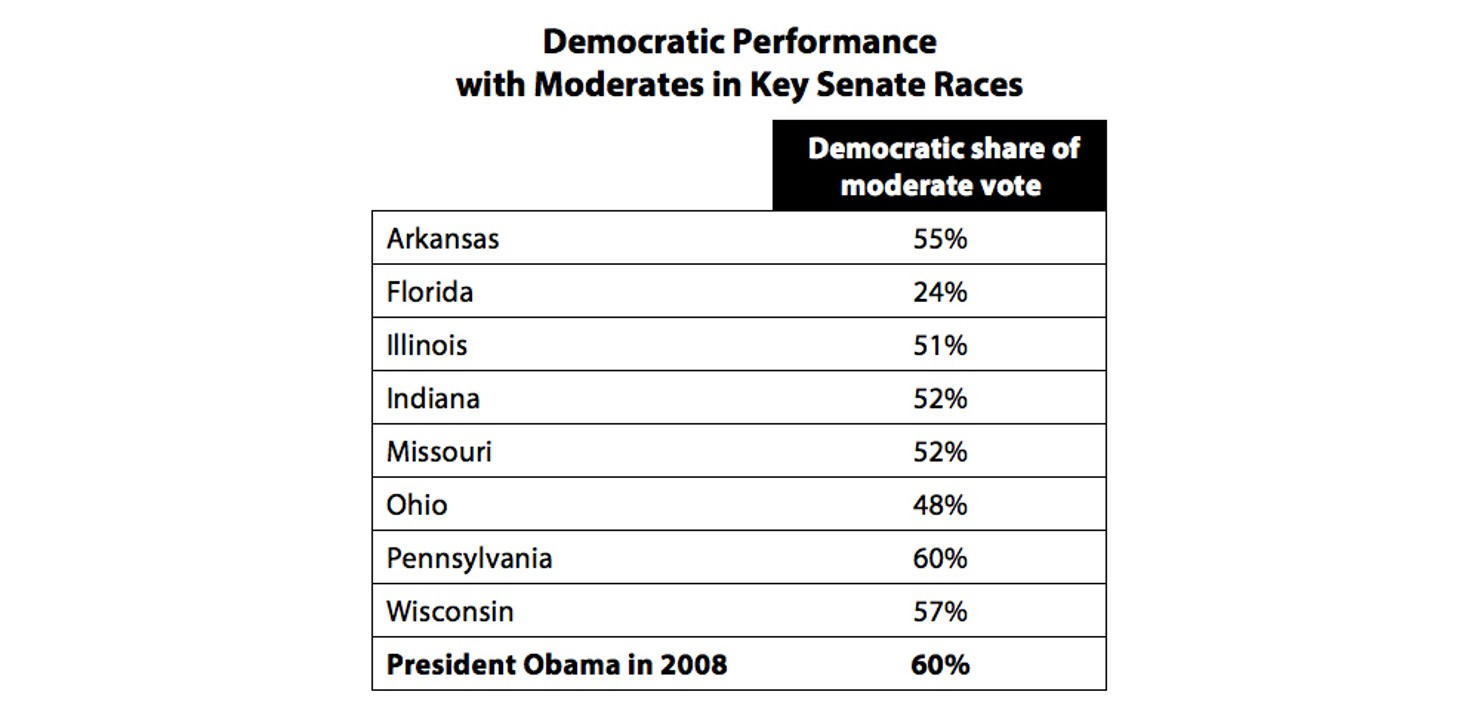
Moreover, in all but one of eight states where Democrats lost or were projected to lose a key Senate race, the Democratic candidate underperformed President Obama with moderate voters by a significant margin. In 2008, President Obama won 60% of moderates. But in 2010, candidates in these key states averaged 7-points below President Obama’s performance with moderates.3
Conclusion
America has lurched decidedly toward the red since 2008, and this red shift has swept many moderates with it. To rebuild their fortunes, Democrats must look to rebuilding a broad coalition from the center out.