Memo Published December 20, 2012 · Updated December 20, 2012 · 12 minute read
Obama's Coalition and Potential Future Swing Voters
Takeaways
In this memo, we offer 5 findings:
- Future Swings are not reliable members of the Democratic Coalition.
- Future Swings describe themselves as center-right.
- Future Swings are especially deficit-conscious and with the President on taxes on the wealthy.
- Future Swings are more skeptical of the positive impact of the government than are non-Swings.
- Future Swings are optimistic about opportunities to succeed.
President Obama won a commanding reelection in November, stunning his opponent and a host of pundits. Moving forward, Democrats must find a way to hold this coalition together if they want to win in 2014 and beyond. Meanwhile, Republicans must retool and peel off enough Obama voters to be competitive not only at the national level but also in purple states. This memo analyzes the segment of the Obama Coalition that is not wedded to the Democratic Party and is potentially up-for-grabs in future elections: Future Swings.
Together with Peter Brodnitz of Benenson Strategy Group, Third Way conducted a survey of 800 Obama voters immediately after the election.1 We isolated a subgroup of voters called Future Swings—Obama supporters who say they are very or somewhat likely to vote Republican in the future and describe themselves as a moderate or a conservative. Future Swings composed 30% of the Obama Coalition.
1) Future Swings are not reliable members of the Democratic Coalition.
President Obama assembled a diverse coalition to win reelection. Yet many members of his coalition are not reliable Democratic Party voters. On this year’s House ballot, 86% of all Obama voters said they voted for a Democrat and 6% for a Republican. But Future Swings in this election were slightly more likely to say they voted for a Republican, with 14% voting GOP for the House and 77% voting Democratic. Even in a strong Democratic year, there was drop-off in support for down-ballot Democrats.
Over half (54%) of the Obama Coalition said they had voted for a Republican candidate in a prior election. But among Future Swings, that figure was much higher, with fully three-fourths (76%) indicating they had voted for a Republican candidate in the past. Future Swings were more likely to support Republicans both in 2012 and in prior elections than other members of the Obama Coalition.
Further, Future Swings are less likely to identify as Democratic. One-quarter of all Obama voters (25%) identified as an Independent in our poll, with 69% saying they are a Democrat. But those Independents are concentrated within the group of Future Swings, where 40% identify as an Independent and only 47% as Democratic. Independents are less loyal than partisans and more likely to defect from the Democratic Party, so the larger portion of Independents among this swing group illustrates another reason they are a more volatile voting bloc in 2014 and beyond.
Future Swings ultimately voted for President Obama, but they still wrestled with their presidential vote choice more than others in the Obama Coalition. One-quarter said their decision to vote for Obama was a hard one, compared to 12% of all Obama voters. And 26% said they seriously considered voting for Romney, compared to 13% for all Obama voters. While most Democrats believe the choice between Obama and Romney was straightforward, Future Swings struggled much more in making their decision. In the upcoming elections, moderate Republican nominees who are more adept at campaigning could peel off enough of these voters to win nationally since this group represents almost 4% of the national electorate.
2) Future Swings describe themselves as center-right.
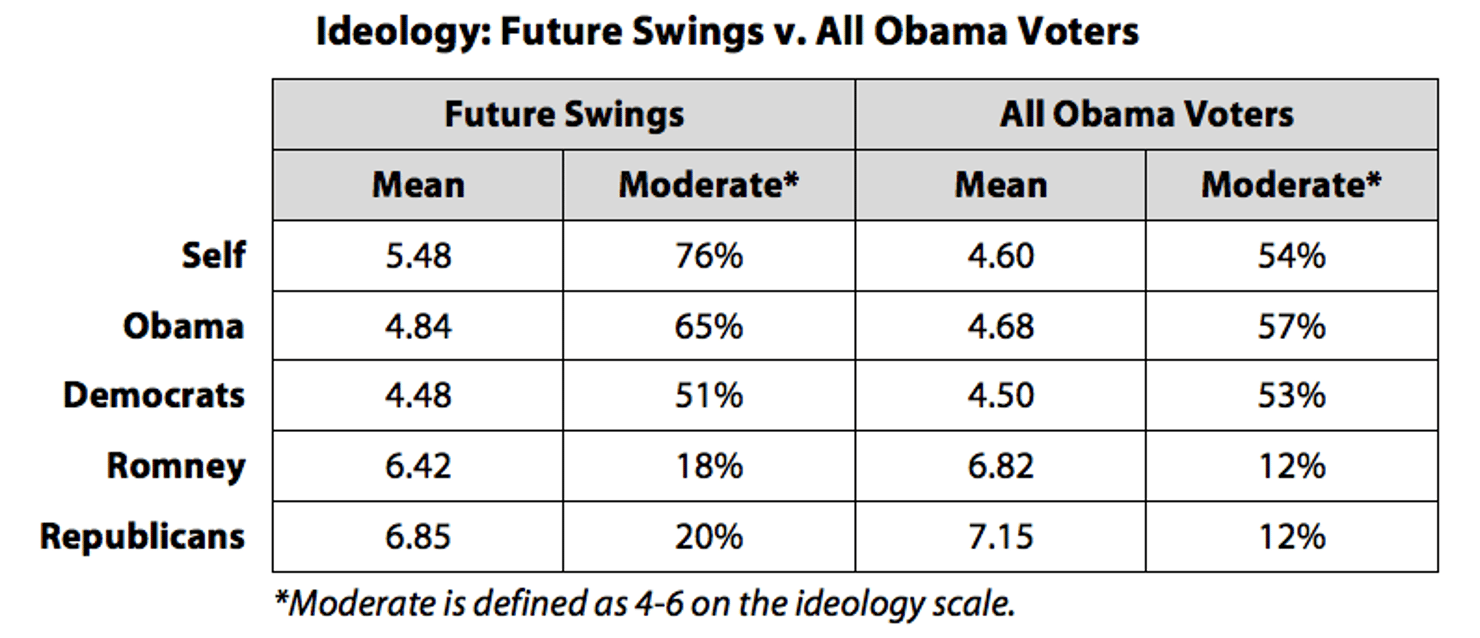
Future Swings are more moderate than the overall Obama Coalition. We asked Obama voters to place themselves on an ideological scale where 1 is liberal, 5 is moderate, and 9 is conservative. Future Swings placed themselves at 5.48, just slightly right of center. They placed President Obama at 4.84—slightly left of center. While the President was 0.64 away from themselves, these voters placed Romney at 6.42—nearly a full point more to the right. Future Swings viewed Romney as further to the right than President Obama was to the left—and further away from themselves ideologically.
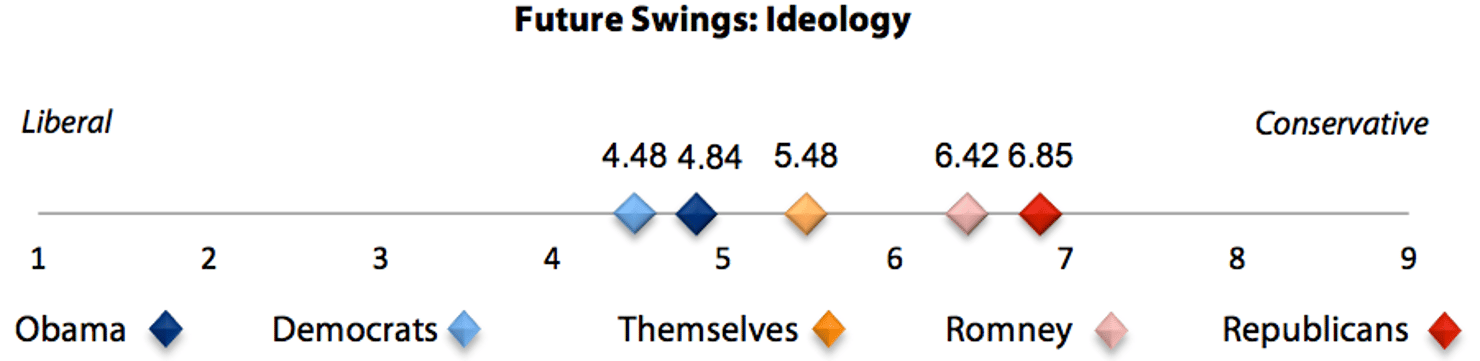
Despite being further to the left than the President, Future Swings felt Democrats were still closer to the moderate center than Republicans. They put Republicans in Congress at 6.85, well over 1 point further to the right than themselves and nearly 2 full points from the moderate center. Future Swings believe Democrats are more liberal than either themselves or the President, but they didn’t believe that Congressional Democrats were as extreme as Congressional Republicans.
Compared to all Obama voters, Future Swings are much more moderate. The Obama Coalition placed itself (on average) at 4.6 on the ideological scale. Future Swings and the overall Coalition are nearly equidistant from the midpoint of 5—except that all Obama voters are slightly liberal-leaning and Future Swings are slightly conservative-leaning. More than three-quarters of Future Swings placed themselves in the moderate third (4–6) of the ideological scale, as compared to 54% of the Obama Coalition as a whole.
When they were casting their vote, 72% of Future Swing voters were looking for a moderate President, and another 20% wanted a conservative President (4% were looking for a liberal). The majority of Future Swings saw in Obama these desired characteristics and beliefs: the majority thought he was a moderate (52%) or conservative (15%). And, in the future, they hope President Obama is more moderate (53%) or more conservative (25%) than his first term, with only 12% wanting him to be more liberal.
3) Future Swings are especially deficit-conscious and with the President on taxes on the wealthy.
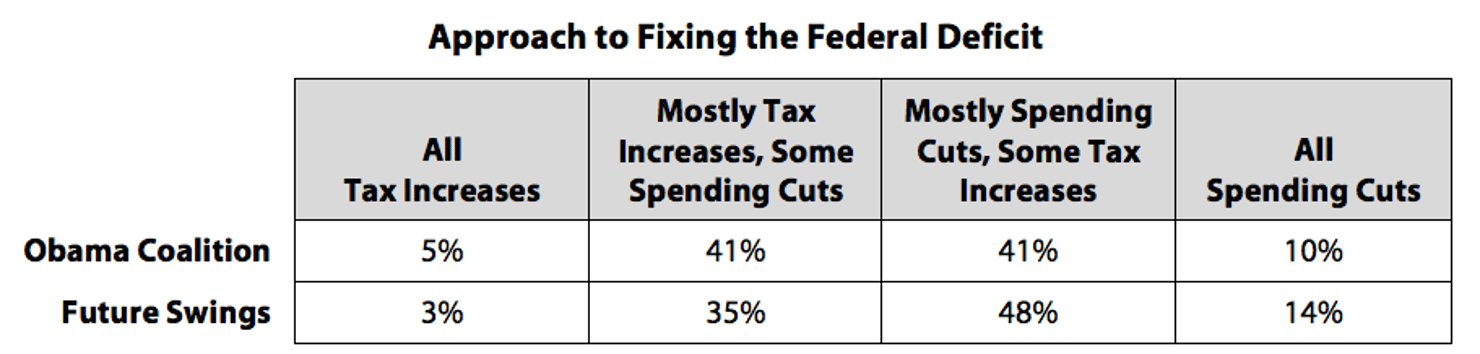
Three-quarters of Future Swings say the federal deficit is a major problem facing this country, slightly more than the 69% of all Obama voters who agreed with that statement. As a solution, nearly half of Future Swings (48%) emphasize spending cuts over tax increases, while 35% support more tax increases mixed with some spending cuts. Here and elsewhere in our poll, Future Swings were less insistent on tax increases than the overall Obama Coalition—although a supermajority (86%) still thought taxes should be part of the solution to the deficit problem.
While the Obama Coalition’s top priority was raising taxes on the wealthy, with 85% support and 53% saying it was extremely important (rated 9 or 10 on a 10-point scale), Future Swings prioritized deficit reduction instead. Future Swings rated reducing the deficit as the most important thing the President should do in his second term, with 90% saying it was important and 53% ranking it as extremely important. They also supported increasing taxes on the wealthy, with 83% saying it should be a priority and 47% saying it was extremely important.
This divergence is also evident in preferred strategies to improve the U.S. economy. For the Obama Coalition and Future Swings, increasing investments in education, research, and infrastructure is overwhelmingly the most popular first choice. But after that, divisions arise. Generally, Obama voters emphasize increasing taxes on the wealthy, with nearly half (48%) rating it as one of the top two best ways to improve the economy. By contrast, for Future Swings, reducing government spending edges out tax increases by 1 point, with 39% supporting spending reductions and 38% preferring increasing taxes.
These deficit concerns also arose when we asked about government support for social spending. The Obama Coalition (73%) and Future Swings (60%) agree that the federal government should be doing more to help the needy. However, when framed as helping the needy “even if it means increasing the federal debt,” Future Swings balked, with only 46% in support and 48% opposed. This drop-off in support was also evident amongst the overall Obama Coalition, with 57% remaining in support of more government help to the needy and 39% opposed, with the added debt language.
4) Future Swings are more skeptical of the positive impact of the government than are non-swings.
The Obama Coalition believes that government is a force for good in most people’s lives, even if they are not entirely convinced that the government helps them personally. But Future Swings display less faith in the abstract impact of the federal government on people’s lives, and they display similar ambivalence as the rest of the Obama Coalition about how they are personally affected by the government.
While 59% of all Obama voters agreed that “the federal government has mostly helped people get ahead,” only 47% of Future Swings concurred with that statement. Future Swings don’t believe the government holds people back, with only 17% choosing that option (compared to a similar 16% of all Obama voters). Yet one-third of Future Swings said “the federal government has had no impact on whether people have gotten ahead,” compared to 20% of the Obama Coalition. Thus, there is considerable skepticism among Future Swings about the role of government in people’s lives.
But when it comes to the impact of the federal government on voters personally—as opposed to the abstract “people”—the Obama Coalition and Future Swings display similar ambivalence. A nearly identical 40% of Obama voters and 43% of Future Swings believe “the federal government has had no impact on whether you have gotten ahead.” Only 45% of the Obama Coalition and 40% of Future Swings believe “the federal government has mostly helped you get ahead.” Future Swings are torn between the impact of the government on both their and other peoples’ lives and are not fully convinced that the government is usually a positive force.
Future Swing voters believe in the efficacy of government (59% say the government generally does a better job than it gets credit for), but there are some limitations to their support for government involvement. They are deficit-conscious and have the philosophy that the government should work to give people more opportunity but each individual is ultimately responsible for creating their own success.
5) Future Swings are optimistic about opportunities to succeed.
The Obama Coalition overall wants the government to emphasize increasing economic opportunity (66%) over increasing economic security (29%), by more than a 2-to-1 margin. Future Swings are even more bullish on the opportunity framework, with 73% choosing that option compared to only 24% for security. This is likely due to their belief in individual efficacy and the opportunities provided in this country for people who work hard to succeed.
An overwhelming 88% of Future Swings agreed with the statement “Government should provide people with the tools and opportunity to succeed but everyone is ultimately responsible for helping themselves,” with 55% saying this describes their views extremely well. That statement was much more popular than “Government should provide people with the tools and opportunity to succeed and help people out if they fall behind,” which garnered only 65% support and only 21% saying it described their views extremely well.
Future Swings believe in individual efficacy likely because they think “America is the land of opportunity,” with 89% agreeing and 60% saying it describes their views extremely well. And 76% of Future Swings agree that “people who work hard mostly get ahead,” with 37% saying this describes their views extremely well. Future Swings see a land of opportunity, believe people are responsible for their own future, and agree that, on average, hard work pays off. These are optimists, not waiting for the government to care for them, but seeking the opportunity to achieve (but they do believe the government should help give people the opportunity to help themselves).
Conclusion
President Obama won reelection by building a diverse, center-out coalition. But as Democrats look to cement their coalition moving forward, they need to continue to appeal to sporadic Democratic voters. Future Swings—Obama supporters who say they are likely to vote Republican in the future—are more moderate than most Obama voters. They express more concern over the federal deficit, and they are not convinced that tax increases on the wealthy will solve the entire problem. Future Swings are more skeptical of the federal government than the rest of the Obama Coalition. They are more likely to emphasize personal efficacy and believe that hard work is rewarded in an opportunity society. Appealing to these Future Swing voters will be crucial both for Democrats looking to preserve a majority and Republicans looking to find a path forward.
Appendix
In order to isolate a group of voters who may not be reliable Democratic Party voters in the future, we created a category of Obama voters called Future Swings. These voters said they were very or somewhat likely to vote for a Republican in the future and identified as a moderate or a conservative.
Of all Obama voters:
- 43% said they were very likely (8%) or somewhat likely (36%) to vote for a Republican in a future election.
- 53% said they were not very likely (24%) or not at all likely (28%) to vote for a Republican in a future election.
Of the 43% who said they would vote GOP in the future, we removed anyone who said they were a liberal on the 3 part ideology question (Which is closest to how you would describe yourself? Liberal, Moderate, Conservative).
We removed liberal voters from our category of Future Swings because they displayed far less propensity to support the GOP both in the past and in the future. By 53% to 46%, liberals in our poll said they had never voted for a Republican. And they are not likely to do so in the future, with only 30% saying they would consider voting Republican. This is in stark contrast with moderates and conservatives in our poll. Nearly two-thirds of moderates had voted Republican in the past (64%). And majorities of moderates and conservatives say they would vote Republican in the future. Since liberals display less tendency to vote for or consider supporting Republican candidates, it is unlikely they are swing voters who future Republicans can entice.