Memo Published February 12, 2026 · 13 minute read
How Young Men View Trump 2.0 After One Year
Takeaways
- President Trump’s job approval is 34 points underwater among young men, with 32% approving and 66% disapproving of his performance in office.
- A paltry 26% of young men would back a J.D. Vance presidential run in the 2028 general election, with 55% opposing and 17% unsure.
- A 61% supermajority of young men say Trump is not fulfilling his campaign promise to put America first, including 25% of young Republican men and 64% of Independents.
- Thirty-three percent of young men combined—including 15% of young Republican men—hold Trump (24%) and Republican leaders (9%) as the figures with the greatest responsibility for lowering the country’s temperature around political violence, while just 6% say Democratic leaders hold this responsibility.
- Young men are most alarmed by Trump’s $1 trillion cut to health care (66% very concerned), followed by his opposition to fully releasing the Epstein files (63%), and his expansion of immigration raids to target anyone who looks or sounds foreign (60%).
- Sixty-five percent of young men say that they are either struggling to pay bills (27%) or are just making enough to pay bills (38%).
- Fifty-eight percent of young men believe that Trump has negatively impacted their finances, while just 23% say that he has had a positive impact.
- Half of young men blame Trump’s tariffs for higher grocery costs (49%), while a larger share blame private corporations that purchase real estate for high housing costs (65%).
- An astonishing 73% of young men believe that American culture has changed for the worse since their parents were their age—20 points higher than the electorate overall.
One year after being sworn in and winning 54% of young men in the 2024 election, Donald Trump is hemorrhaging support with this cohort. In last year’s focus groups, we found that young men who voted for Trump expressed serious concerns about his handling of the economy, tariffs, and immigration enforcement, though most were willing to take a wait-and-see approach as to how his policies panned out. To further analyze where the young male electorate stands today, Third Way worked with HIT Strategies to conduct a nationwide mixed mode survey in December 2025 of 1,462 young men, 18 to 29 years old, who are registered to vote.
Trump Job Approval, Vance 2028, & America First?
It’s no secret that Donald Trump formed a unique coalition with young men in 2024, swinging them 18 points to the right in the general election, with even more acute swings among young men of color. Yet, just one year into his term, his standing with this bloc has deteriorated significantly. President Trump’s job approval is now 34 points underwater with young men, with just 32% approving and 66% disapproving of his performance in office—including 48% strongly disapproving. This marks a dramatic reversal of his 2024 strength, when he held a 58% retrospective job approval rating among young men and a 56% favorability rating, according to analysis of AP Votecast data.
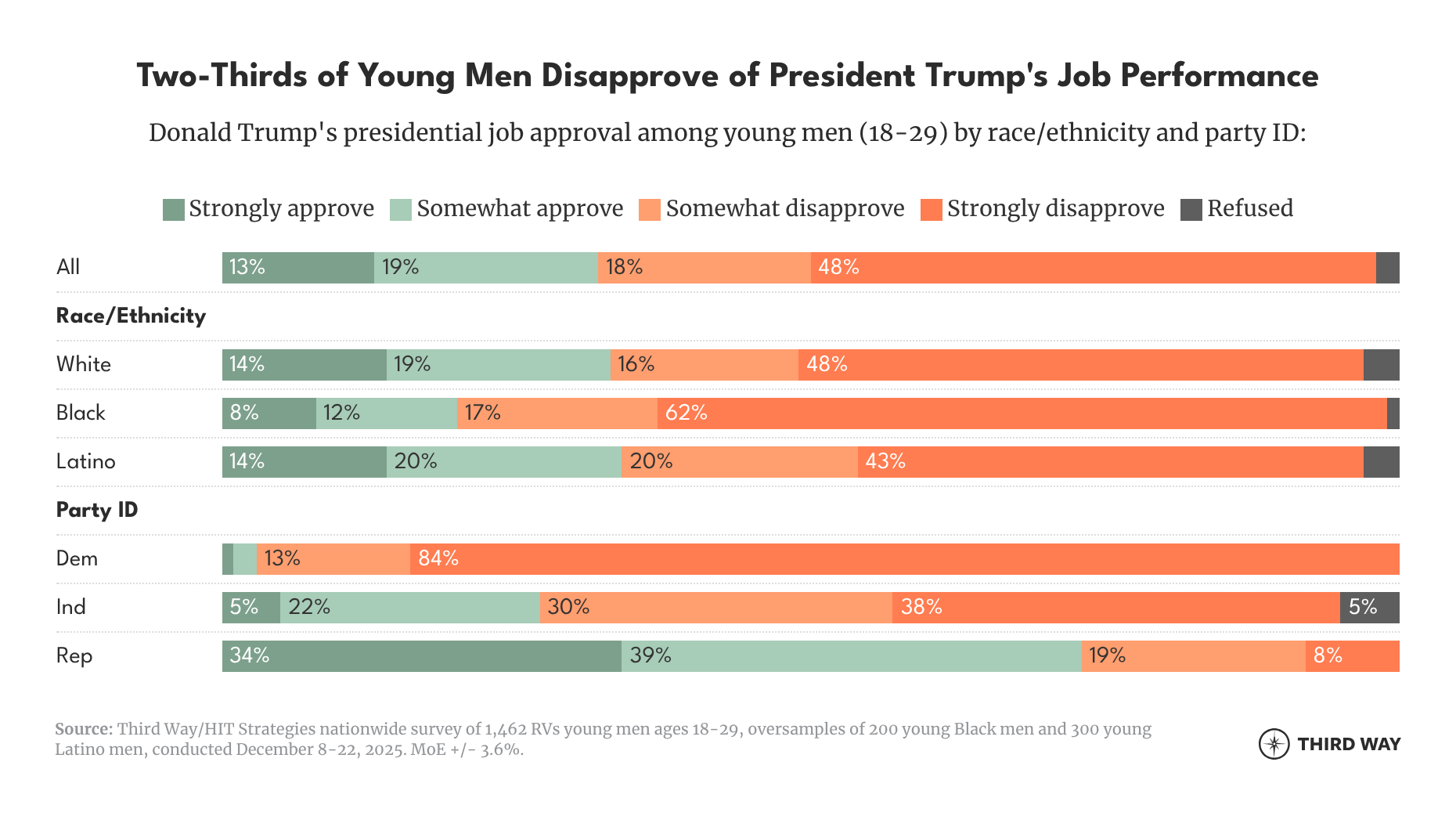
These numbers should be nothing but alarming for President Trump and his allies. A stunning 68% of Independent young men disapprove of his job performance, along with 27% of Republicans and 23% of Trump voters. Interestingly, 26% of young men who indicated that they would vote for a Republican on the 2026 generic congressional ballot also disapprove of Trump’s performance. And after the president made substantial gains with young men of color in 2024, he now holds a 63% disapproval rating with young Latino men and 79% disapproval with young Black men.
This bleeding of support also appears to have spread to Vice President J.D. Vance’s prospects for 2028. While the presidential election is a far way off, we wanted to gauge where Vance starts his base of support at with young men, if he is indeed to be Trump’s successor in the party (as Trump has previously suggested). The results show that a paltry 26% of young men would back a Vance candidacy in the 2028 general election, with 55% opposing and 17% unsure—leaving him with both weak initial support and a low ceiling.
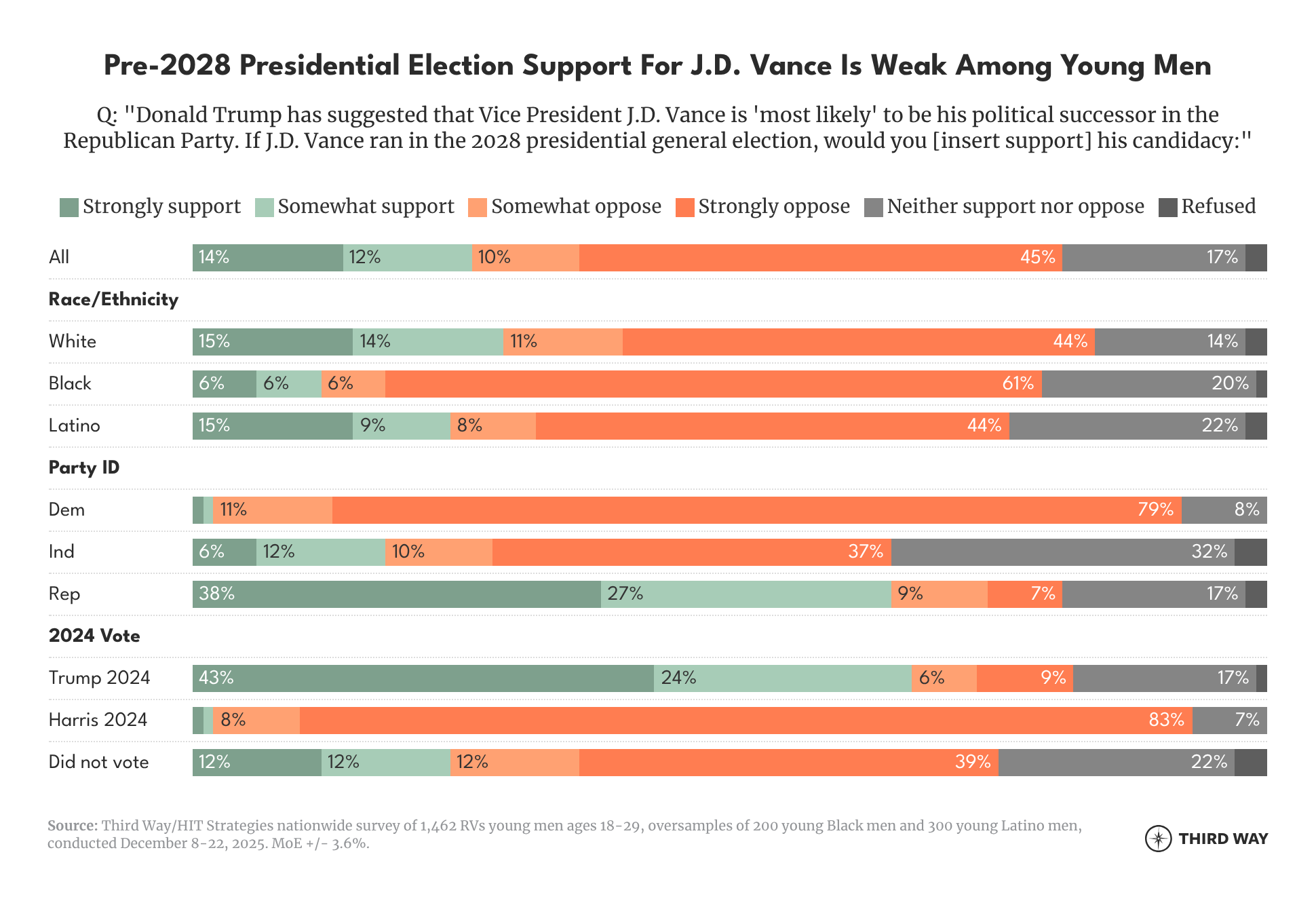
What’s perhaps most interesting is that 15% of young men who voted for Trump in 2024 would not back a Vance candidacy, with 9% strongly opposing, while young men who did not vote in 2024 break 51-24% against Vance. However, if one were looking for potential areas of growth for Vance, there does appear to be a large contingent of Independent, young men of color who are undecided and remain open to voting for a Vance candidacy—but this support level is a far cry from the coalition that Trump assembled.
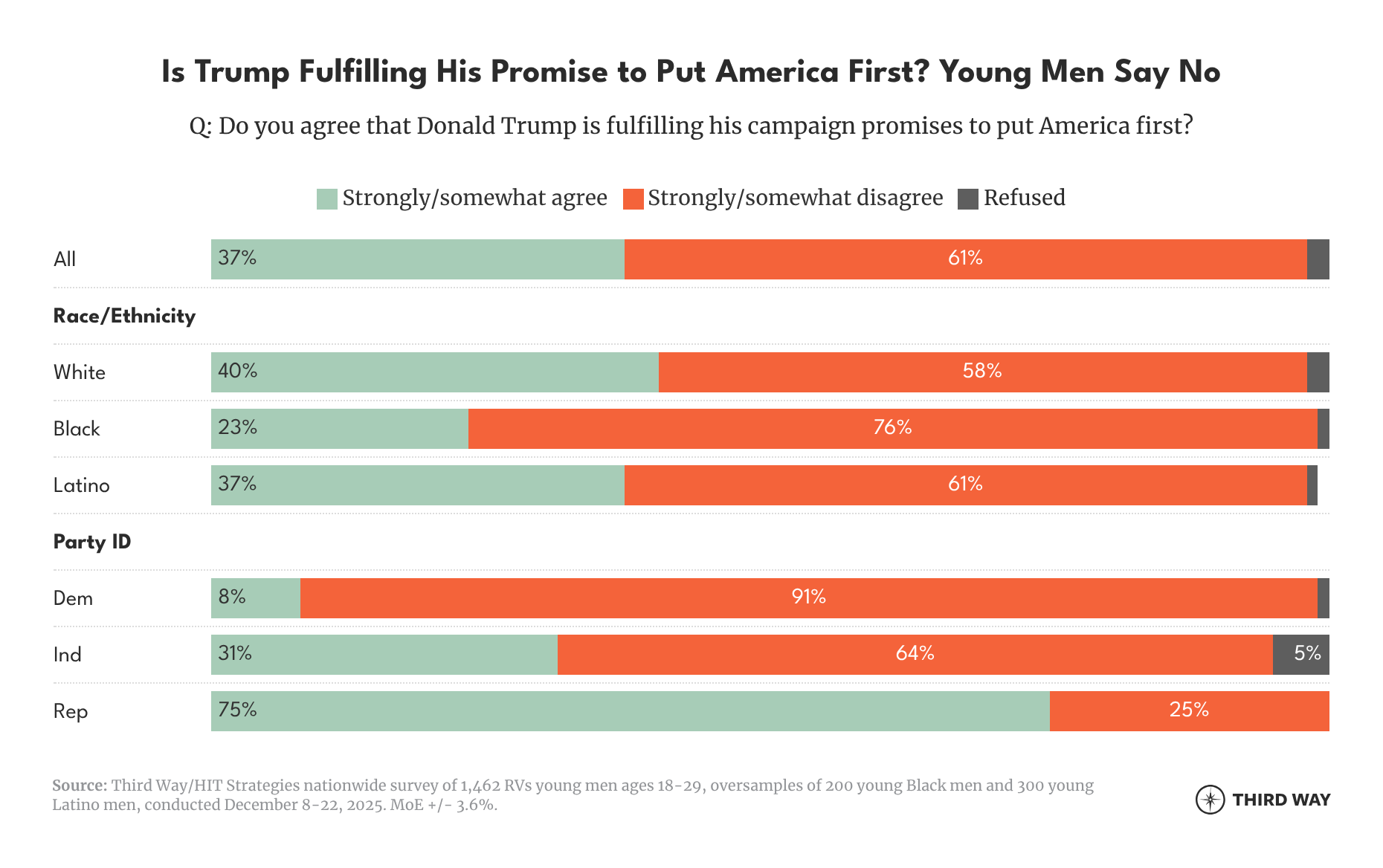
This all begs the question—why are young men turning on Donald Trump and his vice president? Our data shows that voters simply do not believe that Donald Trump is upholding his campaign promises. When asked if Trump is fulfilling his promise to put America first, a whopping 61% of young men said no, with strong majorities across race and ethnicity rejecting the notion that the president is keeping his famous campaign promise, along with 25% of young Republican men, 59% of moderates, and 64% of Independents.
There is no one explanation to the revolt against Trump. Many voters are seeing Trump’s focus turn toward foreign policy, crackdowns on immigration, and giveaways to the wealthy and well connected—not fulfilling his promise to improve their financial circumstances.
A core plank of Trump’s 2024 platform—and a key reason why he won over so many moderate and Independent young men—was his promise to tackle the affordability crisis, yet most young men today remain far from satisfied with what he has delivered so far. When we asked whether Trump has had a positive or negative impact on their personal financial outlook, a 58% majority of young men responded that Trump has negatively impacted their finances, while just 23% say that he has had a positive impact. This comes as the president tries to distance himself from stubborn inflation while repeatedly calling the affordability crisis “a hoax.”
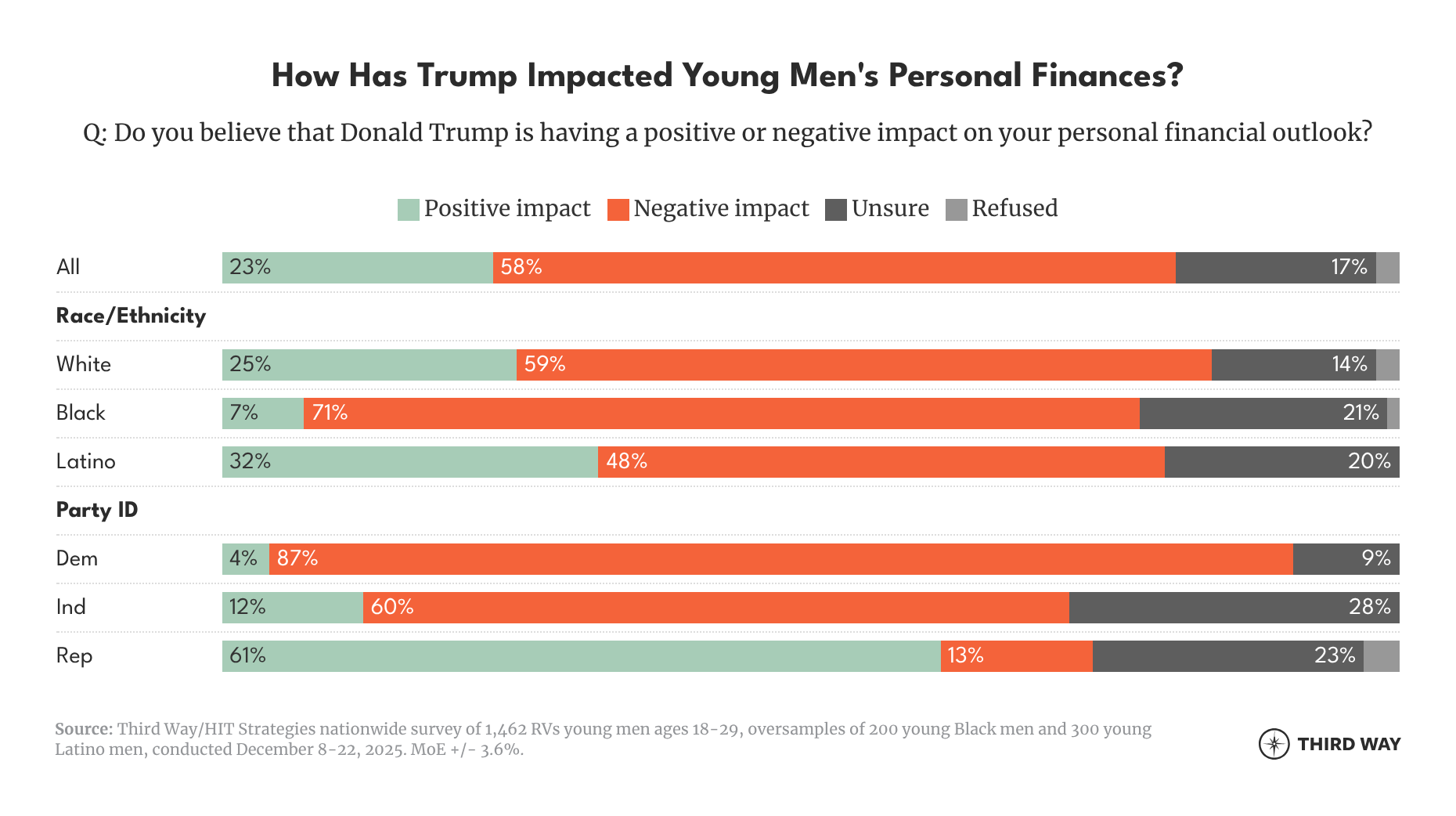
Astonishingly, across race and partisan affiliation, fewer young men say that Trump has improved their personal finances than say they approve of his overall job performance—meaning that even Trump’s supporters are not thrilled with his economic stewardship. As it stands today, 71% of young Black men, 59% of young white men, and 48% of young Latino men say that Trump has negatively impacted their finances—with Latino men being the most optimistic of Trump’s economic impact at 32% positive. Perhaps most dire for Trump is that 60% of young Independent men say that he has negatively impacted their finances.
Trump Admin Actions, Paying Bills, & Economic Enemies
Looking back at some of the actions that Trump and his administration have taken in his first year, we find that young men are most offput by Trump cutting $1 trillion in health care funding to give tax cuts to the top 1% (66% very concerned), followed by Trump opposing the full release of the Epstein files (63% very concerned), and Trump expanding immigration raids and arrests to include anyone who looks or sounds foreign (60% very concerned). While this survey was conducted before the fatal shootings by ICE and CBP in Minneapolis, the salience in opposition to Trump’s immigration crackdown is significant and has likely only grown in the last month.
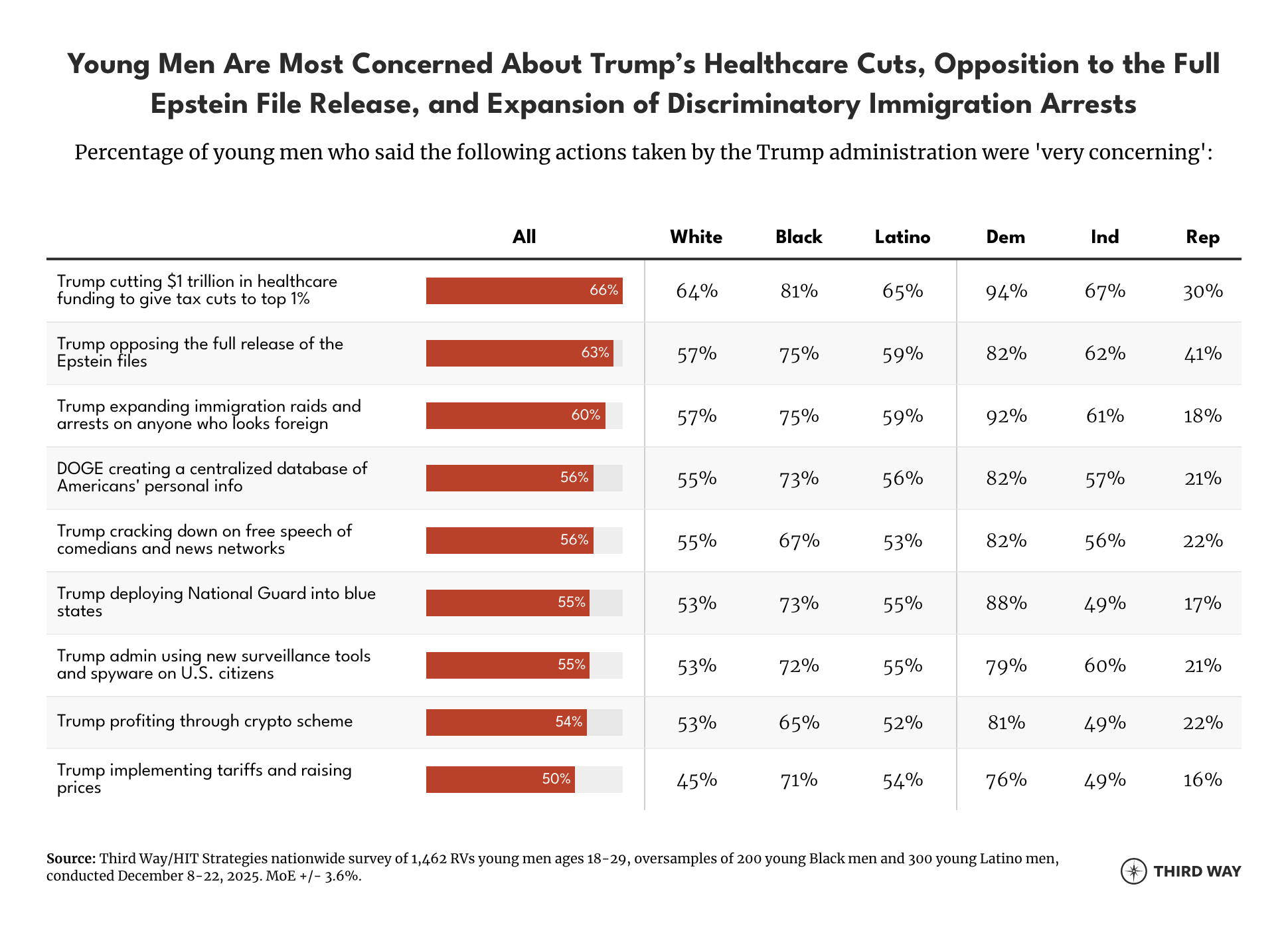
Notably, every single Trump action tested in this survey was highly unpopular with respondents. Concerns about DOGE creating a centralized database of Americans (56% very concerned), and the Trump Administration’s use of new surveillance tools to monitor Americans’ flights and social media activity (55% very concerned) fell in the middle of the pack. Similar levels of concern were expressed about Trump cracking down on the free speech of comedians and journalists (56% very concerned) and deploying the National Guard to blue states (55% very concerned)—demonstrating consistent opposition to Trump’s consolidation of federal power.
When we break down these responses by political affiliation, we find that Republican young men are far and away most concerned about Trump opposing the Epstein file release (41% very concerned). Comparatively, the most cited concern for Democrats (94%) and Independents (67%) was Trump’s health care cuts—which should be little surprise given the salience that health care cuts have taken on in recent months.
The reality is that young men’s financial stress has continued unabated throughout the first year of the Trump Administration, and it is closely tied to their negative rating of the Trump economy. Sixty-five percent of young men say that they are either struggling to pay bills (27%) or are just making enough to pay bills (38%). This is especially acute among young Black, Latino, and Democratic men. Meanwhile, young Republican men appear to be the most economically secure in the Trump economy, with a 45% plurality saying they’re making enough to pay bills and save money.
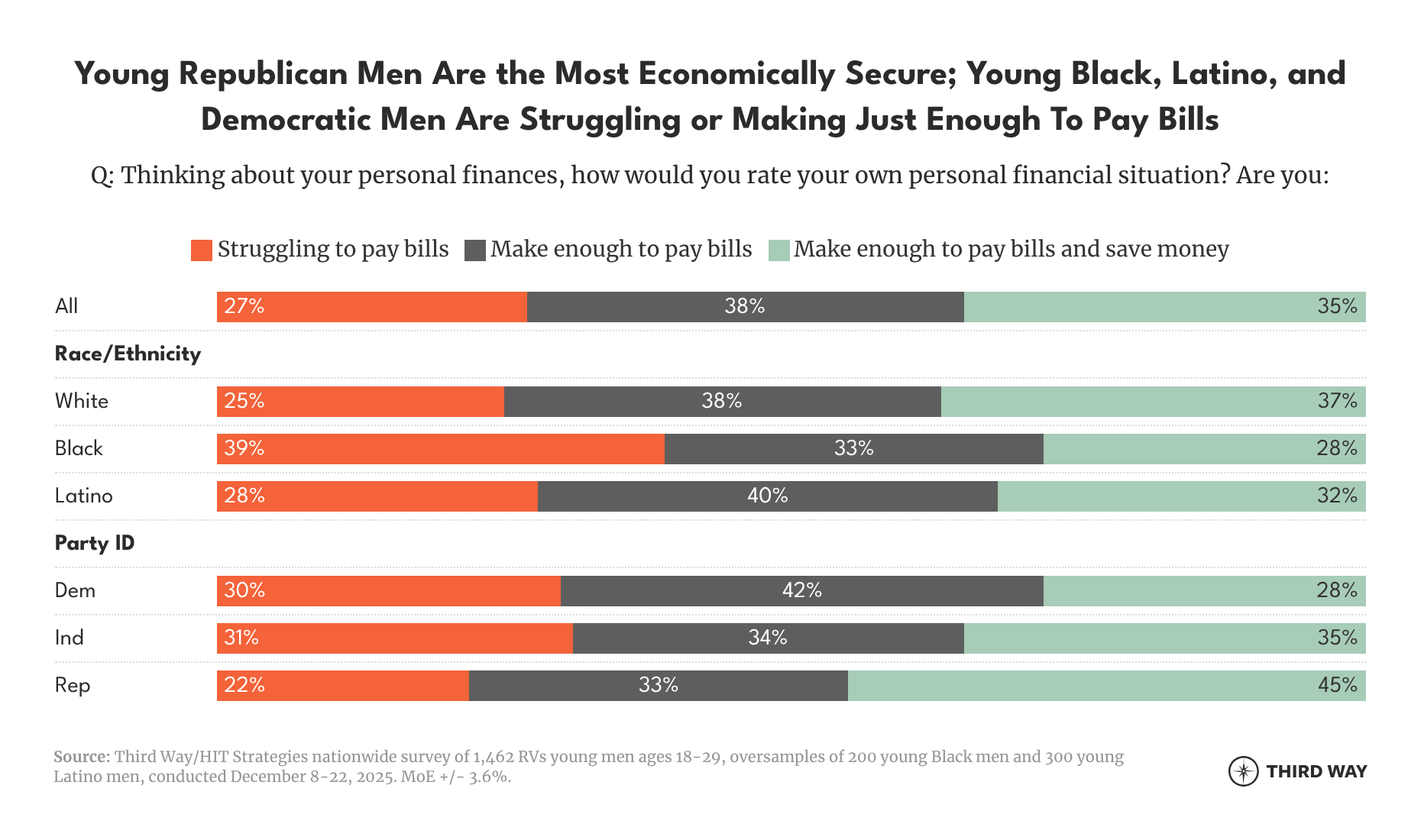
While Trump’s base may be more financially secure—or at the very least are less inclined to be critical about their economic fortunes under his presidency—the personal finances of key swing groups that shifted toward Trump are in a dire state, raising the question of where these voters are placing the blame.
In AP Votecast’s 2024 presidential election survey, 67% of voters nationwide said that they were “very concerned” with the cost of food and groceries—the highest level of concern of any issue, including among nearly 70% of Black, Latino, and white non-college voters. Trump won these voters by a wide 61-38% margin over Harris. When we asked voters who they blamed for the increased costs of groceries today, 49% of young men placed the blame squarely on Trump’s tariffs, followed by “a corrupt political system” (39%) and corporate food manufacturers (38%).
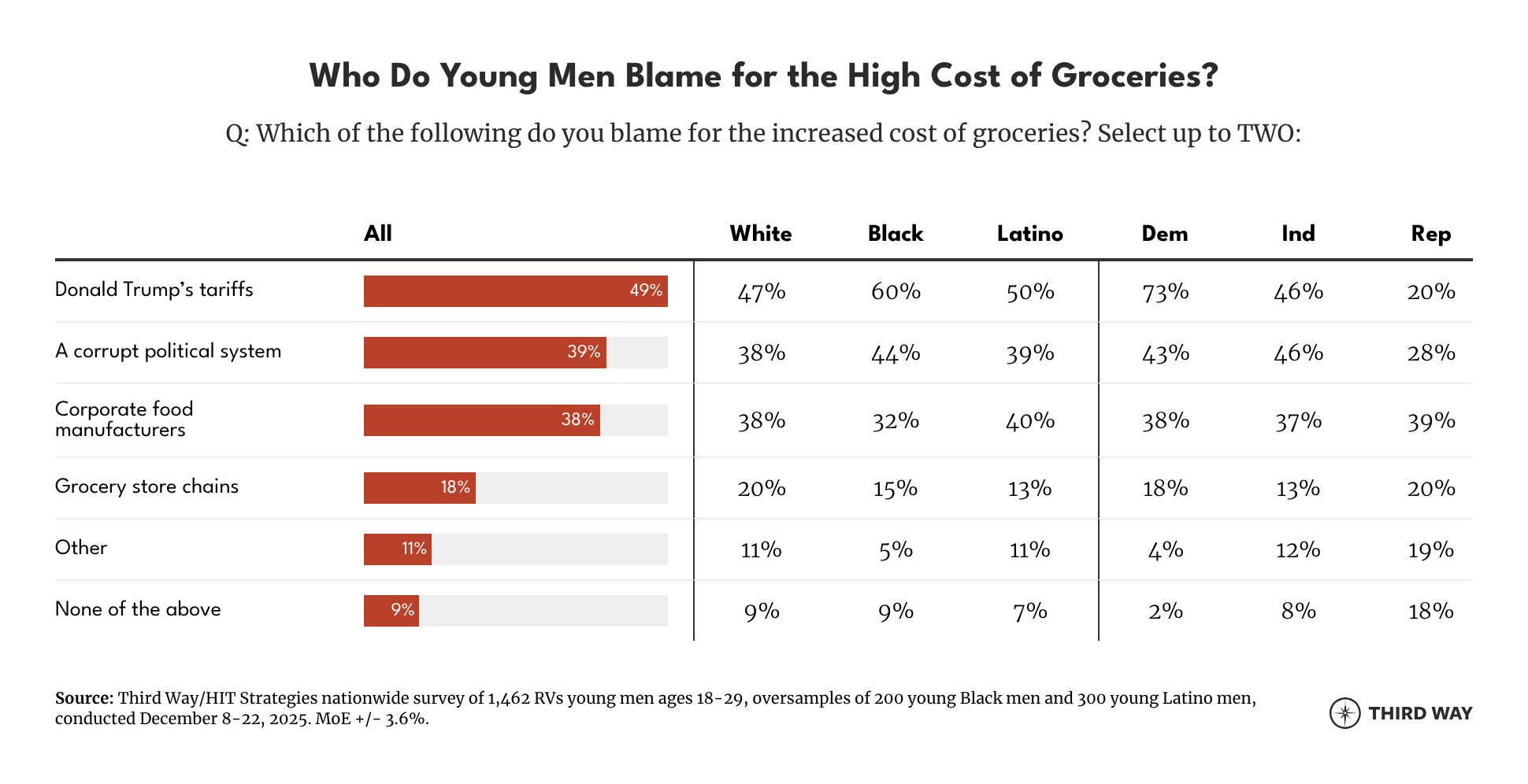
This is consistent across race, with 60% of young Black men and 50% of young Latino men attributing the Trump tariffs as the primary cause for high grocery costs, along with 46% of Independents and 20% of Republicans. It’s clear that Trump’s implementation of harmful tariffs—vividly and directly linked to higher consumer costs—has proven deeply damaging to his standing with the voters who expected him to act on lowering grocery prices.
Following the cost of groceries, the issue that voters said was the second highest level of concern in 2024 was the cost of housing. Our survey shows that across race and political affiliation, respondents place the greatest blame for the lack of affordability in the housing market on private corporations. An overwhelming 65% of young men blame “private corporations who buy real estate,” followed by “a corrupt political system” (37%), and red tape in local government (22%).
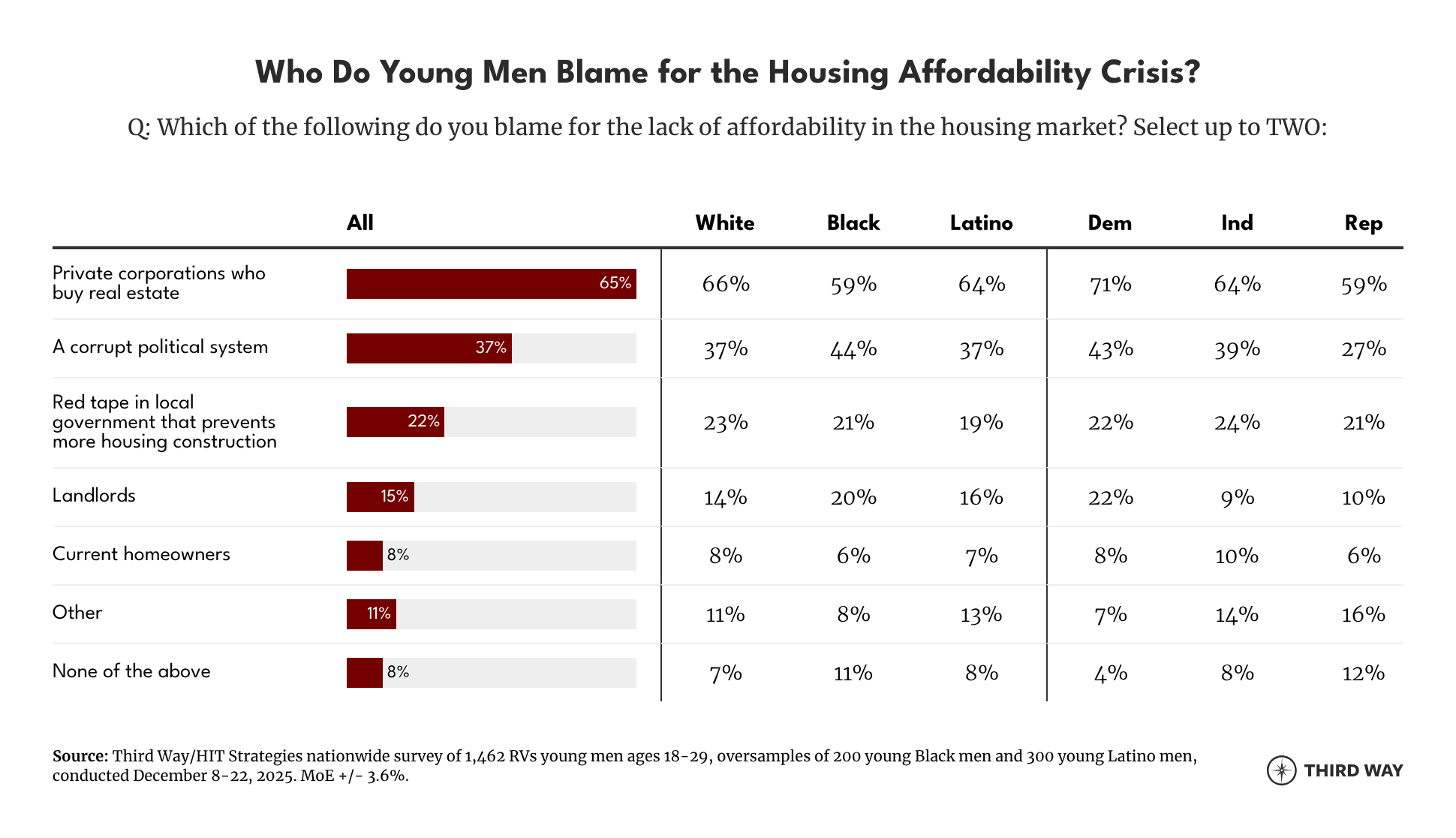
Unlike tariffs, which have become closely and vividly associated with rising grocery costs, Trump may be poised to take on the economic villain young men most often blame for high housing prices. Trump recently announced his support for banning large institutional investors from purchasing single-family homes, a move that could draw bipartisan support from Democrats, given that it’s been a cornerstone of their legislation for years. Still, even if such legislation were to pass and be signed into law—a significant hurdle in itself—it remains an open question if voters would see any immediate relief. And it is uncertain if Trump would receive any political points in the face of stubbornly high prices elsewhere in the economy—a political reality that Trump’s predecessor faced with much of his agenda.
American Culture, Dialogue, and Political Violence
To better understand how young men perceive the broader state of American society, we asked a series of questions about changes in American culture, dialogue with people who hold different political views, and who bears responsibility for lowering the temperature around political violence.
An astonishing 73% of young men believe that American culture has (mostly/slightly) changed for the worse since their parents were their age, and just 21% say it has changed for the better—a notably higher share than in the electorate overall. Recent PRRI polling finds that 55% of voters nationwide say American culture has changed for the worse, while 43% say is has changed for the better—a nearly 20-point gap between young men’s negative views of American culture and the nation as a whole. White young men and Republican young men are the harshest critics of American culture today, with majorities of both saying that it has mostly changed for the worse. Interestingly, young Black (25%) and Democratic men (29%) are the most likely to say that America has changed for the better.
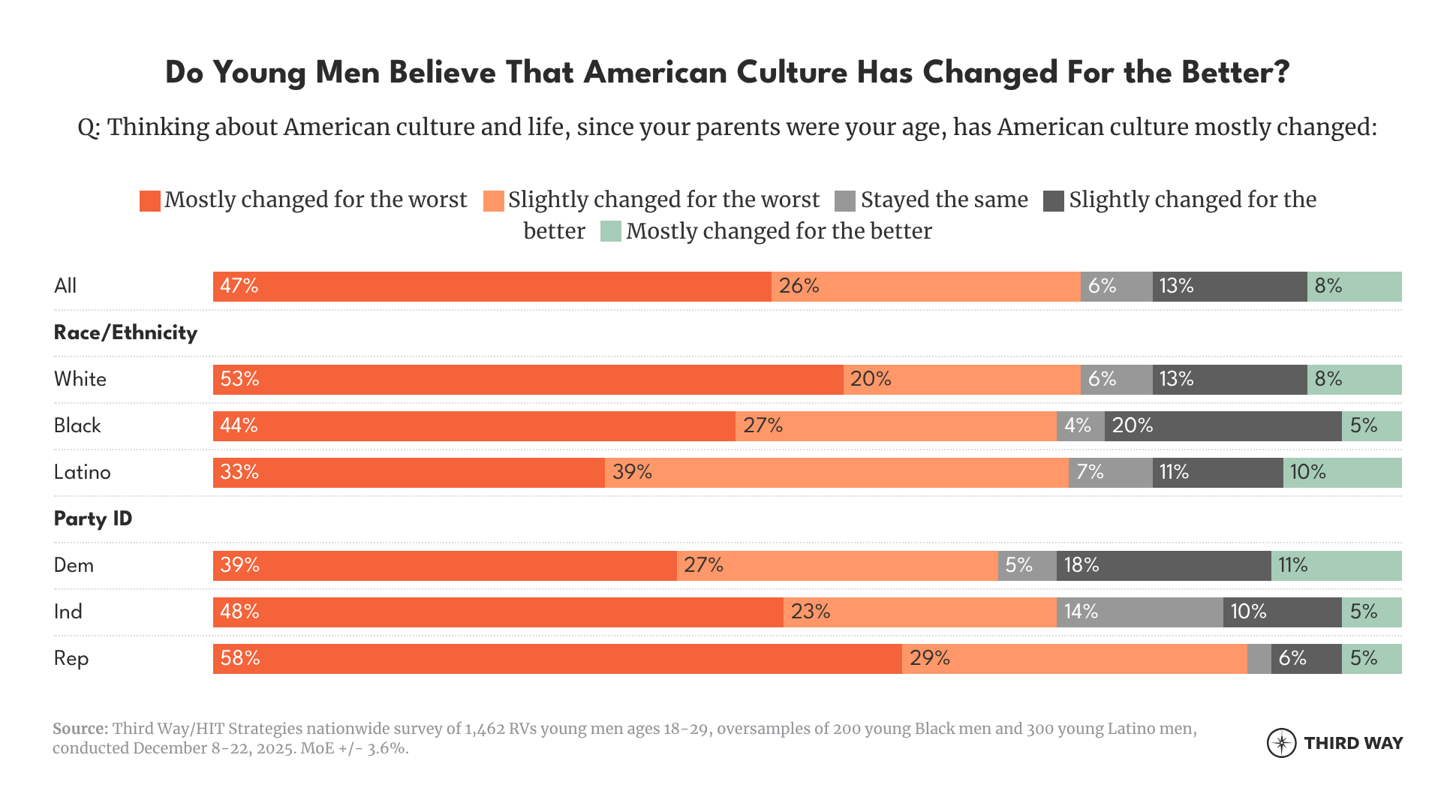
Despite backing Trump in 2024, young Latino men differ from Republican voters in being less acutely critical of American culture and society—just 33% say the country has mostly changed for the worse—highlighting that Latino voters retain a sense of opportunity and optimism in the American Dream that is distinct from other voter blocs.
To measure another aspect of American culture and how young men view a core norm in a democracy, we asked respondents how important they believe it is to engage in conversations with people who hold different political views. Notably, 67% said it was “very important,” with another 20% saying it was somewhat important, and 13% saying these conversations were not very or not at all important.
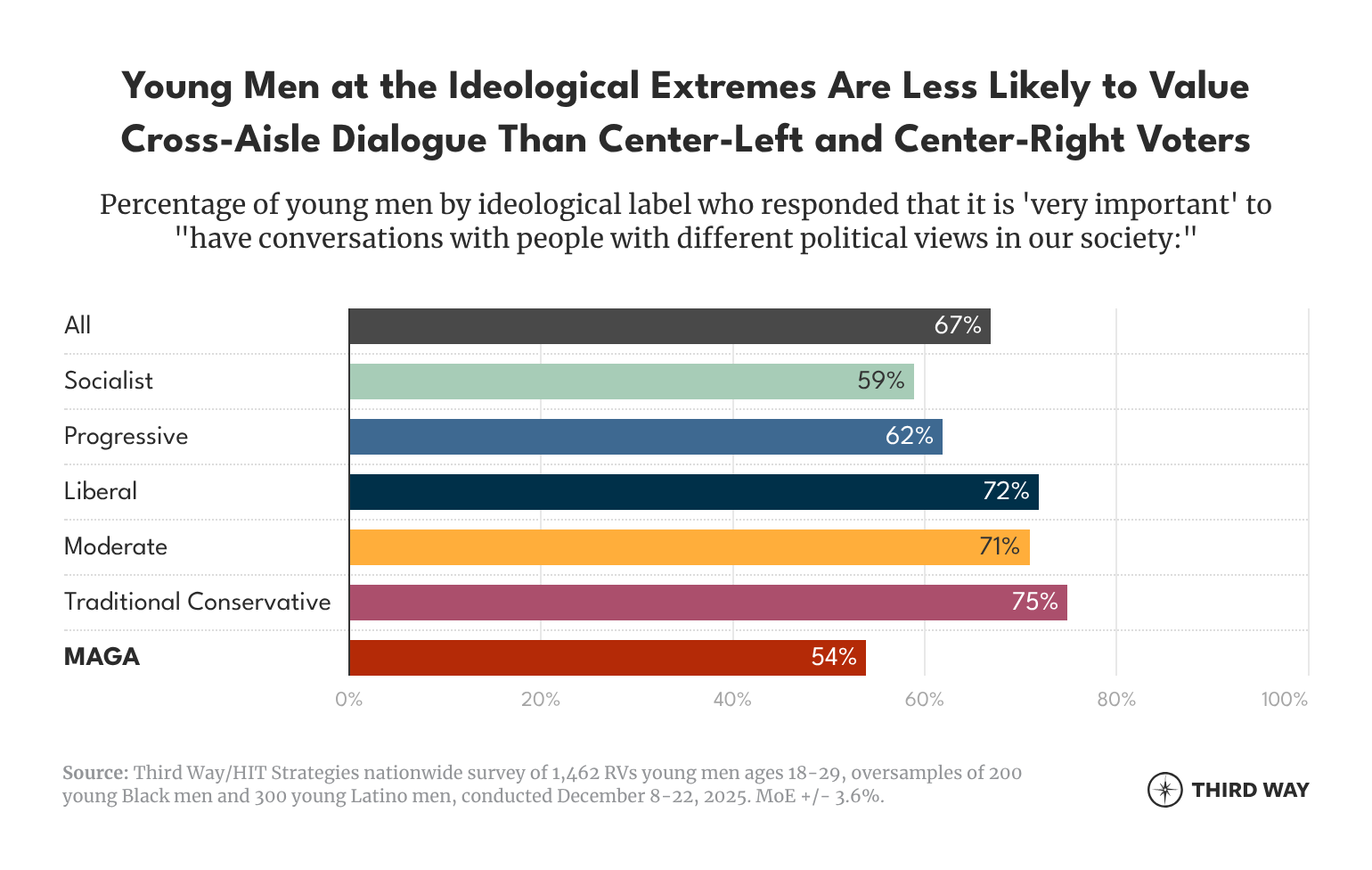
When we break this down by young men’s ideological label, we find that there’s a notable divide between the most ideologically extreme and the most moderate voters. Young men at the ideological extremes—those who identified as MAGA (54%), socialist (59%), and progressive (62%)—are less likely to say that cross-aisle dialogue is “very important” in our society than voters at the center-right and center-left—traditional conservatives (75%), liberals (71%), and moderates (71%).
This suggests that this core tenet of a healthy democracy is less a clash between right and left than a divide between the political center and the ideological extremes. As our prior research with Trump-supporting moderate young men showed, swing voters value having open and nonjudgemental conversations about politics and culture—and are more receptive to elected leaders who model that openness.
Finally, with the horrific rise of targeted political violence in the country, we wanted to gauge voters on who they believe bears the primary responsibility to lower the temperature around acts of political violence. Twenty-eight percent of young men say that the media holds the primary responsibility to lower the country’s temperature around political violence, followed by everyday Americans (26%), Donald Trump (24%), and Republican leaders (9%).
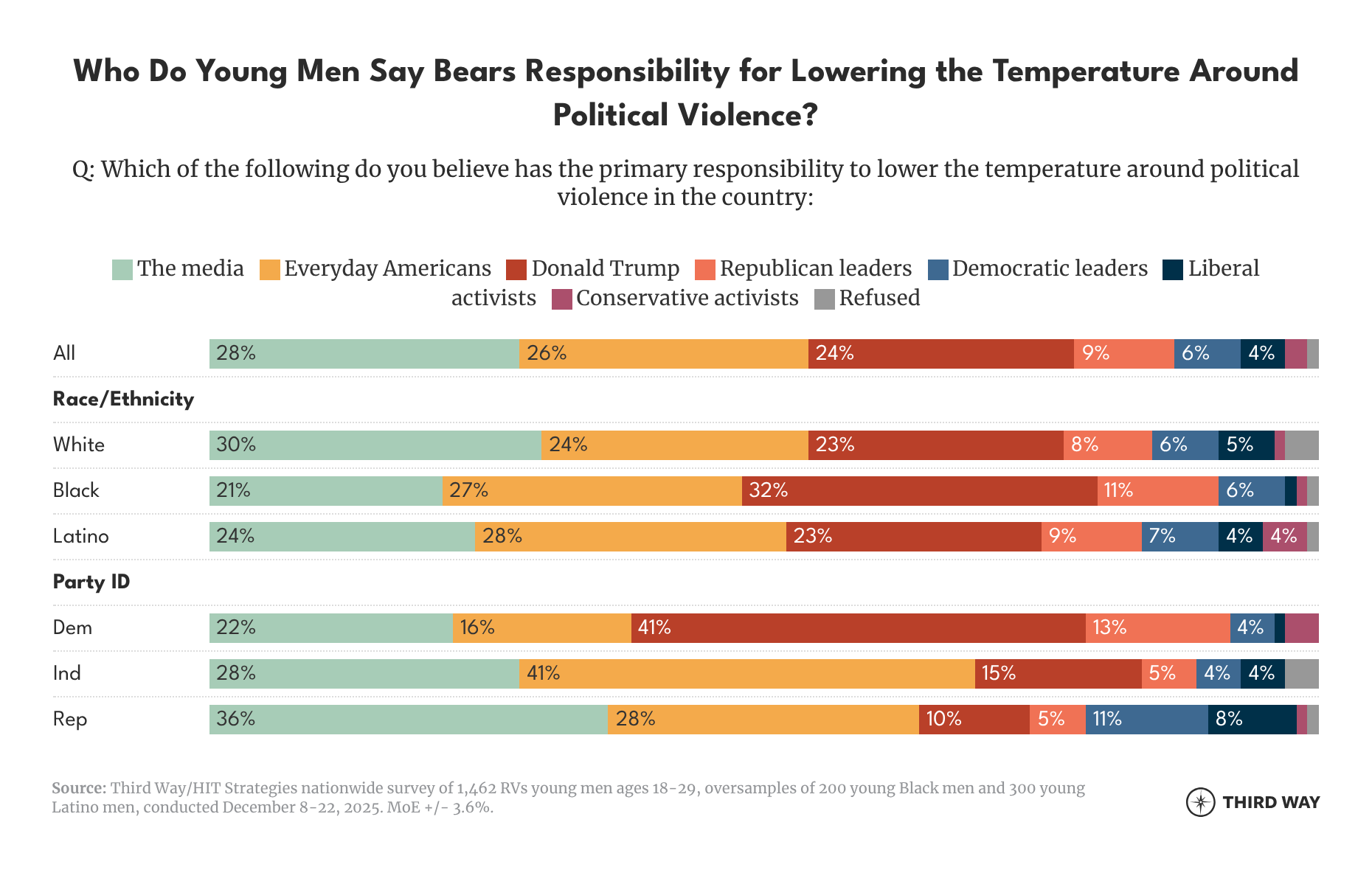
A closer look at the data reveals clear partisan divides around who young men believe should lower the political temperature. Young Democratic men hold Trump (41%) as the primary figure to temper the rhetoric around political violence, while Independents say it is the responsibility of everyday Americans (41%), and Republicans place accountability with the media (36%).
Still, it’s notable that 33% of young men—including 15% of young Republican men—hold Trump and Republican leaders, who currently hold the levers of federal power, as the figures most responsible for lowering the country’s temperature, while just 6% say Democratic leaders hold this responsibility. Despite this, there have been countless examples in recent months of the president continuing to post aggressive rhetoric against politicians, even from his own party, and those recipients receiving real-world threats of violence. As we get further into a polarized and violent political era where such rhetoric, threats, and shootings become more frequent, it’s clear that young men are looking for leaders in all parts of society who will rise to the moment, de-escalate, and show their humanity.
Conclusion
While some young men are still drawn to Trump and the Republican Party, this survey makes clear that there is a wide swath of persuadable swing voters who are turning on Trump and his vice president. From the chaos of tariffs causing higher grocery prices, to the overreach in immigration crackdowns, to the president’s opposition of releasing the Epstein files, there is a bitter taste with many of the voters who broke for Trump in 2024. Those who wish to understand what economic and cultural burdens young men are feeling in this moment—and why they are softening on the GOP—would do well to reflect on this data in the years ahead.