How the Current Interior Immigration Enforcement Approach Is Failing

The Trump administration’s immigration enforcement strategy has prioritized political theater over public safety. By abandoning clear enforcement priorities, it has driven up arrests of people with no criminal history and pushed agents chase numbers instead of genuine threats. Under pressure to increase arrests and rapidly hire 12,000 new officers, the administration has tolerated tactics that are unprofessional, dangerous, and deadly—from chokeholds and teargas to wrongful arrests of US citizens and armed confrontations with bystanders. The expanded use of masks has opened the door to impersonations by criminals and the Department of Homeland Security (DHS) has justified these trends by citing dramatic increases in assaults on ICE officers that are not supported by available evidence. With thousands of hastily hired, minimally trained officers now in the pipeline, these problems are poised to escalate unless significant course corrections are made.
Lack of Priorities
For the first time since 1999, U.S. interior immigration enforcement is operating without explicit enforcement priorities. On his first day in office, President Trump issued an executive order that rescinded the Biden administration’s priorities and instructed ICE, among other agencies, to set their own priorities that “protect the public safety and national security interests of the American people.” This broke with 26 years of continuous, explicit interior immigration enforcement priorities, maintained across Democratic and Republican administrations.
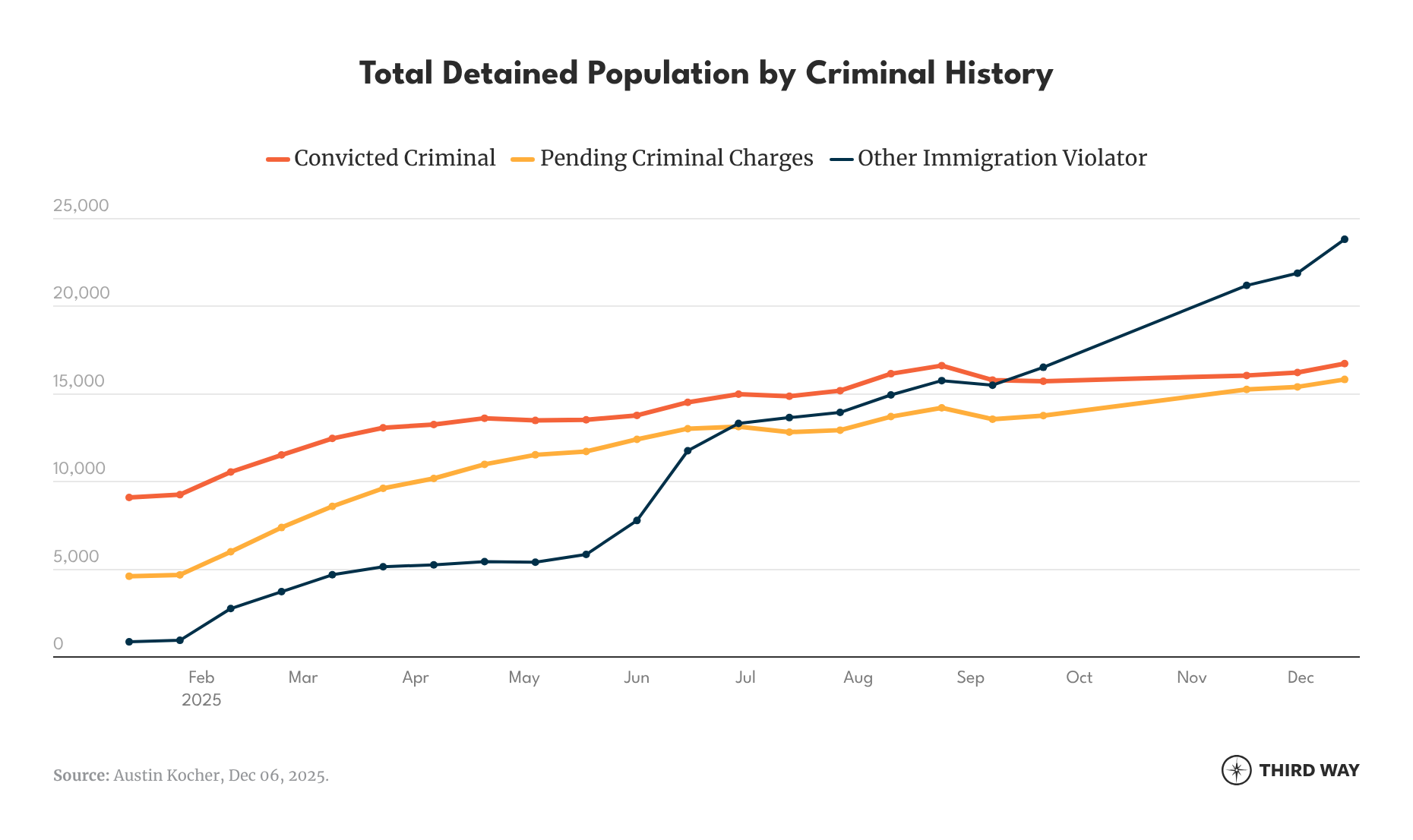
The consequences are already visible. Even though ICE has stopped publishing arrest or deportation statistics, detention data released through the end of November—as required by the FY 2020 Department of Homeland Security Appropriations Bill—shows a marked increase in the number of people detained with no criminal record. As of December 13, 2025, 70% of individuals in immigration detention had never been convicted of a crime. Communities are experiencing enforcement that is broader, less targeted, and less tethered to public safety than at any point in recent memory.
Masking and Problematic Policing Tactics
There has been a significant rise in high-profile arrests of noncitizens and citizens alike in which ICE and other federal law enforcement officers are using masking and other concerning policing tactics. Videos have caught ICE and other federal officers pulling US citizens from their vehicles, pointing guns at crowds or specific bystanders, impersonating utility workers, and using excessive force, such as chokeholds, kneeling on a target’s head, vehicle maneuvers, pepper balls against peaceful protesters and reporters, and tear gas at close range and in residential areas. The enforcement push has included at least fourteen shootings so far, two of which were fatal. One was the shooting of a 37-year old US citizen in Minneapolis, who appeared to be driving away from the scene, but who the administration quickly labeled as having tried to commit “an act of domestic terrorism.”
Despite the widespread evidence of problematic policing tactics and violations of DHS’s own use of force policies, DHS has given no indication that any officers have been disciplined. Instead, in response to a report on potential violations of DHS’s use of force policy, DHS issued a statement praising the officers’ “incredible restraint in exhausting all options before force is escalated.”
Early on in the administration, local police began speaking out against ICE tactics and the ways they are eroding trust with law enforcement. Recently, when discussing ICE’s tactics, Chuck Wexler, executive director of the Police Executive Research Forum, explained that police departments in some cities are getting 911 calls from community residents reporting the presence of armed masked men in their neighborhoods.
Gil Kerlikowske, former commissioner of US Customs and Border Protection and police chief in Seattle, has also spoken out against the tactics, saying “These are tactics and strategies that are clearly not needed to be able to do their job… I couldn’t be more disappointed.” Kerlikowske also explained that federal immigration officers “do not have the training or skillset or experience to police an urban environment.”
Arrests of US Citizens
News and social media sites are flooded with stories of US citizens being arrested and detained by ICE, the vast majority of which are later released without charge. Here are some of the more appalling examples:
- In Alabama, US. citizen Leonardo Garcia Venegas has been arrested twice by federal agents. During both arrests, which occurred one month apart, agents dismissed his Real ID as being fake. During one of the arrests, agents refused to remove his handcuffs until hours later when Venegas provided his social security number.
- In California, George Retes, a 25-year-old veteran and US citizen, was attempting to enter his workplace in Ventura County, CA, when he was stopped and detained by immigration agents. Agents used tear gas to try and disperse protesters, which filled up his car, leaving him choking. Agents then refused to verify his identification, smashed his window, pepper sprayed Retes, knelt on him, and left him zip tied for four hours until being transferred to a cell. He was held for three days, was not allowed to make a phone call or contact a lawyer, and missed his daughter’s third birthday.
- In Florida, Silvia was detained with her undocumented husband while they were on their way to work, despite attempts to prove her citizenship. Her family claims that federal agents didn’t believe her since she didn’t sound Puerto Rican to them. Silvia, who was pregnant at the time, was thrown to the ground and handcuffed, remaining detained for 5 hours. Silvia says the incident led to her later losing her unborn child.
- In Oklahoma, a US citizen mother and her three US citizen daughters were woken in the middle of the night, forced to stand in the rain in their underwear, and had their phones, laptops, and all of their cash savings confiscated. The federal agents were executing a search warrant for the family’s home, but none of the individuals listed on the warrant lived in the home. The agents also failed to listen to the family’s pleas that they were US citizens.
The US government does not keep track of the numbers of US citizens arrested in the course of immigration enforcement operations. In October, ProPublica compiled and reviewed publicly available incidents and found more than 170 US citizen arrests that occurred during the first nine months of President Trump’s second administration. Third Way is also collecting cases of US citizens arrested by federal immigration agents and would be happy to share this resource.
Imitation of ICE Officers
Federal agents’ use of masks and failure to identify themselves have created an opening for bad actors to impersonate ICE officers. Examples include:
- In Delaware, two men wearing vests labeled “ICE” pulled a man over, removed him from his vehicle, and took his wallet, while wielding a knife and a firearm.
- In Colorado, a masked man walked into a grocery store with a semi-automatic gun in a holster on his hip. When an employee told him that firearms were not allowed in the business, he flashed a fake ICE badge.
- In Florida, a woman wearing an ICE shirt and a mask kidnapped a hotel clerk, who was later able to escape.
- In Pennsylvania, a man wearing a mask and impersonating ICE, entered an auto repair shop, yelled “Immigration!” tied up a woman who remained in the store, and stole $1,000 in cash before fleeing.
- In New York, a man ordered a woman into a basement stairwell after telling her he was an ICE agent. He assaulted and robbed her.
- Also in New York, three men in black vests entered a restaurant claiming to be ICE agents. Inside, they tied up two workers, kicking one to the ground and pulling a garbage bag over the others’ head.
- In North Carolina, a man allegedly posed as ICE, showing a badge, and threatening to deport a woman if she didn’t have sex with him at a motel.
- In South Carolina, a man presented himself as an ICE agent to pull over and detain a group of Latino men.
While there is no official count of alleged ICE officer impersonations, a CNN review found two dozen incidents of such in 2025, a significant rise from prior years. The problem has become so persistent that in October, the FBI issued a law enforcement bulletin warning of criminals posing as US immigration officers who have carried out robberies, kidnappings, and sexual assaults.
Safety of ICE Officers
The Trump administration has defended its masking policy by claiming attacks on ICE officers are up “more than 1,000 percent” and death threats by “8,000%.” Yet DHS has provided no data to substantiate those numbers.
While there is no doubt assaults on ICE officers have increased, and attacks on law enforcement should be taken seriously, there is no public evidence backing the administration’s claim that they have spiked dramatically. An NPR analysis of court records found a 25% rise in charges for assault against federal officers compared to the same period in the prior year—a far cry from a “more than 1,000 percent” increase. For the administration’s claims to be true, there would have to be thousands of assaults that did not result in criminal charges.
One of the best ways to improve both officer and community safety is de-escalation. However, despite ICE training on de-escalation and its role in DHS’s use of force policy, it is not being consistently used. The many videos featuring aggressive tactics and unnecessary escalations suggest the problem is systemic.
Talking Points
- A US citizen is dead following an ICE operation. When civil immigration enforcement results in lethal force against an American, it raises profound questions about training, escalation, and command responsibility that Congress has an obligation to answer.
- The Trump administration’s initial response utterly failed to meet the gravity of the moment. Instead of calling for a thorough investigation and preserving public trust, senior officials rushed to rhetoric and narrative-setting. That instinct—to defend first and investigate later—undermines accountability and public safety.
- Interior enforcement works best when it is focused on genuine threats—not political theater. By abandoning clear enforcement priorities for the first time in 26 years, this administration has pushed ICE officers to chase numbers instead of public safety.
- The data we do have shows enforcement drifting away from its mission of keeping Americans safe. Detention records reveal a sharp increase in people being swept up despite having no criminal history—a sign of an unfocused system and a waste of limited resources.
- No one should tolerate unprofessional or dangerous policing tactics in immigration enforcement. We’ve now seen chokeholds, tear gas, masked arrests, and armed confrontations with bystanders—tactics that have no place in routine civil enforcement.
- Republican lawmakers are abdicating their duties to their own constituents. More than 170 US citizens have been detained by ICE this year alone—people pulled from cars, zip-tied for hours, left in the rain in their underwear, and in some cases hospitalized. This is a systemic failure that needs Congressional oversight.
- The widespread use of masks has created serious public-safety risks. Criminals are impersonating ICE officers to carry out robberies, kidnappings, and assaults—so frequently that the FBI issued a national bulletin. Police officers and the public both pay the price for ICE masking.
- Local law-enforcement are raising alarms. Police chiefs across the country are coming out of the woodwork to say ICE’s tactics are undermining trust and generating 911 calls about “armed masked men”—showing just how far routine enforcement has drifted from community-policing standards.
- Every assault on an ICE officer is unacceptable—and we take those threats seriously. But the administration’s claims of a 1,000% increase in assaults is not backed by evidence. The best way to protect officers and communities alike is through proven de-escalation tactics that reduce risk, not escalate it.
- The administration’s rush to hire and deploy 12,000 new officers is a recipe for more mistakes. Flooding the field with minimally trained agents increases risks for the public, other federal officers, and the agents themselves.
- Public safety demands a reset: clear priorities, accountable practices, and professional standards. When enforcement is targeted, transparent, and grounded in best practices, it protects communities and preserves trust in the immigration system.
- Democrats support strong, smart, and lawful enforcement. That means focusing resources on individuals who pose threats, not sweeping up people at random; enforcing the law with professionalism; and ensuring federal officers have the training they need to keep everyone safe.
Dems Discussing Interior Immigration Enforcement
Voters have continuously questioned Democrats’ handling of immigration and border security issues and continue to place more trust in Republican tactics despite disagreeing with the current approach by the Trump administration. To gain this trust, Democrats need to be vocal about their stances on immigration, especially as this issue continues to be at the forefront of concerns for voters. Here are some examples of Democrats speaking well on the administration’s current approach to interior immigration enforcement:
- Representative Greg Stanton calls attention to how the administration raced to hire and deploy thousands of federal agents without proper training, leading to the death of a woman killed by ICE.
- Representative Nikki Budzinski responds to the death of a woman shot by ICE, calling for a full investigation and accountability from the administration.
- Senator Alex Padilla speaks on several instances of US citizens being detained by federal immigration officers.
- Representative Gabe Vasquez, in an op-ed piece, writes that immigration enforcement operations hinder local law enforcement, reduces public safety, and calls for smart investments that keeps the border secure, holds criminals accountable, and creates legal pathways to citizenship.
- Senators Mark Warner and Ed Markey discuss the constitutional concerns that Americans face with Border Patrol’s use of license plate surveillance technologies.
- Senator Elissa Slotkin, in an interview with the New York Times, speaks on Democrats being scared of offending immigrant advocacy groups or people further on the left, doubling down that Democrats need be more comfortable with clamping down on the rules when it comes to legal immigration.
- Representatives Tom Suozzi and Brian Fitzpatrick discuss where the administration has been right such as securing the border, deporting violent criminals, and targeting narcoterrorism while simultaneously reinforcing how it shouldn’t go after hard working individuals with families and how most of these tactics don’t truly address the current immigration system.
- Representative Tom Suozzi advocates for lawmakers to lean in on legalizing individuals who have been here for decades and haven’t committed a crime.

Latest Publications
The Immigration Enforcement Revolution: How a Historic Funding Surge Is Reshaping American Criminal Justice
Battleground Democrats Aren’t Ducking the Immigration Fight
On Immigration, Battleground Voters Want Both Order and Opportunity
Restoring Confidence in the Supreme Court
Never Miss an Update
Sign up for updates on the pragmatic, center-left ideas shaping the future of American policy.