Growth is a Winning Economic Framework for Democrats
In our inaugural State of the Center poll, we found that moderates prefer candidates who emphasize economic growth and opportunity over income inequality and economic security1. 2While they see inequality in America, they don’t count themselves as victims. And rather than a focus on how to divide the existing economic pie, moderates want to grow the pie and provide all Americans with greater opportunity to succeed through hard work. Economic growth and opportunity are aspirational and achievement-oriented, which appeal to these crucial Democratic voters.
Moderates prefer candidates who focus on economic growth.
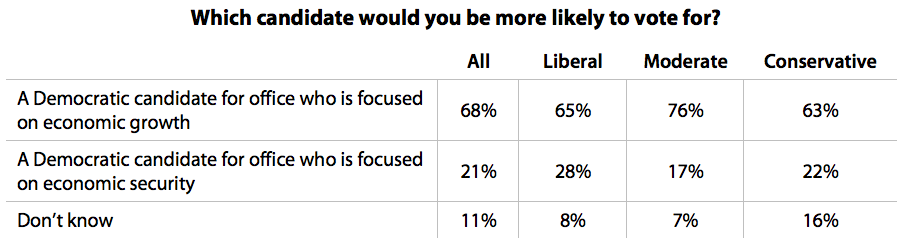
Moderates would rather a Democratic candidate focus on economic growth instead of economic security or income inequality. Liberals also prefer a message of economic growth over security. However, when economic growth and income inequality are compared, liberals are divided while moderates overwhelmingly select growth. While economic growth doesn’t alienate liberals, income inequality may fall on deaf ears for moderates.

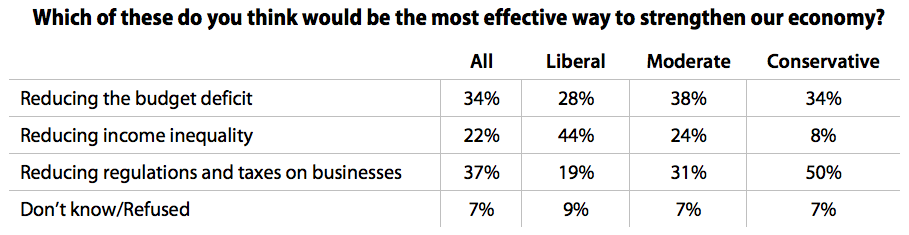
Liberals are also more likely than moderates to emphasize reducing income inequality as a way to strengthen the economy. A plurality (44%) of liberals think reducing income inequality would be the most effective policy while less than one-quarter of moderates agree (24%). Moderates prefer reducing the budget deficit (38%), followed by reducing regulations and taxes on businesses (31%), with reducing income inequality coming in last.
Moderates believe economic growth will benefit them personally.
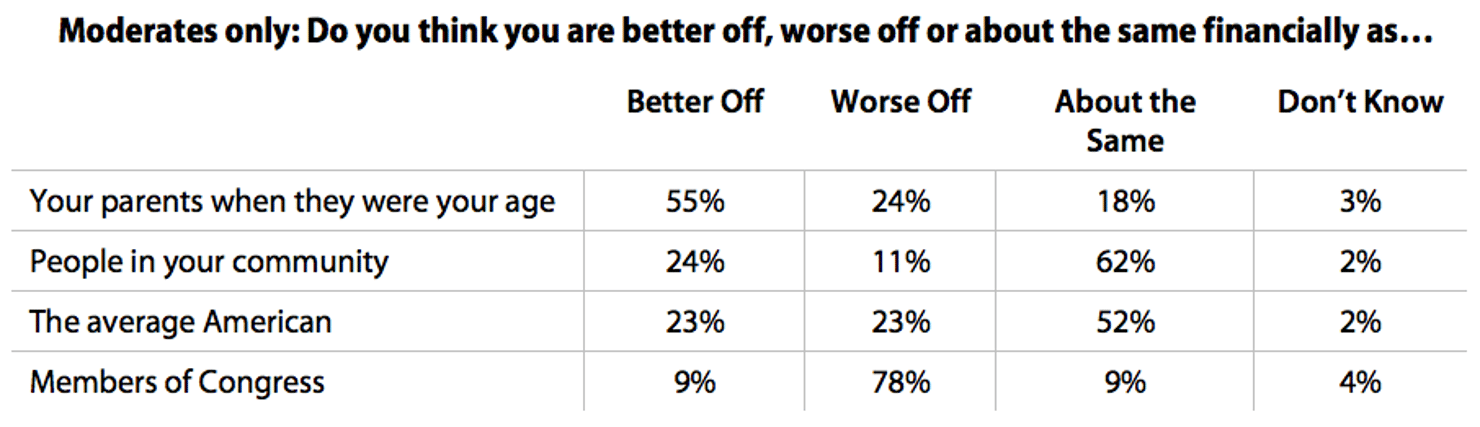
Moderates believe the world is unequal, yet they do not see themselves as victims of inequality. While 75% of moderates see an America divided into the “haves” and “have-nots,” only 25% place themselves in the latter category. Few moderates (28%) think the deck is stacked against people like them. And 75% think they are financially better off (23%) or the same (52%) as the average American. With 85% of moderates believing hard work pays off, a framework for growing the economy suggests expanded opportunities for individual achievement.
By contrast, a focus on income inequality implies to moderates that the problem to be solved is how the economic pie is divided—not on increasing its size. If you believe you are a “have,” and the message you hear from politicians is that we need to reduce income inequality, you likely see yourself as losing—not benefitting—from those policies. This doesn’t mean that moderates feel their economic circumstances are excellent. They overwhelmingly agree (85%) with the statement that “a middle class job doesn’t buy a middle class life anymore” which places many moderates in the position of both seeing themselves as a “have” and feeling squeezed. But they do not believe income inequality fixes that problem. In fact, moderates’ biggest concern about Democrats being in control of government is increased government spending on programs from which they see no benefit to themselves or their families. Worse, moderates see politicians as elites who benefit from the system they designed—making those same politicians poor messengers on inequality, unlikely to be trusted to more fairly divide the economic pie. In our poll, 78% of moderates said they were worse off financially than Members of Congress.
Economic opportunity is achievement-oriented.
Equal opportunity for success is a cornerstone of the American Dream, and moderates connect opportunity with economic growth. Moderates believe the best way to grow the economy is through opportunity, far outstripping economic security or increased freedom. Two-thirds of moderates support greater economic opportunity for Americans to succeed through hard work—a position with which liberals also agree. While one-quarter of liberals emphasize security, only 13% of moderates agree. Giving Americans greater freedom to make it on their own is popular among conservatives (31% support) but falls flat with moderates (17%).
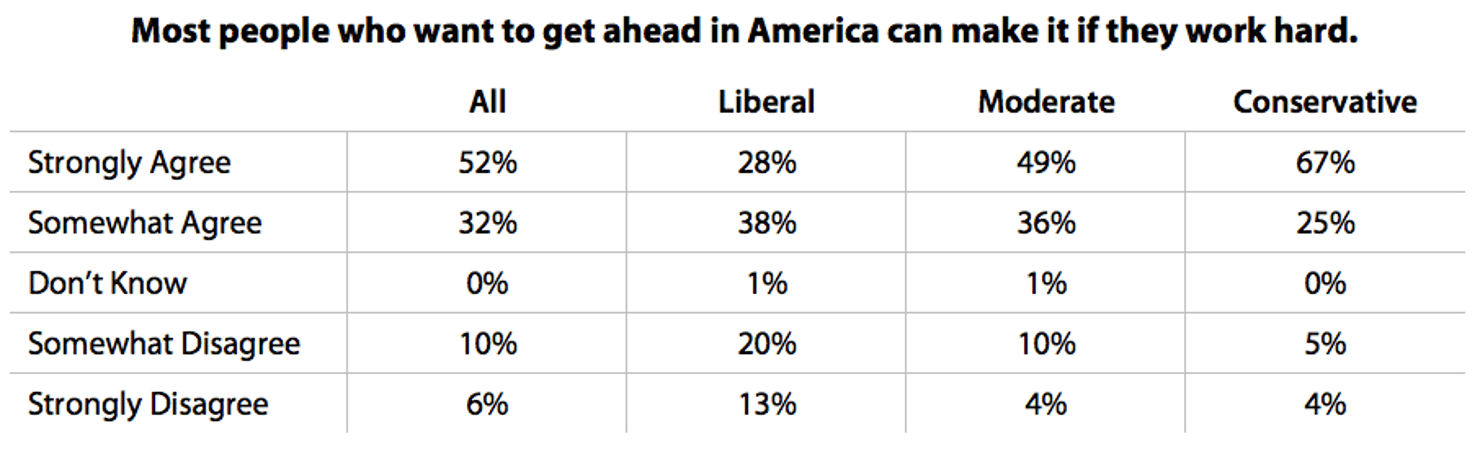
Opportunity appeals to moderates’ values—85% believe that most people can get ahead in America through hard work—and offers tools for success. And while moderates are torn about how much the government should be involved in the economy, 84% agree that the government has an important role to play in ensuring equal opportunity.
Conclusion
The Democratic coalition is apportioned fairly evenly between liberals and moderates. Owing to the greater number of conservatives than liberals in the electorate, Republicans rely much less on moderates—they make up only 26% of the Republican coalition. While income inequality has been growing in the U.S., voters in the center see themselves as “haves,” not “have-nots,” and aren’t motivated by appeals to increase economic security or reduce inequality. Rather, they view growth as crucial to our economic strength. An emphasis on economic growth and opportunity resonates with moderates and doesn’t alienate liberals—making it an ideal message for the ideologically diverse Democratic coalition.
Appendix






Endnotes
Pete Brodnitz of the Benenson Strategy Group conducted a poll of 1500 registered voters, with an oversample of 800 moderates, April 14–18, 2014. The margin of error for the poll is /-2.53 for all and higher for subgroups. Data for the poll questions discussed herein are located in the Appendix.
Pete Brodnitz of the Benenson Strategy Group conducted a poll of 1500 registered voters, with an oversample of 800 moderates, April 14–18, 2014. The margin of error for the poll is /-2.53 for all and higher for subgroups. Data for the poll questions discussed herein are located in the Appendix.

More in Politics
View all Politics
What Do Moderates Want on Economic Issues? Growth.

The State of the Center