Memo Published April 23, 2026 · 5 minute read
Economic Stress Test: How Trump Has Stretched Americans to the Limit
Takeaways
“Americans hate the 2026 economy,” was the headline of an April 13 Axios piece. Fewer than one-fourth rate the economy as either excellent (2%) or good (21%), says a separate April 3 University of Massachusetts-Amherst poll. Fifty-eight percent believe the US economy is getting worse, a recent YouGov poll finds.
The stock market is up and unemployment is low, so why are Americans so pessimistic about the Trump economy? To find out how Americans are doing, we looked at economic data from business sources that do not have a dog in America’s partisan political fight—the Federal Reserve, trade association and industry reports meant to guide companies and investors, business news outlets, and corporate consulting firms helping clients gauge the markets. We found:
- Americans are burdened by record personal debt resulting in rising delinquencies and loan defaults.
- The cost of family essentials is increasing—from gas tied to the Iran War to health care tied to Trump’s refusal to extend Obamacare subsidies.
- Household financial cushions are shrinking to multi-year lows leaving families little buffer between stability and calamity.
- Consumers are pulling back in anticipation of hard times over good times.
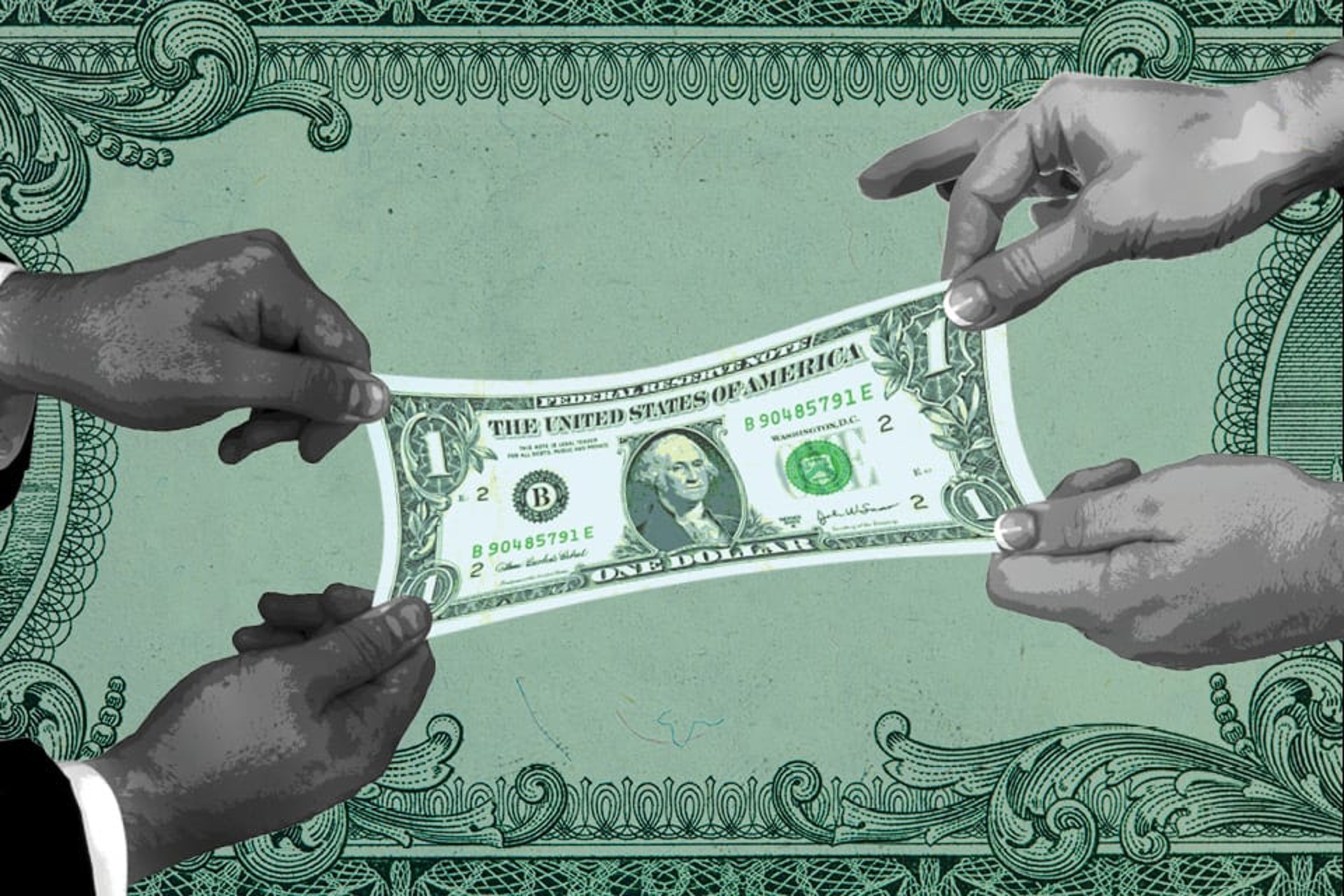
The S&P may be setting records, but Trump actions—imposing steep tariffs, ending Obamacare credits, reducing electricity supply by stopping clean energy projects, miscalculating Iran’s response to US attacks, and overall economic uncertainty fueling high interest rates—have stressed the average American to the breaking point.
Personal Debt Rising: Record Personal Debt, Rising Delinquencies and Defaults
“Delinquency worsened in Q4 2025, with 4.8% of outstanding debt in some stage of delinquency.” –New York Federal Reserve
Americans owe a lot of money, are behind on payments, and are increasingly crossing into default territory.
- Household debt reached an all-time high of $18.8 trillion at the end of 2025, according to the New York Federal Reserve's February 2026 report.
- Non-housing debt at the end of 2025—meaning credit cards, car loans, student debt, and home equity loans—surpassed the $5 trillion mark for the first time ever.
- Seriously delinquent loans (at least 90 days past due) have doubled since the end of 2024, led by student loan delinquencies and followed by mortgages and home equity loans, the New York Fed finds.
- More than 20 million households are behind on their utility bills, the National Energy Assistance Directors Association reported in August 2025.
- The average overdue balance on utility bills jumped from $597 in 2022 to $789 by mid-2025, The Century Foundation reported in November 2025.
- Bad medical debt and charity care at hospitals are climbing and are up 13% over 2023, said Kaufman & Hall Consulting in January 2026.
- Late rent payments ballooned from 8.8% of renters in 2024 to 11.7% by June 2025. Late rent payments (which rarely broached double-digits in the past) exceeded 10% every month in 2025, according to CRE Daily.
Rising Costs: The Price of Family Essentials is Relentless and Rising
“US consumer spending barely rose in February against a backdrop of persistent inflation that’s set to accelerate due to the Iran war.” –Bloomberg News, April 9, 2026
Americans have weathered inflation since the end of the pandemic, but prices keep rising—particularly the essentials that make up a middle-class life.
- Electricity prices are up 8% since mid-2024. Natural gas prices for households are up 13%, reported Deloitte Insights on March 31, 2026.
- Beef and veal prices are up 20.9% since mid-2024. Coffee, tea, and other beverage prices have risen by 15.2% according to Deloitte Insights.
- Gas prices at $4.09 on April 16, 2026 are 92-cents higher than the $3.17 per gallon average national price on April 16, 2025, according to AAA.
- The cost of health care coverage is expected to increase 8.5% in 2026 and is approaching inflationary levels not seen since before the implementation of Obamacare, PwC estimates.
- 30-year fixed mortgage rates have jumped to 6.39% and are up 40 basis points since the start of the Iran War and the resurgence of inflationary pressures, according to Mortgage News Daily. A rise of 40 basis points adds $940 per year for the cost of a $300,000 home loan.
- Seventy percent of farmers say that they could not afford all the fertilizer they needed due to spiking prices from the Iran War, an April Farm Bureau survey finds.
Shrinking Financial Buffer: Americans Straddling Stability and Calamity
“US consumers’ financial well-being dropped in 2025, according to Deloitte’s financial well-being index.” “The lowest-earning 60% of Americans are no better off than they were three years back.” –Deloitte, March 31, 2026
“Real disposable income declined 0.5%, the most in nearly a year, according to the BEA [Bureau of Economic Analysis].” –Bloomberg News, April 9, 2026
Pandemic-era government payments have dried up, and Americans are eating into savings.
- American household savings plummeted during the last half of 2025, falling $218 billion (19%), according to the St. Louis Federal Reserve.
- Only 47% of Americans have cash readily available to handle a $1,000 emergency expense, the BankRate Emergency Savings Report finds.
- Pawn shop lending is accelerating with share prices for the two largest publicly traded pawn shop operators at 5-year highs. The typical loan is in the $200 to $300 range. “‘I just need a little bit until I get paid,’ we’re hearing that more and more often,” said Janelle Morehart-Leevey, co-owner of Ponders Pawnbrokers, Bloomberg News reports in April 2026.
- US Consumer Confidence is the lowest in the 70+ years of the Michigan Consumer survey, the Wall Street Journal reports.
“When households are in the midst of or are anticipating financial hardship, they pull back on spending in an act of self-preservation,’ said Elizabeth Renter, senior economist at NerdWallet.” –Bloomberg News, April 9, 2026.
Conclusion
The stock market is flying, and the national economy continues to grow. That is of great benefit to the investor class but not the vast majority of Americans who have little-to-nothing in the stock market. Americans are sour on the economy—not because of partisan reasons that color their view but because their debts are growing, prices keep rising, and their savings are dwindling.