Polling Published July 30, 2026 · 8 minute read
Voters Want Accountability on Spending


Does the government waste your money? Democrats, Independents, and Republicans all agree: the answer is yes.
Affordability is the dominant word in today’s political debate. But Third Way’s new public opinion research points to another “A-word” that policymakers should take seriously: accountability.
In late June, Third Way and Impact Research surveyed 1,000 registered voters nationwide about government spending, focusing on their views of waste, fraud, and abuse.
- Affordability remains voters’ top concern, but government corruption ranks second.
- Voters, regardless of partisan affiliation, believe waste, fraud, and abuse are widespread across major federal programs. Democrats are most likely to think there is waste in military and defense; Republicans, in foreign aid and Medicaid; and Independents, in foreign aid and defense.
- Voters across party lines support measures to reduce waste, fraud, and abuse and are more likely to vote for a member of Congress who supports cost-cutting measures.
- Partisans differ on the goals of cutting spending: Republicans want savings returned to taxpayers; Democrats want savings to go to program beneficiaries; and many Independents want savings to reduce the deficit.
On government accountability, trust in both parties is bleak. President Trump receives poor marks on corruption and government abuse. Democrats are seen as not caring strongly about fraud and waste in government. Importantly, voters do not view attempts to promote government accountability as hostile to program goals or the role of government.
In short, voters are not asking government to do less. They are asking it to do better. They want proof that taxpayer dollars are being spent wisely, that programs are delivering results, and that those who allow waste or abuse the system are held accountable. For lawmakers looking to rebuild public trust, accountability is no longer optional—it is the starting point.
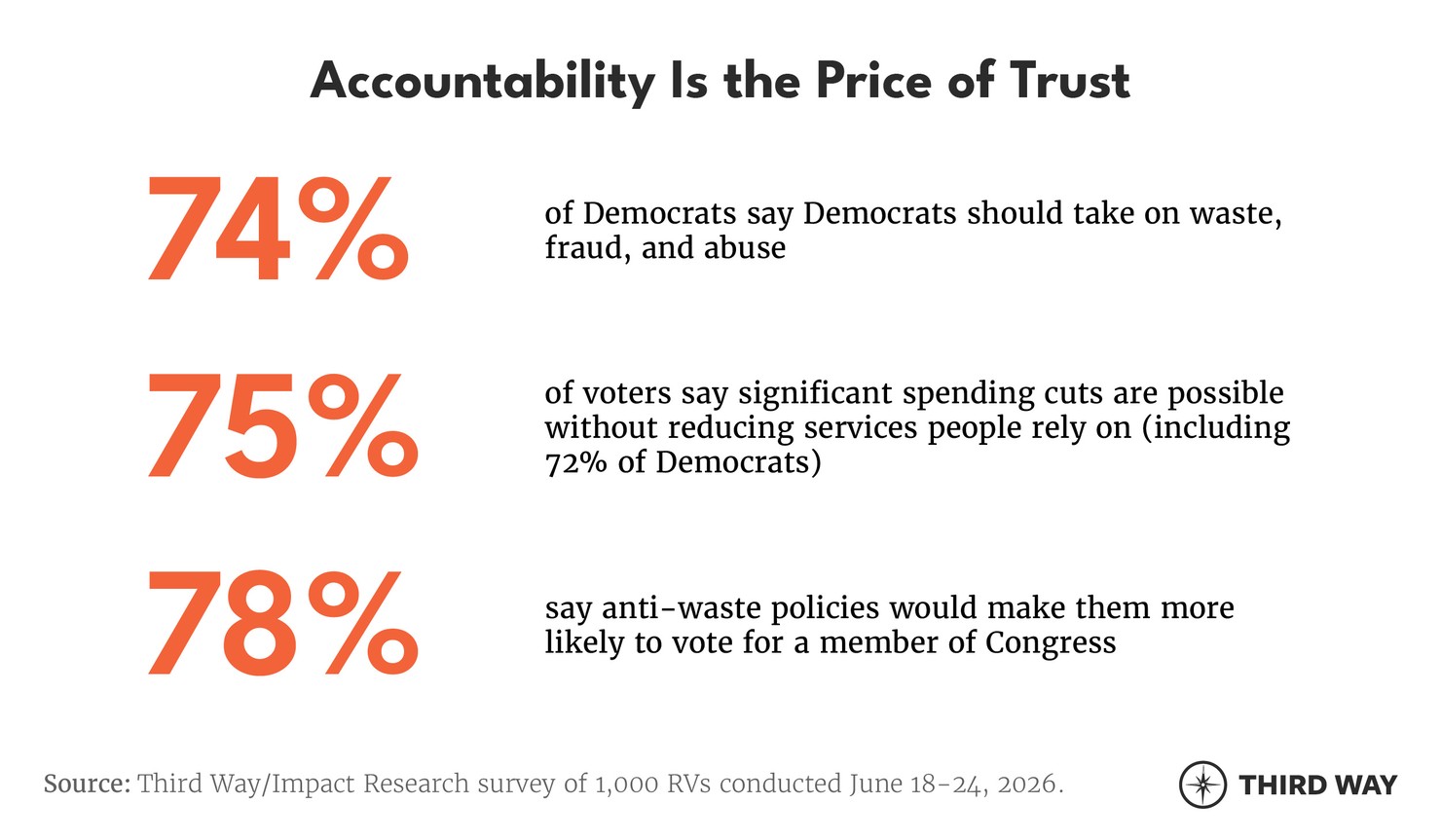
This memo highlights five key takeaways from the poll:
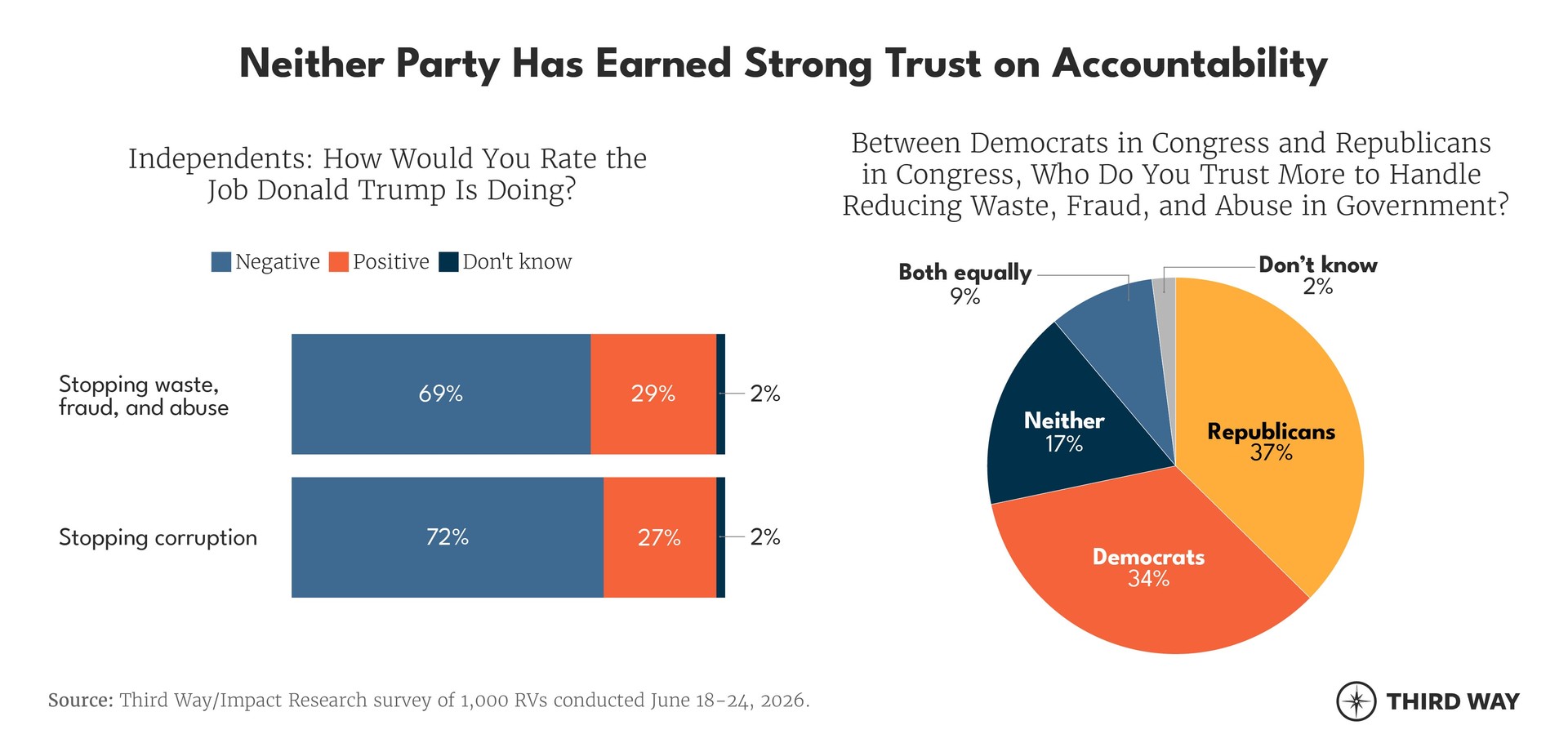
1. Trump Gets Bad Marks on Waste and Corruption, but Neither Party Enjoys Broad Public Trust on Accountability.
Waste and corruption are weak points for President Trump, especially with swing and independent voters. But the findings suggest skepticism extends beyond any single elected official. Voters are skeptical of Trump’s approach, but they also do not clearly trust Democrats to do better.
- Overall, voters rate Trump negatively on stopping corruption in government: 38% positive / 59% negative.
- Voters also rate Trump negatively on stopping waste, fraud, and abuse: 40% positive / 57% negative.
- Among swing voters, Trump is deeply underwater on corruption (25% positive / 71% negative) and on stopping waste, fraud, and abuse (29% positive / 67% negative).
- Independents are similarly negative on corruption (27% positive / 72% negative) and on waste, fraud, and abuse (29% positive / 69% negative).
- Yet voters still express slightly greater trust in Republicans than Democrats on reducing waste, fraud, and abuse (37% to 34%, with 17% trusting neither party).
- Democrats are only slightly ahead of Republicans on making government work better: 35% to 34%, with 18% trusting neither party.
2. Only the Hardcore Base Trusts Democrats
Waste, fraud, and abuse are not side issues. Voters are not simply asking whether Democrats support worthy programs; they are asking whether Democrats can make those programs work effectively.
- Overall, voters trust Republicans slightly more than Democrats on addressing corruption in government: 35% to 33%.
- Voters also trust Republicans slightly more than Democrats on reducing waste, fraud, and abuse: 37% to 34%.
- Independents are split on the issue, reinforcing that neither party has fully earned credibility on government accountability. On corruption, 28% trust Democrats more, compared with 22% who trust Republicans more; on reducing waste, fraud, and abuse, the parties are tied at 30% apiece.
- The trust problem also shows up inside the Democratic coalition: not-so-strong Democrats are much less likely than strong Democrats to trust Democrats in Congress on reducing waste, fraud, and abuse: 49% vs. 75%.
- Similar gaps inside the Democratic coalition show up on corruption and broader economic trust.
Policymakers cannot assume that support for public programs automatically translates into trust that programs will be managed well. Democratic stalwarts may give the party the benefit of the doubt, but softer Democrats and swing voters are less likely to do so.
3. Voters See Waste in Popular Programs
Voters believe waste exists across nearly every major part of government, including many popular programs. That does not mean voters want those programs gutted. In fact, the vast majority (75%) believe it is possible to cut government spending without reducing services people rely on.
- 62% of voters say Medicare loses at least some money to waste, fraud, or abuse (30% say it loses a lot).
- 65% say the same about Medicaid (35% say a lot).
- 54% say the same about Social Security (25% say a lot).
- 63% say infrastructure spending has a lot or some waste (26% say a lot).
- 54% say scientific research has a lot or some waste (20% say a lot).
- 65% say military and defense spending has a lot or some waste (31% say a lot).
- 76% say foreign aid has a lot or some waste, the highest of any program tested (46% say a lot).
The partisan differences are revealing. Republicans are much more likely than Democrats to see waste in Medicaid (81% vs. 49%), Medicare (75% vs. 50%), Social Security (64% vs. 43%), and scientific research (66% vs. 45%). But notable shares of Democrats still see waste across these programs.
Notably, defense reverses the usual partisan pattern. Democrats are more likely than Republicans to say military and defense spending has a lot or some waste (75% vs. 57%). Foreign aid is also viewed as wasteful across the spectrum, including 68% of Democrats, 85% of Republicans, and 72% of independents/leaners.
4. Democratic Voters Support Addressing Waste, Fraud, and Abuse
Some pundits worry that talking about waste, fraud, and abuse validates the argument that government does not work. Our polling shows that Democratic voters do not agree. They believe Democrats should address the issue directly:
- By 74% to 16%, Democrats say their party should address waste, fraud, and abuse because doing so would make more tax dollars available to help people, instead of avoiding the issue because it plays into the Republican narrative.
- This view is shared equally across the Democratic coalition: 74% of strong Democrats and 74% of not-so-strong Democrats say Democrats should take on waste, fraud, and abuse.
- Only 17% of strong Democrats and 15% of not-so-strong Democrats say talking about the issue plays into the Republican narrative.
Simply put, Democratic voters are saying the best way to protect government’s ability to help people is to make sure it works.
5. Accountability isn’t Austerity
The poll also tested six approaches to stopping waste, fraud, and abuse.1 The strongest anti-waste message focused on accountability: holding contractors, officials, and politicians responsible when they cheat taxpayers or abuse public power.
The top-testing approach said: “Waste and fraud keep happening because the people writing the rules benefit from it. Contractors overbill by millions and get another contract, officials misuse government funds and keep their jobs. We need to add accountability so anyone who defrauds taxpayers goes to jail, any contractor that cheats gets banned, and any official who abuses their position gets fired and prosecuted.”
The same pattern shows up when we tested nine specific ways to limit waste, fraud, and abuse. The highest-testing ideas were practical accountability reforms:
- 89% support requiring government agencies to identify, minimize, and recover overpayments and report it each year to the public.
- 88% support strengthening whistleblower protections for anyone who reports the fraudulent use of government funds.
- 88% support banning any politician or government official convicted of fraud in court from ever holding a federal job again and stripping them of taxpayer-funded benefits like retirement and health care. This policy had the most intense support.
- 85% support requiring all government agencies to pass a full, independent audit or else return 1% of their budget to the Treasury for deficit reduction.
- 84% support increasing the criminal penalties for anyone convicted of defrauding the government.
- 84% support setting a cap on administrative and overhead expenses in each government agency.
- 82% support banning corporations and their lobbyists who receive taxpayer-funded contracts from contributing to political campaigns.
- 80% support requiring the Department of Defense to pass a full, independent audit or else return 1% of its budget to the Treasury for deficit reduction.
- 64% support using artificial intelligence to track spending to hunt down and eliminate misspent tax dollars in every agency and department across the federal government.
Voters are asking for proof that public dollars are protected, programs are managed well, and people who exploit government face consequences.
* * * * *
Our poll points to a clear feeling among voters: they want accountability to be a central part of governing—not treated as a mere slogan, a pretext for indiscriminate cuts, or an exercise in partisan axe grinding. They want support for effective public programs paired with concrete reforms that prevent fraud, recover misspent funds, strengthen oversight, and impose real consequences on officials, contractors, and other bad actors. Voters want government to work better, protect public dollars, and begin earning back trust.