Climate & Energy Communications Cheat Sheet 11/2/18

Ahead of the midterm elections next Tuesday, we thought it would be a great time to look at a handful of candidates who could emerge as prominent climate leaders in 2019 and beyond--here we’ve focused on two House and two Governor’s races.
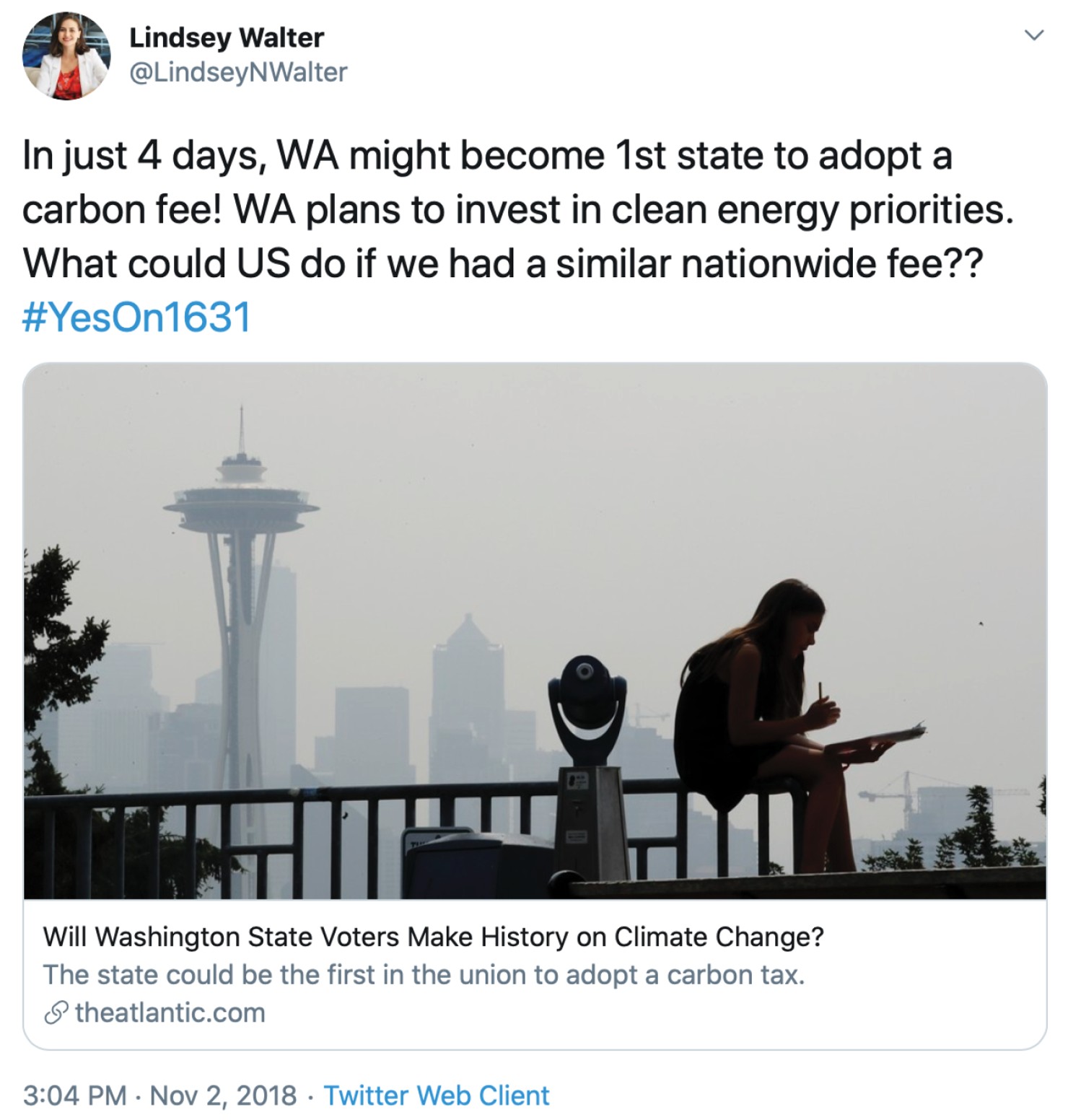
We also wanted to highlight the Washington State Carbon Emissions Fee and Revenue Allocation Initiative (Initiative 1631) on the ballot in that state this year, as it’s a really big deal.
Obviously, this note is not comprehensive, but it shines a light on candidates and energy/climate policies that are definitely worth checking out:
House of Representatives
Nevada 4th
Who: Steven Horsford, a native Nevadan, is the Democratic candidate for the Nevada 4th congressional district, which includes most of northern Clark County. He represented the district in 2013-2015 and served on the House Natural Resources Committee, but lost his re-election campaign. During the 113th Congress.
On Climate & Energy: Prior to serving in the US House, Horsford served as Majority Leader in the Nevada Senate, where he was a champion of clean energy and climate policy. He authored the Clean Energy Jobs Initiative, which helped with workforce training to place Nevadans in clean energy and energy efficiency jobs. And thanks to his efforts, the Nevada legislature was able to pass a 25% renewable portfolio standard. Given his commitment to clean energy, Horsford has earned the endorsement of a variety of environmental organizations like the League of Conservation Voters. Should he win on Tuesday, we can expect him to continue pushing for low-carbon energy solutions and land conservation.
The Latest: FiveThirtyEight says this is a lean Democratic district and has Horsford up more than 7 points over his Republican challenger.
Florida 26th
Who: Debbie Mucarsel-Powell has an incredibly powerful story, having emigrated to this country with her mother and sisters from Ecuador seeking a better life. She worked through high school, put herself through a political science undergraduate program, and eventually graduate school. She then worked for non-profit organizations such as the Hope Center, Zoo Miami Foundation, and the Coral Restoration Foundation in efforts to ensure everyone has access to opportunity.
On Energy & Environment: Previously, Mucarsel-Powell worked with the Coral Restoration Foundation, which invested in clean energy, reducing carbon emissions, and updating infrastructure in South Florida. With the red tide becoming a major issue this cycle in the Florida Gubernatorial and Senate races (Hello, “Red Tide Rick”), Mucarsel-Powell says, “the only thing that counts is immediate and effective action to invest in green energy, reduce carbon emissions, and update infrastructure that will protect South Florida from sea level rise.”
Mucarsel-Powell’s previous environmental credentials not only allow her to speak authoritatively about environmental issues but also authentically, making her one to watch should she defeat incumbent Rep. Carlos Curbelo.
The Latest: FiveThirtyEight says that Mucarsel-Powell has a very slim lead on Curbelo, but that she has 5 in 9 chance of flipping the seat in this “leans Democratic” district.
Gubernatorial
Florida
Who: Andrew Gillum is the current mayor of Tallahassee, Florida and running in an open race as the Democratic candidate for Governor. This is one of the most watched races in the country, given the GOP’s long hold on state politics; stark differences between the leading candidates on the economy, environment, education, and pretty much every other issue you could imagine; and the GOP candidate’s alignment with President Trump.
On Clean Energy & Environment: Gillum has a strong stance on protecting the environment, focusing on urgent issues like the red-tide phenomenon that is killing fish populations along the Florida coastline. He also wants Florida to take advantage of its huge potential for carbon-free power, by investing more in solar and other clean energy technologies. Frank Jackalone, director of the Sierra Club’s Florida chapter, said, “Gillum established a strong track record of environmental protection while Mayor of Tallahassee. He has a wonderful, refreshing vision for protecting Florida’s natural treasures, combatting the causes of climate change, and ensuring clean air and water for our families and our wildlife.”
The Latest: Most polls have Gillum with a 2-3 point lead over his Republican challenger, Congressman Ron DeSantis. That’s within the margin of error, and DeSantis has been closing in on the wide lead Gillum enjoyed after the candidates’ recent debates.
Colorado
Who: When Jared Polis, was only 11 years old he spoke before his city council, urging them to protect a canyon near his home in Colorado from the proposed development. This marked the start of a lifetime advocacy and action to protect the environment, including as the current representative of Colorado’s 2nd congressional district.
On Clean Energy: Since first elected to Congress in 2008, Polis has sponsored a number of conservation bills and pushed for renewable energy requirements. He intends to provide the same type of bold and ambitious leadership on clean energy and climate if he becomes Colorado’s next governor. This will be particularly interesting, as Polis acknowledges the challenge of moving a fossil-rich state like Colorado to a cleaner future. Definitely, one to watch.
The Latest: Most polls have Polis at a 5-8 point advantage over his Republican challenger, Colorado State Treasurer Walker Stapleton.
State Ballot Initiative
Washington's I-1631
What: Per Ballotpedia, a YES on I-1631 will enact a carbon emissions fee of $15 per metric ton of carbon beginning on January 1, 2020; increase the fee by $2 annually until the state's greenhouse gas reduction goals are met; and use the revenue from the fee to fund various programs and projects related to the environment and aggressively addressing climate change.
Why: Washington would be the first state in the nation to pass a carbon fee, and could set a strong precedent for other states to continue stepping up while the Trump Administration fails to act on climate change. Last week, David Roberts of Vox took a deep dive (along with some great graphs and maps) into the Initiative and the numerous opportunities it would create if passed, saying: “The result would be a rolling wave of investments across the state, to the tune of around a billion dollars a year, for decades to come.”
It’s also noteworthy that Washington has chosen a policy mechanism that allows a wide variety of carbon-free resources to help solve the problem. As Bill Gates noted in his endorsement of I-1631, a carbon fee would incentivize new renewables in Washington, but also support the hydro and nuclear facilities that are already helping keep the state’s emissions low. With this approach, Washington would be joining a trend among climate leaders toward technology-inclusive policies (as we’ve recently seen in New York, California, New Jersey, Massachusetts, and Illinois).
The Latest: The YES position led the opposition by 14 points in a poll from early October and has drawn validators like Washington state Governor Jay Inslee, Vermont Senator Bernie Sanders, Bill and Melinda Gates and groups as diverse as the NAACP Spokane Chapter, League of Women Voters, American Lung Association, and the Nature Conservancy. But the NO campaign, driven primarily by major oil and gas companies, has been pouring money into ads and outreach to mislead and scare consumers in the state. Spending $31.3 million compared to the $15.5 million raised by I-1631’s supporters could make a big difference in the final outcome, unfortunately.
There’s still time to give these candidates and initiatives a boost. If you are interested in getting involved in any of these races on your personal time, please feel free to reach out on your personal account and we’d love to share more details about how you can help out in these final few days!

Downloads
Latest Publications
On Permitting Reform: How To Talk About BAAJA
Past the Pump: How Americans are Footing the Costs of Trump’s War of Choice
EIA is Under Attack. That’s Dangerous for the Entire Energy Sector.
On the Grid: PERMIT Me to Celebrate
Never Miss an Update
Sign up for updates on the pragmatic, center-left ideas shaping the future of American policy.