Memo Published October 6, 2026 · 10 minute read
With Federal Support, Geologic Hydrogen Can Unlock an Energy Revolution

Takeaways
- Vast reserves of geologic hydrogen underground across the US1 could create a surge in energy production and economic growth akin to the shale gas revolution—if we’re able to unlock it.
- The unknowns for geologic hydrogen—technical viability, public safety, environmental quality—will be uneconomic for the private sector to unpack on its own.
- Federal support is essential to leveraging existing data, funding research, and creating a navigable regulatory environment for this nascent energy resource.
The Potential Behind Geologic Hydrogen
Nations around the world have taken a keen interest in developing geologic hydrogen, which is found underground and is extremely energy dense. Largely unconsidered by the scientific community and energy sector until an accidental discovery in 20122, its energy density and potential abundance have drawn global attention.34
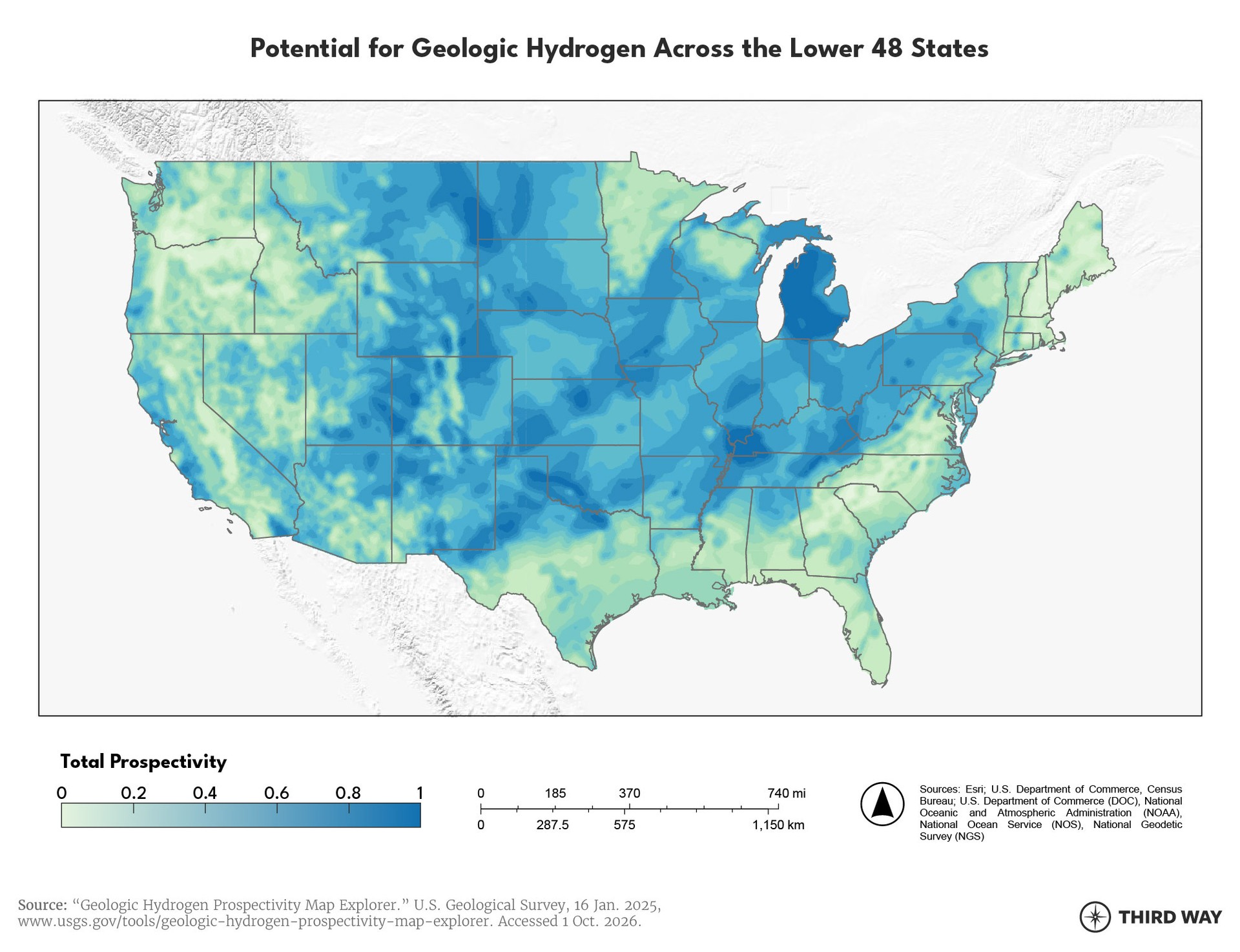
In January of 2025, the U.S. Geological Survey published a first-of-its-kind map5 to estimate the potential for geologic hydrogen in the lower 48. While the technically and economically recoverable volumes remain unknown, USGS researchers suggest they could be vast—“roughly twice the amount of energy in all the proven natural gas reserves on Earth.”6
If commercialized, it could not only reduce costs for the sectors that already use commercial hydrogen supplies today,7 including agriculture and oil refining, but could unlock nascent applications for hydrogen in hard-to-decarbonize sectors.
Some states, like Michigan,8 are taking this opportunity seriously. But the very notion that economically recoverable volumes of hydrogen might be trapped in the subsurface is new even to federal science agencies.
Not only are there no federal programs expressly dedicated to exploring the geologic hydrogen, but the terms “geologic hydrogen” and “natural hydrogen” do not appear in any federal statute and have apparently never appeared in a federal science agency’s budget request.
For the US to compete internationally, the federal government must play a role. That means increased funding for research and development, unearthing the massive amounts of data already gathered by USGS, states, and industry, creating regulatory clarity for the hydrogen industry.
With this support and its expertise in mining and energy production, the US can be the global leader in the first new form of primary energy in nearly a century.
Current Outlook of Commercial Hydrogen
Hydrogen producers around the globe make about 100 million metric tons (Mt) of hydrogen each year, with the United States responsible for about 10 Mt. The vast majority is produced through steam methane reforming,9 or SMR. SMR applies high-temperature steam and pressure to methane, which is cheap and abundant in the United States, in the presence of a catalyst. What results is a pure stream of hydrogen—the most energy-dense substance (by weight) on the planet—but also a large carbon dioxide (CO2) byproduct.
Hydrogen can then be compressed and shipped via liquid tanker trucks or gaseous tube trucks. But hydrogen’s energy density by volume is fairly low, making shipping largely impractical in today’s market. More often, hydrogen is used where it is produced. Hydrogen production plants are often co-located with an oil refinery. In the United States today, oil refining accounts10 for about 70% of hydrogen demand. Production of ammonia, which is used primarily to create fertilizers for crops, accounts for another 20%.
But hydrogen also has promising use cases for hard-to-decarbonize parts of the economy, including sustainable aviation fuel, maritime transportation, rail transport, and industrial sectors like glass, steel, and aluminum manufacturing.
To meet that demand, the value proposition of geologic hydrogen is significant. First, on cost: technical experts project that if a large subsurface hydrogen resource is discovered, the cost of exploiting it in terms of $ per kilogram of hydrogen will be lower than other hydrogen production pathways. It will likely be significantly less expensive to capture and store geologic hydrogen than electrolytic (green) production, and either on par or less than the cheapest fossil derived (grey) hydrogen, which currently sells for roughly $1.50/kg11 domestically.
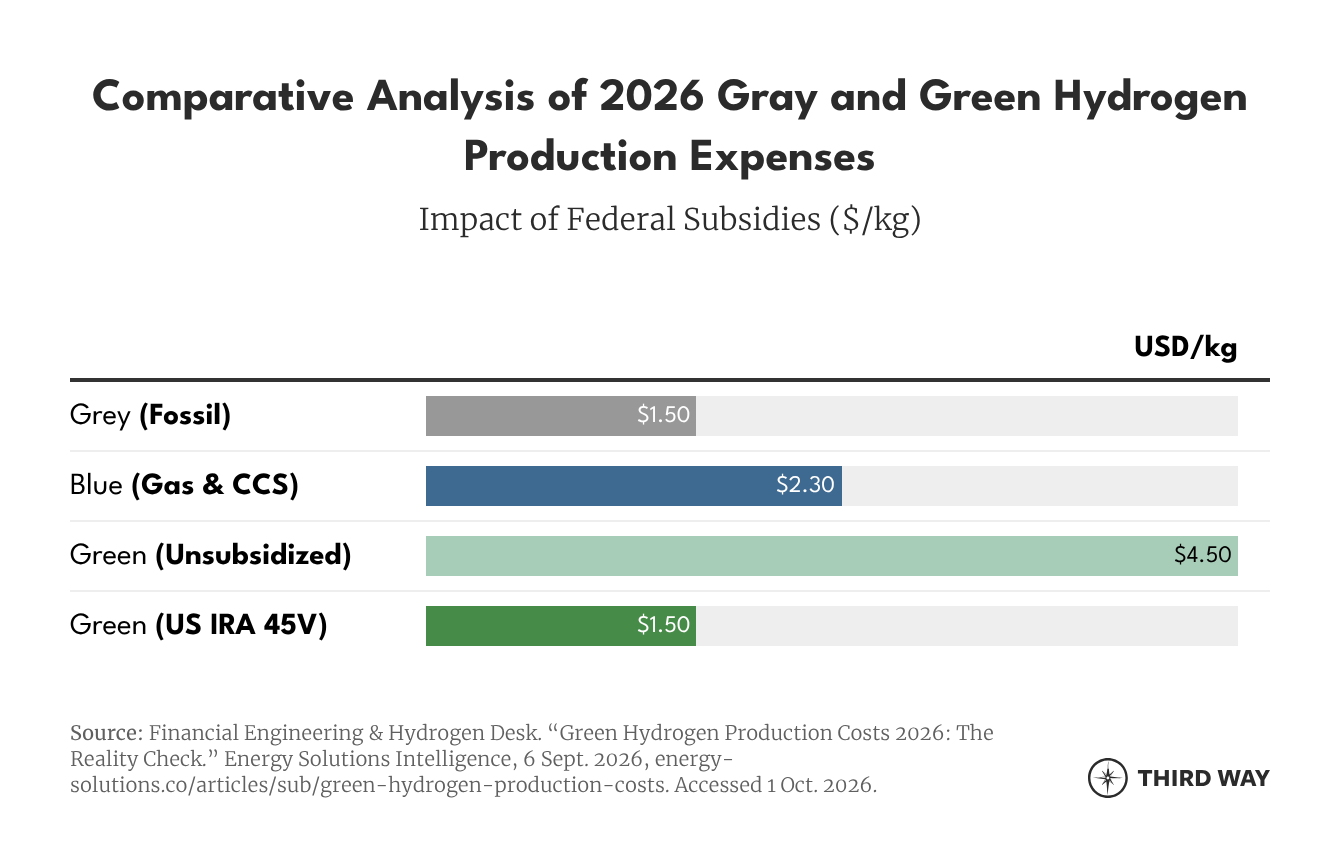
The Department of Energy’s Advanced Research Projects Agency-Energy (ARPA-E), which initiated an impactful program12 on geologic hydrogen research in 2024, has offered an informal estimate of 50 cents to $1.50 per kilogram as produced. The geologic hydrogen startup Eden GeoPower projected13 production costs of less than $1.00 per kilogram.
At these prices geologic hydrogen would beat the DOE’s ambitious “1-1-1” Hydrogen Earthshot target14—to reduce the cost of clean hydrogen production to $1 per 1 kilogram in 1 decade—right out of the gate.
This would be an 80% drop from average baseline prices, making clean hydrogen cheaper than natural gas.
The United States already has a mature industry for the transportation and offtake of hydrogen. That means that if extraction costs meet expectations, the consumers will come.
Policy Setbacks and Policy Paths Forward
With an eye toward the economic and climate opportunity, the Biden Administration oversaw a flurry of new federal resources and billions of dollars to expand the hydrogen economy and increase domestic production. This included seven15 regional clean hydrogen hubs spanning across 17 states, new funds for research grants, demonstration projects, and tax credits.
But in 2025, President Trump tried to shut the door on the clean hydrogen industry. His administration eliminated incentives,16 closed or froze funds for the hydrogen hubs,17 and even asked Congress to rescind remaining unobligated balances18 for all of the hydrogen programs funded by past legislation.
Despite these setbacks, federal policymakers don’t need to reinvent the wheel to help this nascent industry get started. The United States has a long legacy of success in leveraging its talent for innovation to take advantage of our abundant natural resources.
Success in geologic hydrogen requires three major lines of effort:
1. Use Existing Federal Dollars and Programs for Research and Development
The clear first step for the federal government right now is more research. The unknowns for geologic hydrogen are numerous, with questions about technical viability, public safety, and environmental quality all needing attention.
The easiest approach is to use what’s already available: substantial funding from the Infrastructure Investment and Jobs Act (IIJA) is still available at DOE. Despite President Trump's cuts, there is still at least $1.5 billion in unobligated, uncommitted funding available that could be leveraged, in part, for geologic hydrogen.
The law provided $500 million for Clean Hydrogen Manufacturing & Recycling, $1 billion for Clean Hydrogen Electrolysis, and $8 billion for Hydrogen Hubs. Under President Biden, DOE obligated about $7 billion of the Hubs funding and $850 million across the other two programs. That leaves at least $1.5 billion in unobligated, uncommitted funding available that could be leveraged, in part, for geologic hydrogen.
Additionally, policymakers could also look at DOE’s history of technology-specific test centers for nascent technologies. Going back decades, DOE has established location-specific technology “petting zoos” that support pilots of new technologies, training and education for engineers and site operators, technology transfer, and testing protocols and standards development. This approach has enabled profound innovation breakthroughs: DOE’s National Reactor Testing Station19 at Idaho National Laboratory led to the birth of the first Naval reactor in the 1950s, and the National Wind Technology Center in Colorado pioneered new airfoils for wind turbines that became the worldwide industry standard. More recently, the FORGE Enhanced Geothermal Test Center in Utah has helped reduce drilling speeds for EGS by 500%.20
2. Organize the Troves of Existing Data Sets
The USGS’s preliminary resource map is groundbreaking (pun intended). It illustrated for the first time how vast a hydrogen resource the United States may have under its feet. But the study’s authors point to the large remaining uncertainty about how exactly this hydrogen is distributed in the subsurface and where it could be economically recoverable. Far more data is needed to enhance the fidelity of the USGS’s map to provide true resource assessment and, ultimately, to de-risk physical exploration.
A multi-agency database of subsurface data—in common formats that play well with high-performance computing—could provide critical new insights not just on the opportunity for geologic hydrogen, but also for other sectors like critical minerals and materials, oil and gas, and geothermal.
The United States has drilled thousands of boreholes over more than a century, and together they contain a wealth of information. A modest amount of targeted federal funding to USGS and/or DOE would help leverage valuable data about the subsurface where it already exists, e.g., in the records developed and held by counties, states, private companies, and academic institutions around the country.
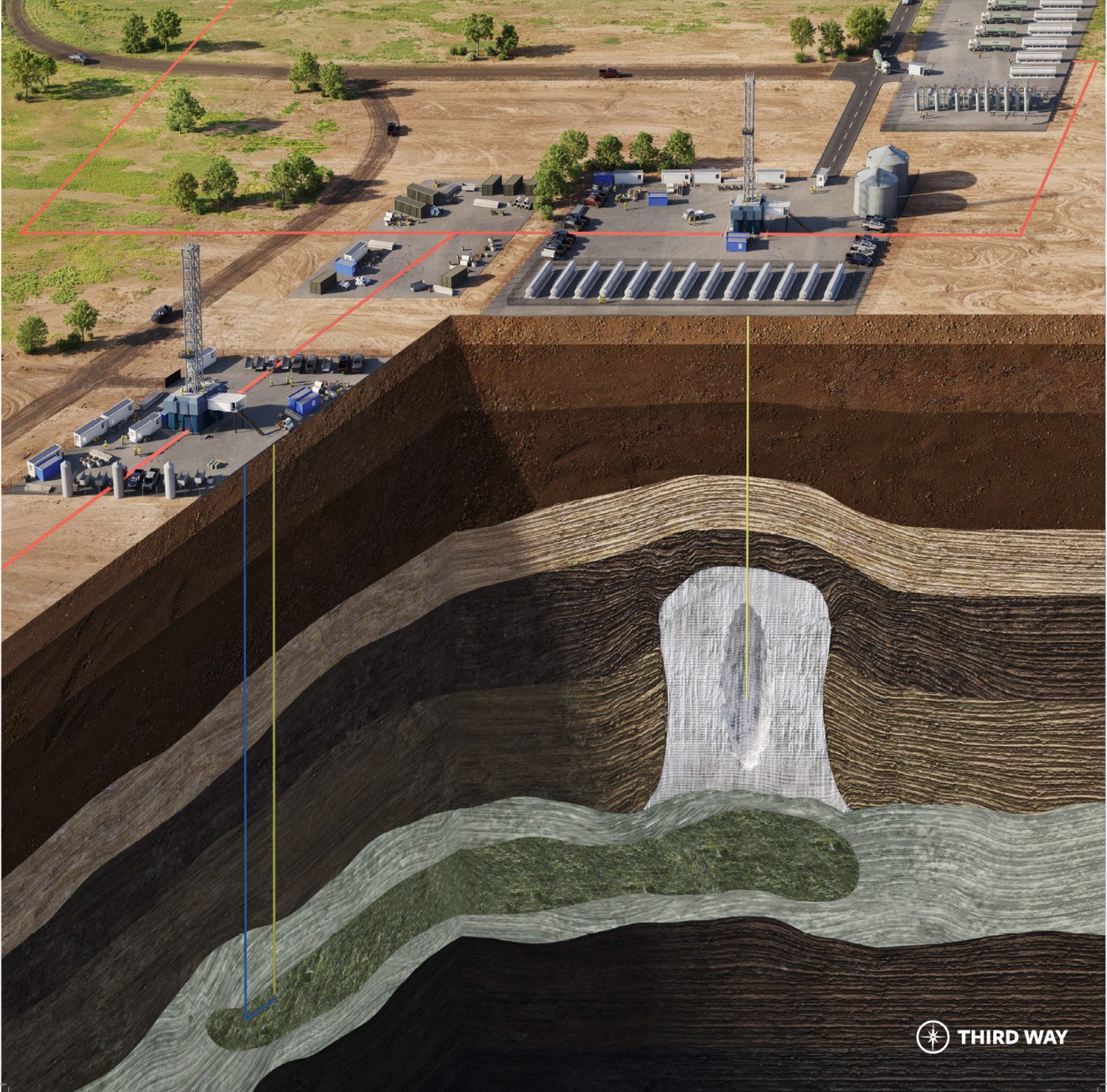
Many state geological surveys have detailed records from subsurface exploration going back decades, but only in paper format. A targeted funding effort to aggregate and digitize these materials into a common format could yield dividends. Private oil, gas, and geothermal companies also have extensive data from past exploration wells—information which at the time was largely irrelevant to their exploration campaigns but now could shed light on the likelihood of a viable subsurface hydrogen resource. Federal agencies, particularly DOE and USGS, could also examine the data sets it already controls across various program offices and national laboratories, which have not been consolidated effectively.
Senators Lisa Murkowski (R-AK) and John Hickenlooper (D-CO) and Congressmen Rob Wittman (R-VA) and Debbie Dingell (D-MI) have already recognized the potential of USGS’s subsurface data for geologic hydrogen in their respective reauthorization bills21 for the Earth MRI program. Both drafts call out geologic hydrogen specifically as a subsurface resource to be prioritized for characterization.
3. Establish Clear Regulations
Private sector developers want expediency and certainty when it comes to financing and building projects. A clear and navigable regulatory environment22 is paramount for enabling investment in new clean energy infrastructure, and geologic hydrogen is no exception. The industry needs a predictable, efficient system that protects public safety and the environment without unnecessary delays and backlogs, barriers, and exorbitant fees that punish the entrepreneur. The Environmental Protection Agency (EPA) and Department of Interior (DOI)—as well as state-level agencies—should look for opportunities to clarify the regulatory landscape for prospective developers of geologic hydrogen while making sure adequate oversight mechanisms are in place.
For example, there is no dedicated permitting pathway for the various types of subsurface hydrogen. Natural extraction, stimulated production, underground storage or hydrogen transport may each fall under different local rules from oil and gas,23 mining, geothermal, underground injection etc. Furthermore, current subsurface and groundwater protections are not tailored to geologic hydrogen. Regulators still need sector-specific approaches for well integrity, hydrogen leakage, groundwater contamination, geochemical reactions, induced seismicity, monitoring, closure, and financial responsibility.
The EPA already has identified underground hydrogen storage considerations,24 though these existing rules are largely adapted from natural gas storage and other injection regimes. Nevertheless, they can serve as a good starting point for defining a clearer permitting pathway for pilot wells and better coordination across states.
Conclusion
In less than 14 years from the first global discovery, geologic hydrogen has evolved from scientific obscurity into a serious energy opportunity with massive industrial applications. But like any new technology, resource, or industry, getting off the ground will be faster and more competitive with dedicated federal action.
By expanding targeted RD&D funding, aggregating state and private subsurface data, and establishing transparent regulations, policymakers can de-risk commercial exploration and position the United States as a global leader in this transformative clean energy resource.