Insights from Post-Debate Survey of Battleground Suburbs

Third Way, David Binder Research
Six months ago, Third Way launched a comprehensive public opinion project to dive deep into the views of suburban voters in the battleground states that will decide this election. As part of that project, we are fielding a series of tracking surveys to test the impact of Donald Trump’s attacks against Joe Biden in these key places. The arguments we are testing include that Biden is a Trojan Horse for the far left, that he is weak on crime, that he would crash the economy, and that it was Trump who acted decisively on the coronavirus. This poll is meant to warn if any of Trump’s messages begin to take hold in the final weeks before Election Day.

Our latest survey went into the field the morning after the first presidential debate, and it was in the field when the country learned of Trump’s positive coronavirus test. What follows are six quick insights from the data.
1. Biden expanded his lead in the suburbs post-debate, and the race remains stable despite Trump’s chaos.
Biden leads Trump by 15 points in our post-presidential debate survey of suburban voters in battleground states, and he is significantly outperforming Hillary Clinton’s 2016 numbers. Voters in the survey self-reported that they supported Clinton over Trump by a 46–43% margin in 2016. But now, Biden leads Trump by a 51–36% margin (55–40% w/ leaners). This is the first time Biden has broken the 50% benchmark in our research this year. Biden’s margin increased by six points from our pre-debate survey with the same population of voters, when he led Trump 46–37% (52–43% w/ leaners).
Since this survey was in the field when we learned Trump was diagnosed with coronavirus, we also looked at the horserace numbers pre- and post-announcement. Biden led before the country learned the president had coronavirus 48–38% (52–43% w/leaners). With voters polled afterward, he led 54–34% (57–38% w/ leaners). Future research will indicate whether this was a fleeting surge or a lasting shift in the race.
At this point, a remaining 16% of suburban voters in these key states are not yet fully committed: they only lean toward a candidate, are undecided, or recently changed their vote to Biden or undecided. These persuadable voters are the primary focus of the rest of this memo.
Despite the unrelenting chaos that is swirling around us, the defining feature of the race right now is stability—with Biden sustaining a solid suburban lead. Like in our pre-debate survey, Biden is still most vulnerable on Trump’s economic attacks—on taxes, jobs and small business, and the economic recovery. Persuadable voters are still uncertain on who would be best for the suburbs, and they believe Trump would be better on the economy. But Trump made few inroads between surveys and lost ground in some areas. For Biden, an expanding margin and otherwise stable race is great news three weeks out from Election Day.
2. Biden is still most vulnerable on an economic attack, but Trump isn’t effectively landing that argument.
Trump’s and allies’ most effective message against Biden in the suburbs is an economic one that says he would “raise taxes by $4 trillion,” “hurt small business,” and destroy the “rapidly improving economy.” It was the most effective attack in both our pre- and post-debate surveys, but it did not become any more persuasive from the first poll to the second.
Fifty-two percent of suburban voters in battleground states say that this economic message is “very” or “somewhat” concerning, which is nearly identical to the response in our pre-debate survey (53%). When they hear a Democratic counter-message on Biden’s “Build Back Better” agenda, 33% say it eliminates “all” or “most” of their concern (also 33% in the pre-debate survey). Trump’s message is more concerning with persuadable voters than with suburban voters overall, but that’s true by a narrower margin than in our pre-debate survey. Sixty-one percent of persuadable voters find it concerning (down from 66%), while 29% say the counter-message eliminates their concern (up slightly from 27%).
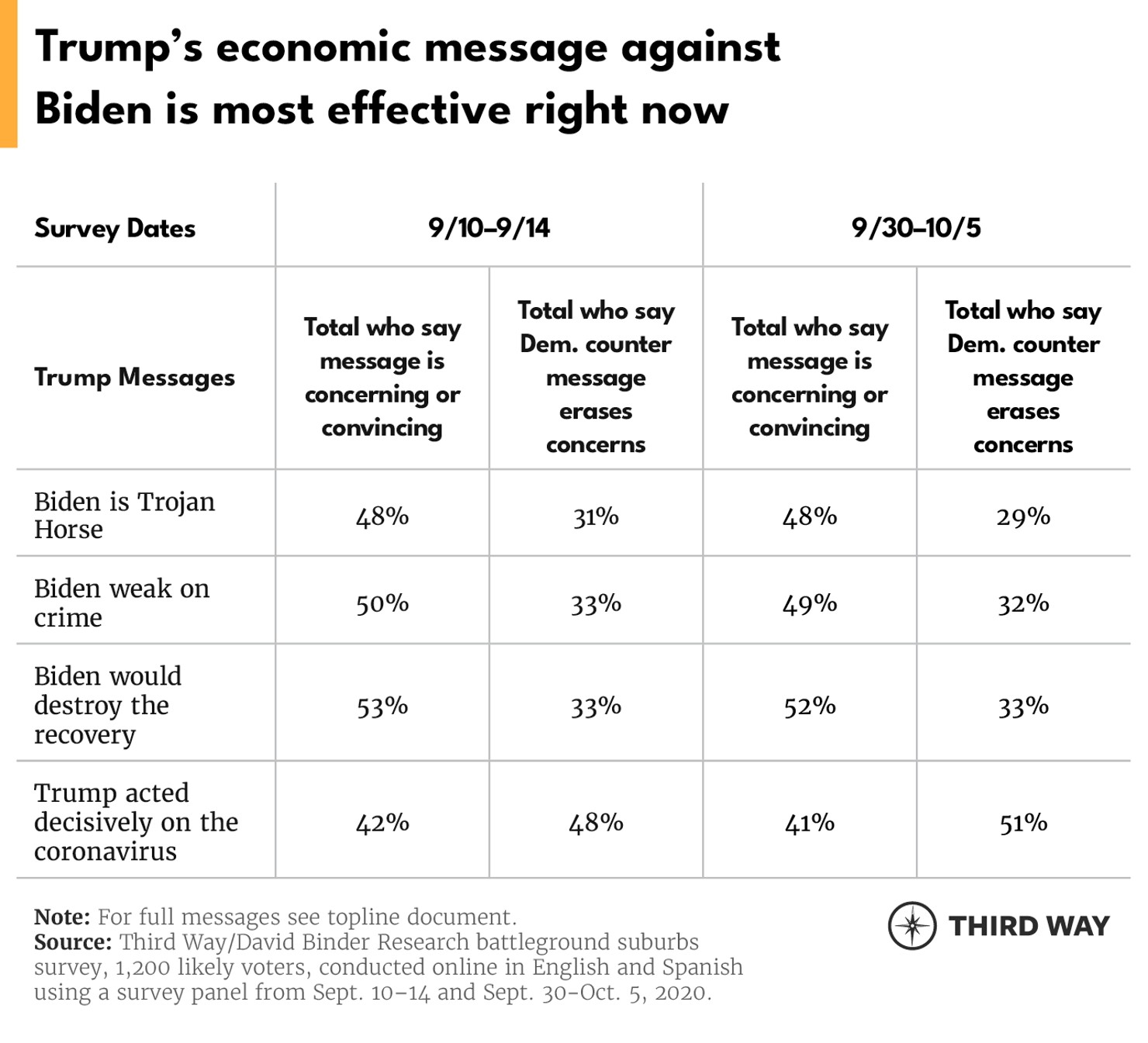
Trump’s economic message against Biden raises concerns with voters, but it is not reshaping the race. Our recent research on countering Trump on the economy showed that it is essential for Biden and Democrats to link an economic recovery to getting the virus under control. Biden’s most effective response on the economy may be equal parts linking back to the coronavirus and countering Trump’s specific lies on taxes, jobs, and small business.
3. Views on the protests are trending negative, but so are perceptions of Trump’s response.
The Black Lives Matter protests are an essential step toward achieving racial justice in this country, and voters in the suburbs of battleground states are largely aligned with the goals of that movement. But isolated incidents of lawlessness have caused some suburban voters to have a less favorable view of the protests as a whole, and this trend expanded between our pre- and post-debate surveys.
Overall, 42% of voters in the battleground suburbs say that their views of the protests have become more negative over the last three months compared to 26% who say their views have grown more positive (41–29% in pre-debate survey). Thirty-seven percent of persuadable voters have a more negative view compared to 24% who say more positive. But by a 51–41% margin, suburban voters say that Trump is inflaming the protests rather than calming them. This margin was 49–42% pre-debate. And persuadable suburban voters say Trump is inflaming rather than calming protests by a 44–38% margin.
Suburban voters overwhelmingly back Biden speaking out against lawlessness. Eighty-eight percent agree (74% strongly) with a Biden statement in which he condemns rioting and looting and calls for prosecutions of those who perpetrate it. Among persuadable voters, 85% agree (66% strongly). Supporting protesters’ goals while criticizing the behavior of the small number of bad actors is a winning formula for Biden with suburban voters.
4. Biden is undermining Trump’s threat that he would be bad for the suburbs.
Trump and his allies know the suburbs will be decisive this year, and so they are making dishonest claims that a Biden presidency would lead to crime and problems in these communities. But Biden is making progress pushing back against these spurious attacks.
Biden maintains a narrow edge on who would be better for the suburbs among these voters. He leads Trump 47–41% overall on this question and 32–30% with persuadable suburban voters. Pre-debate, he led 47–42% and persuadables were split at 28–29%. And Biden is continuing to successfully rebut Trump’s claim that a new administration would mean more crime and problems for the suburbs. In our pre-debate survey, suburban voters disagreed with this line of attack by a 50–43% margin, and persuadable voters were split 39–40%. But post-debate, the margin of all suburban voters disagreeing with Trump expanded to 52–39% and 46–33% with persuadables.
5. Biden continues to lead on most issues and positive qualities, but Trump maintains an edge on strength.
Between pre- and post-debate surveys, nothing fundamentally changed in suburban voters’ perceptions of who would be better on the issues. Biden continues to lead on most, although both candidates expanded their margins on issues where they already led. Biden increased his edge on suburban voters’ top issue, the coronavirus, from 15 to 19 points. And with persuadable voters in the suburbs, his lead grew from 24 to 30 points on this most crucial issue. On Trump’s most favorable ground, the economy, his advantage grew from six to nine points. He continues to have a large lead with persuadables on the economy, but it narrowed slightly from 35 to 31 points.
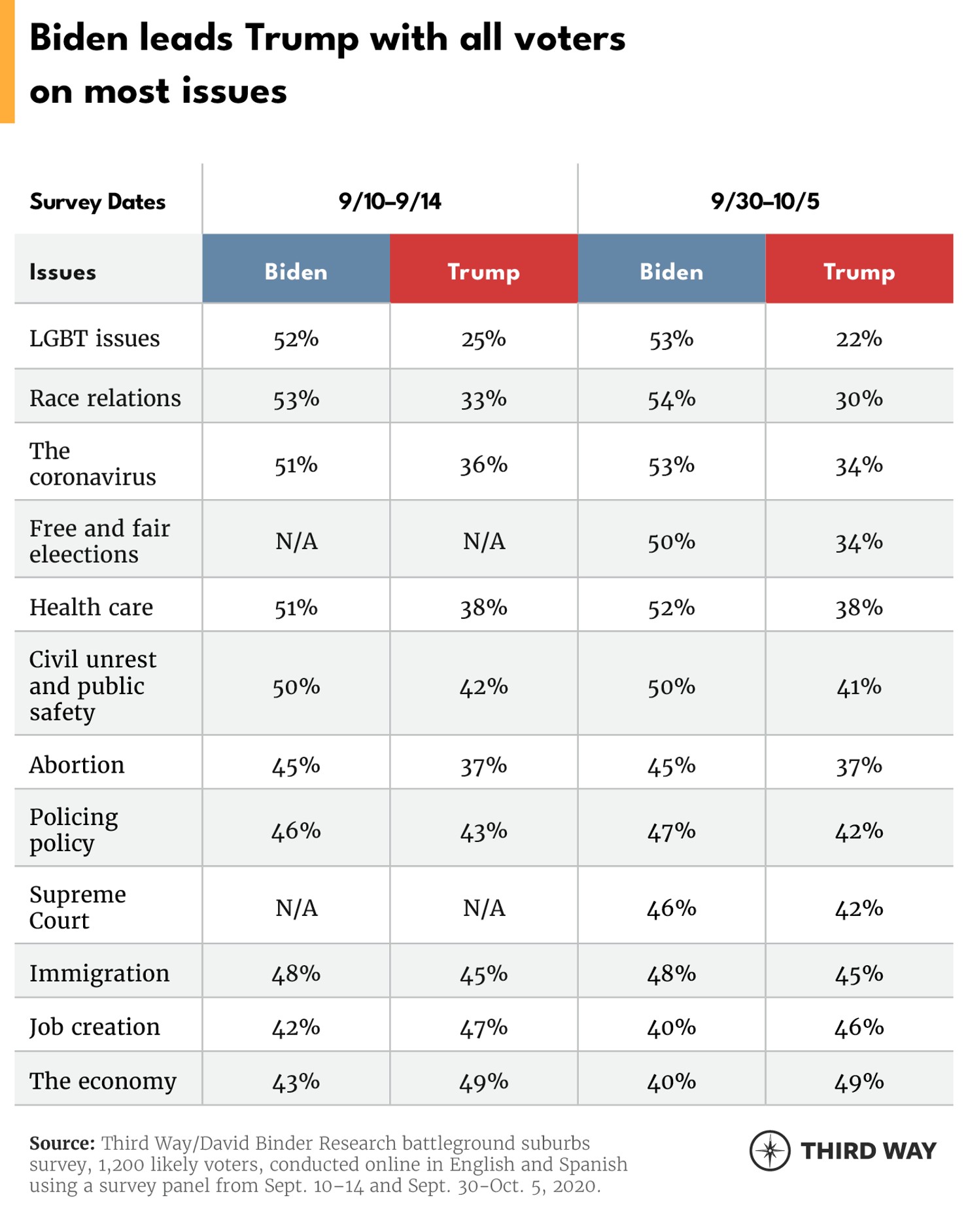
We added a new question in this survey to ascertain who would be better for “free and fair elections,” and Biden leads on that front by 16 points with all suburban voters and 19 points with persuadables. Suburban voters disapprove of Trump’s refusal to commit to a peaceful transition of power 61–32%. And when asked how it affects their vote choice, 46% of persuadable voters say that it makes them more likely to vote for Biden.
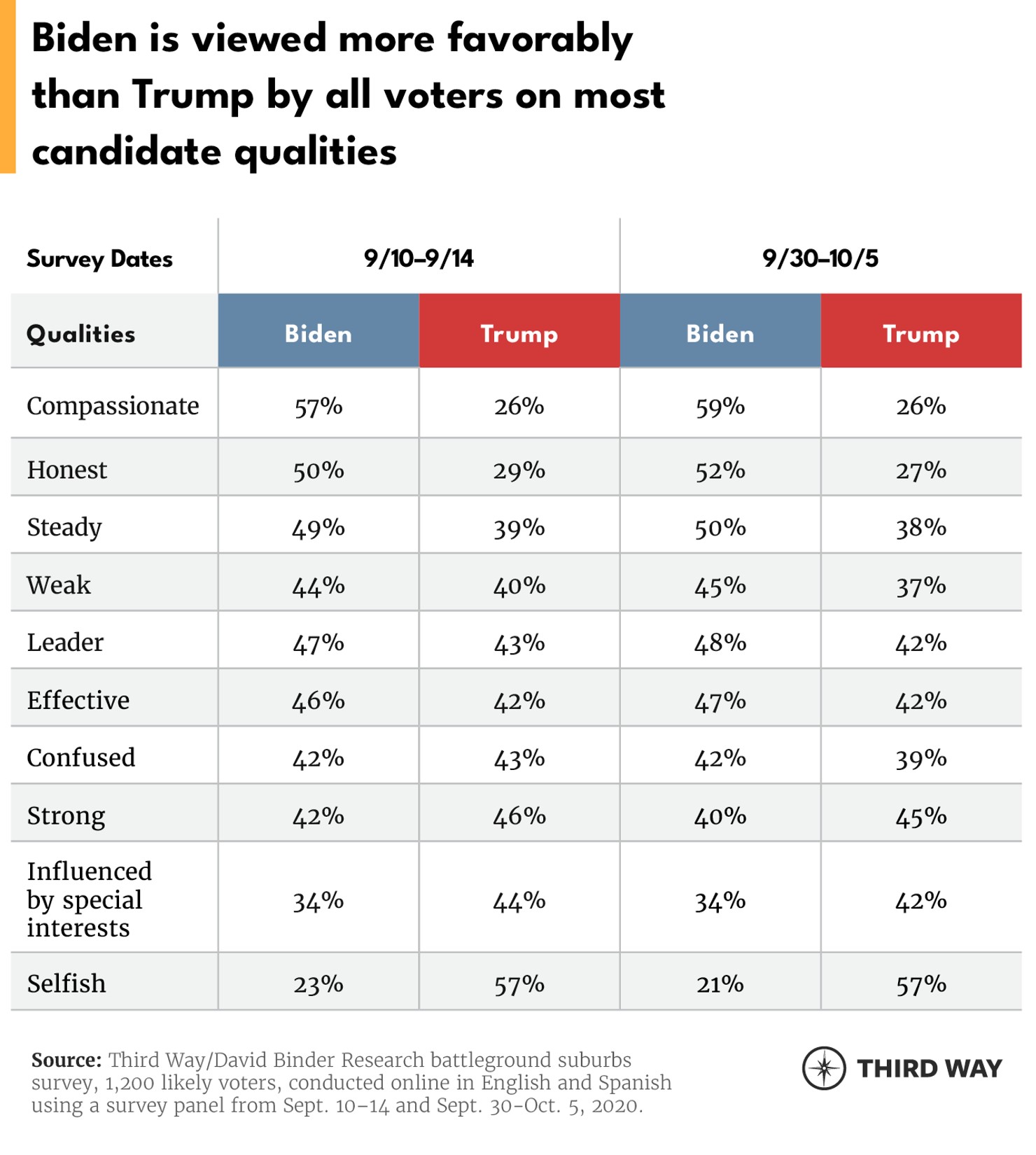
In our pre-debate survey, suburban voters said Biden better conveys “leadership” and gave Trump an edge on “strength,” while persuadable voters sided with Trump on both of those qualities. In our post-debate survey, all suburban voters again split with more saying Biden exhibits leadership and Trump strength, but Trump lost his leadership advantage with persuadable voters. Trump’s previous 11-point edge with persuadables on being a leader reversed to a four-point Biden advantage. The debate and other recent events have only grown Biden’s advantage as the candidate perceived as more honest and compassionate. But notably, after Trump harassed Biden, the moderator, and the nation in the debate, the margin of suburban voters saying Biden rather than Trump conveys weakness and confusion grew moderately—a data point we should continue to watch in the weeks to come.
6. Persuadable suburban voters are growing more comfortable with Biden.
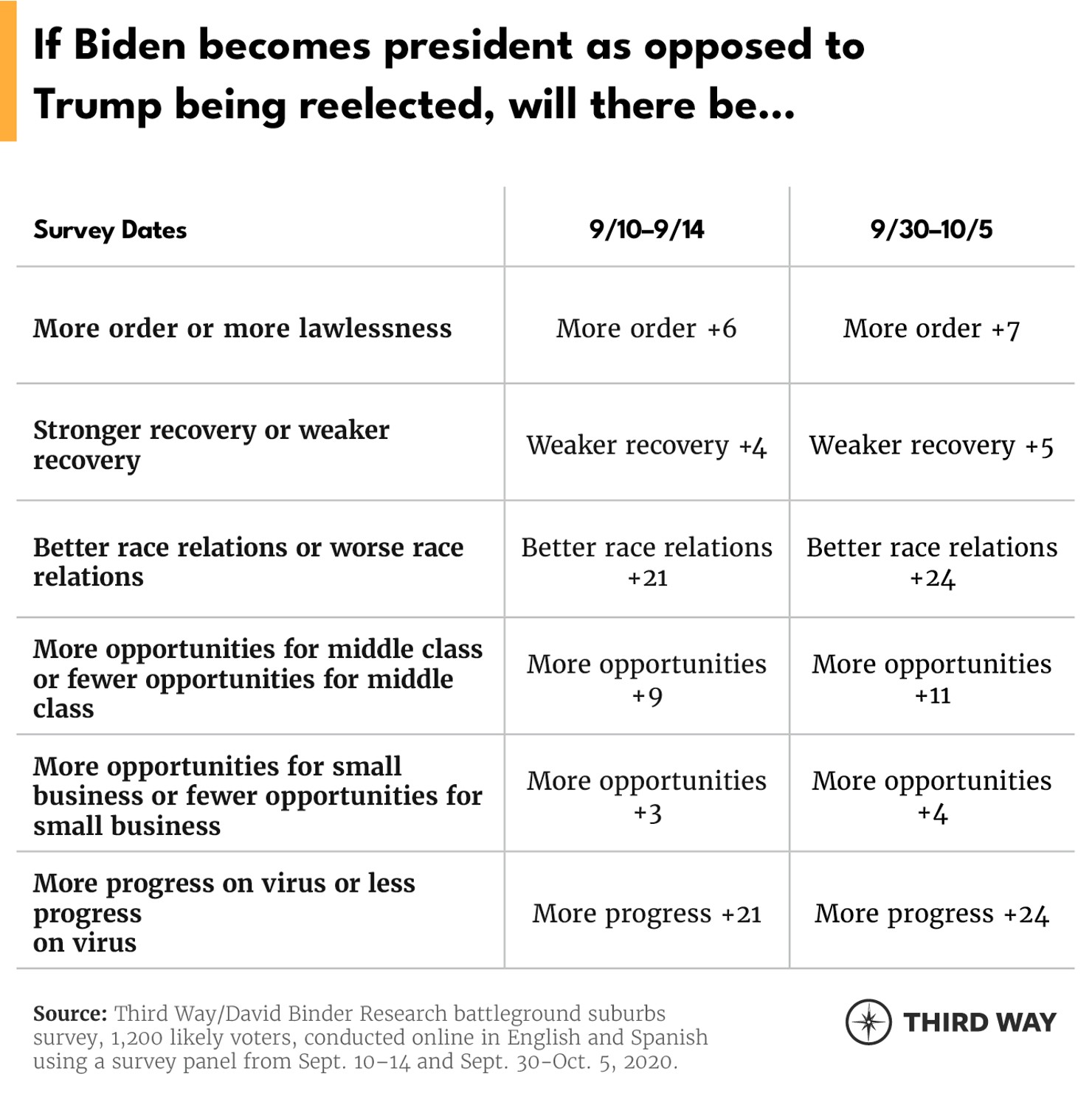
Overall, suburban voters continue to believe that a Biden presidency would bring positive changes to the country. But what changed between our pre- and post-debate surveys is that Biden made gains with persuadable voters on several areas.
Voters in the suburbs continue to feel that Biden would achieve more progress on getting the virus under control, with this margin growing from 21 to 24 points between surveys. They also still say that a Biden presidency would lead to a weaker recovery, but only by a five-point margin. But among persuadables, Biden made inroads between surveys. In our pre-debate poll, persuadable suburban voters said a Biden presidency would lead to more lawlessness by eight points, but now these voters are split on whether he would mean more lawlessness or order. And the margin of persuadables saying Biden would mean a weaker rather than stronger recovery fell from 35 to 23 points. In addition, pre-debate persuadable voters in these key suburbs said Biden would mean fewer opportunities for small business by eight points, but now they say he will bring more opportunities by two points. Trump’s greatest asset remains his perceived handling of the economy, but suburban voters are becoming less wary of handing Biden the economic reins.
Conclusion
Three weeks out from Election Day, Biden is gaining support in the battleground suburbs while the rest of the race is stable or trending his way. He is in a strong position. Trump does still have a few attacks he could deploy against Biden, most notably on the economy, but these arguments have not gained additional traction in recent weeks. Biden, on the other hand, has made inroads with persuadable voters in the suburbs on the economy as well as law and order. They now view a potential Biden presidency as better for small business, and Biden is chipping away at the perception that he would lead to a slower recovery than another four years of Trump. And his advantage on the coronavirus continues to swell across the board. If Biden maintains this continuity in the race, it will produce the change we need to evict Trump from the White House.
Methodology
Third Way and David Binder Research partnered to conduct a survey of 1,200 suburban 2020 likely voters in Arizona, Florida, Michigan, North Carolina, Pennsylvania, and Wisconsin. This produced a margin of error of 2.8%. Suburbs were defined using a zip-code level classification. The survey was conducted online using a panel matched to vote history, in English and Spanish, from September 30 to October 5, 2020.


More from Third Way

Battleground Suburbs Tracking Survey Deck (10/5)

Full Toplines: Battleground Suburbs Tracking Survey (10/5)
Never Miss an Update
Sign up for updates on the pragmatic, center-left ideas shaping the future of American policy.