Memo Published September 16, 2026 · 12 minute read
Front Door, Welded Shut: How Trump Is Dismantling Legal Immigration
Donald Trump’s deportation machine is all too visible: raids, detention beds, deportation quotas, troops in American cities. That fight has rightly dominated the public’s attention because it raises profound questions about democracy, due process, and respect for humanity. But while that fight unfolds in public, the Administration is building a second machine garnering far less attention: the systematic dismantling of the American legal immigration system.
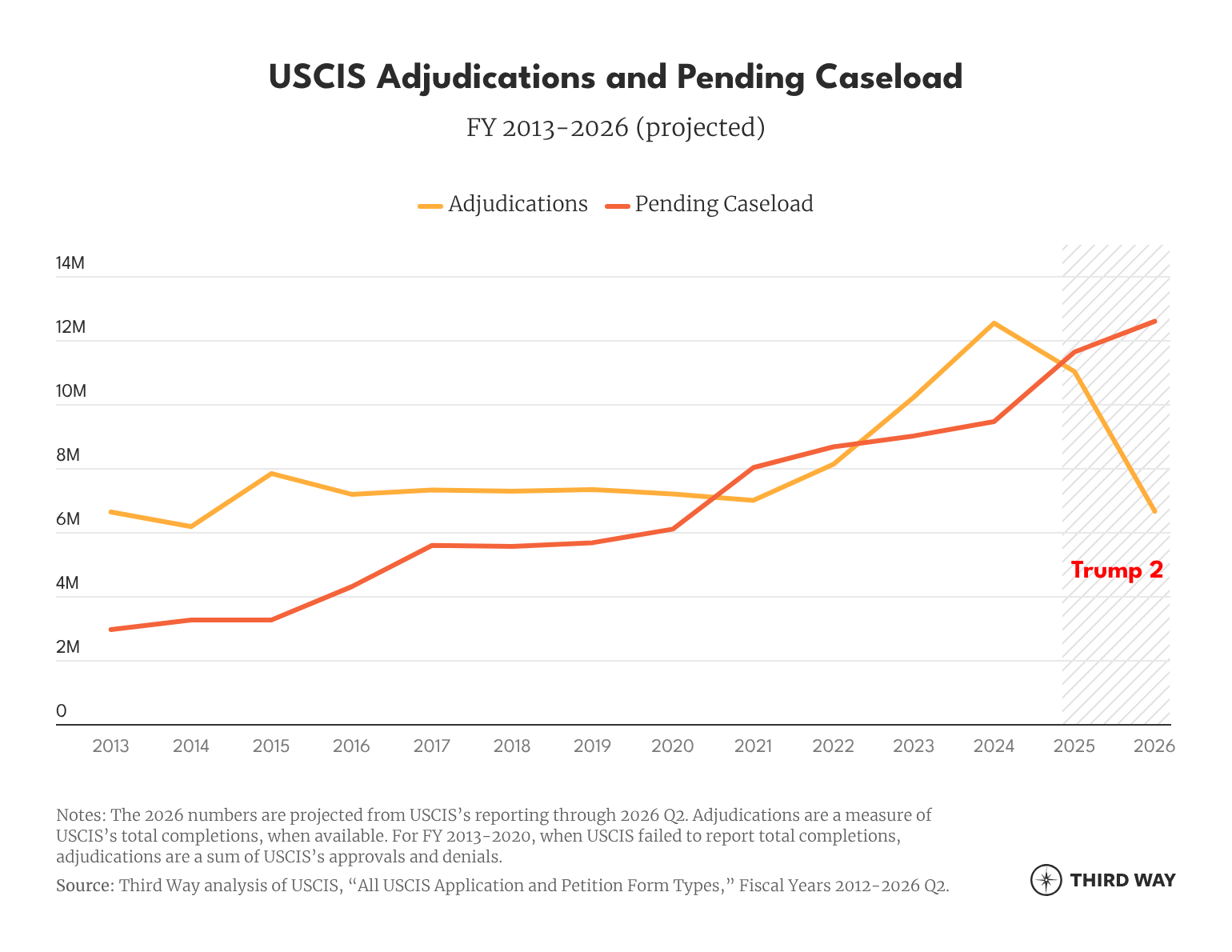
This is not an effort to reform or improve legal immigration. The Administration is closing pathways category by category, by administrative actions that never received a vote in Congress. By the end of Trump’s second term, these policies will cut legal immigration by 33% to 50%—1.5 million to 2.4 million fewer legal immigrants. Meanwhile, net migration may have already reached zero. The damage is already visible inside US Citizenship & Immigration Services (USCIS), which is on track to adjudicate fewer applications in 2026 than in any year in more than a decade, while its backlog has swelled to a record 12.1 million pending cases.
The consequences extend far beyond immigrants themselves. The Administration is making it harder for American businesses to recruit workers, for universities to attract talent, for hospitals to staff communities, and for American citizens to live here with their own families. And it is doing so just as an aging population makes a functioning legal immigration system more important than ever to American growth and competitiveness.
There is an alternative, and it is not uncontrolled or unmanaged immigration. It is a legal system that is orderly, responsive, and built around the country’s needs.
The Front Door, Welded Shut
Start with the immigration Trump says he wants. During the transition, Trump acknowledged the need for and benefits of high-skilled immigration, saying “I’ve always felt that we have to have the most competent people in our country. We need smart people coming into our country, and we need a lot of people coming in.” Yet, despite this declaration, his Administration has systematically attacked high-skilled immigration into the United States.
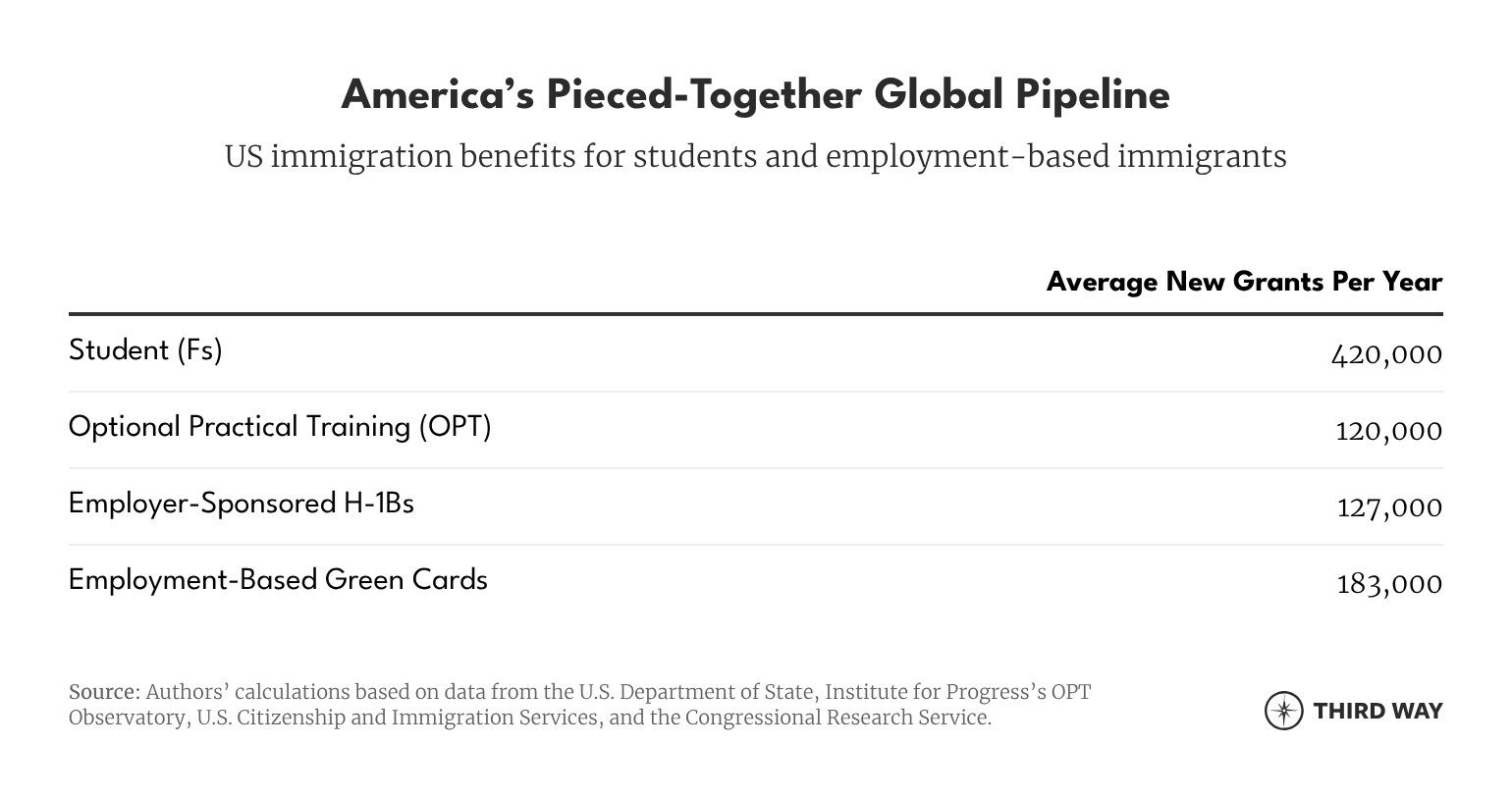
While immigrating to the United States is neither easy nor straightforward for high-skilled workers, there is a series of visas and work authorization opportunities that have facilitated a steady pipeline of talent over the decades. Yet the Trump Administration is breaking this pipeline down at each step of the process.
Starting with international students, the Administration has attacked this entry point from nearly every direction. The State Department revoked hundreds of student visas, while ICE separately terminated the immigration status of more than 4,700 international students, before restoring many after a wave of court challenges. Then the State Department imposed new sweeping social-media vetting for student visas. The Department of Homeland Security (DHS) has now finalized a new “duration of status” rule capping student stays at four years, regardless of how long a degree takes, though a federal court blocked it one day before it could take effect.
The effect has been enormous. In 2025, new F-1 visas to international students declined by 33.4%. Enrollments for 2026 are on track to drop even further. NAFSA estimates that as many as 111,000 fewer international students will enroll in US higher education institutions this fall, a loss of $3.4 billion in revenue.
The bill also lands on American students. Because international students often pay full tuition, that lost enrollment hits American students: tuition revenue from international students helps universities expand seats for US students and holds down in-state tuition. One study of public universities found that each additional international freshman was associated with roughly two additional in-state freshmen and 1.4 additional domestic graduates. Fewer foreign students means fewer seats for college-goers who grew up in America.
Next, the Administration is attacking Optional Practical Training (OPT). OPT is a temporary work authorization that allows international students to gain work experience related to their field of study. USCIS Director Joseph Edlow made it clear during his confirmation that he intends to end the ability of foreign students to work beyond their time in school. The Administration has already made it more difficult to obtain OPT with the duration of status change. And now, they are finalizing a $100,000 fee for a program that is currently free, a change that would effectively shut it down. This, too, makes attending higher education in the United States less attractive.
On H-1B visas for skilled foreign workers, the Administration imposed a $100,000 fee on many new petitions. A federal judge struck it down in June. In August, the Administration proposed a permanent fee of $103,265 per petition through rulemaking instead. It has also replaced the random lottery with a system that favors higher-paid workers, moved to raise wage requirements, and expanded vetting. The Administration will also soon make H-1Bs harder to obtain for workers at certain higher education and research institutions, eliminate the 60-day grace period after H-1B employment ends—a provision that was originally designed to give workers time to leave abusive or exploitative employers—and end employment authorization for spouses of H-1B workers.
Finally, the Administration is making employment-based green cards harder and more expensive by intensifying fraud and enforcement scrutiny, proposing to make the application process more onerous and expensive for employers, working to increase the wage requirements, and imposing sweeping nationality-based processing freezes that temporarily halted green card applications from workers already in the United States.
Together, these measures are throttling high-skilled immigration into the United States at precisely the wrong moment, weakening innovation, productivity, and US global competitiveness. Foreign workers have driven 55% of the job growth in US AI-related occupations. We are choking off talent in the middle of an AI boom. In FY 2025, more than 80% of certified applications for new H-1B petitions at Amazon, Meta, Google, Microsoft, and Apple were for AI-connected roles. Meanwhile, China has launched a new "K visa" to recruit young scientists, and Canada and the EU are expanding skilled-worker routes. Our rivals are competing for the talent we are turning away.
Family-based immigration has also been squeezed. The Administration’s expanded travel ban now blocks immigrant visas—including for spouses, children, and parents of US citizens—from dozens of countries. It also imposed a 75-country immigrant visa freeze that was only recently struck down, has broadened public charge rules to make family-based green cards easier to deny, and is currently postponing immigrant visa interviews worldwide while consular officers undergo new public charge training.
The Administration has effectively shut down two other major legal pathways. The State Department has issued no diversity visas since December 2025—a policy that was recently struck down—while refugee resettlement has been all but shut down, limited to a trickle of White Afrikaners from South Africa and ignoring the rest of the world.
Finally, by making an outsized investment in fraud detection and vetting and diverting hundreds of USCIS employees to Presidential-pet projects like searching for unlawful voters, while simultaneously attacking the agency’s workforce, the Trump Administration has transformed USCIS, the agency responsible for managing the legal immigration system, into a bureaucratic nightmare. USCIS is currently on pace to adjudicate the smallest number of immigration applications in more than a decade—less than half of its ballooning caseload. This slowdown has directly advanced the Administration’s goal of increasing ICE arrests, as the agency has shifted to arresting foreign nationals with pending, unresolved immigration cases.
Legal Yesterday, Illegal Today
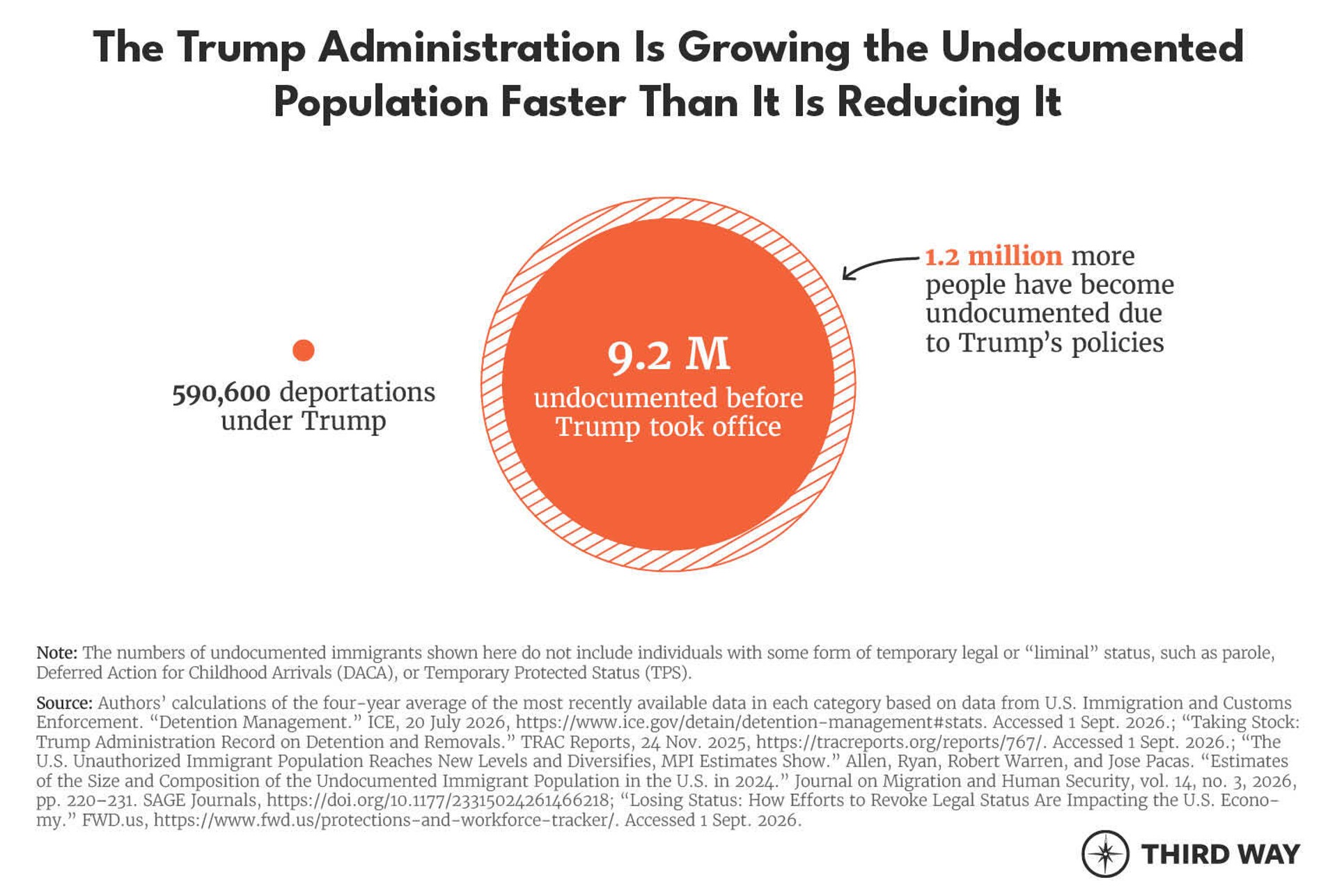
Then there's the Administration’s attack on immigrants who are already here. The Trump Administration is stripping immigrants of their legal status. As many have pointed out, this "Great Delegalization" is actually increasing the size of the unauthorized population in the United States faster than the Administration can deport them: for every unauthorized immigrant the President has deported, he has created another two.
Many of the millions who are losing their legal status have been in the United States for years, or even decades. Temporary Protected Status (TPS), a congressional creation from 1990, was designed to provide deportation protection and grant work permits to people from specific countries affected by war, natural disasters, political instability, or any other condition that makes the country unsafe for its nationals to return to. There is a legitimate criticism here: some designations have long outlived their original justification—Honduras and Nicaragua have been designated since January 1999. But the answer to a program that has drifted from its purpose is to work with Congress to fix it, not to end designations en masse and ramp up removals to countries that are still dangerous, such as Haiti. These are people who worked here legally, registered with the government, and renewed on schedule for many years.
And it isn't finished. On September 9, the Administration allowed designation for El Salvador to expire without clarifying whether they will terminate or extend TPS for the more than 170,000 Salvadorans who have been living legally in the United States since at least 2001. Salvadorans have the highest TPS labor-force participation at 88%. In October, 400,000 Venezuelans lose their authorization. Ukraine's designation for about 101,000 people was set to end the same month; DHS missed the statutory deadline to decide, and it now runs to April 2027 by default but is still at risk.
These terminations are creating government-manufactured labor shortages. As Representative Mike Lawler, a New York Republican, highlighted, roughly a third of Haitian TPS holders work in our health care system. When the terminations took effect in late July, layoffs hit airports, schools, and nursing homes that took beds offline.
The Administration is also terminating legal status and work authorization by simply delaying adjudications. This year, USCIS approved only 344,830 work permits between January and March, down from 719,030 a year earlier, and the backlog of pending work permits nearly tripled to 1.9 million. A permit that expires while the agency sits on the renewal does the same work as a termination notice: legal on Friday, unemployable on Monday.
This isn't about securing the border or pursuing criminals. It's an effort that is keeping out and kicking out the workers we need.
The Trump Stall
The economic consequences are no longer forecasts. They're in the monthly jobs numbers.
Paul Krugman calls it the "Trump Stall": long-run job growth depends heavily on how fast the labor force grows. Baby Boomers aging out had already slowed that growth; Trump's immigration crackdown is pushing it over a cliff. America's obligations—national security, retirees, infrastructure, health care—don't shrink with the workforce, but there will now be "fewer workers, paying less taxes" to meet them. Stuart Anderson and Mark Regets warn that Trump is on track to become the first president in a century to leave office with a smaller labor force than when he entered. Since the start of Trump’s second term, the workforce has shrunk by 1.6 million.
The jobs that disappear aren't only immigrant jobs. Immigrant and American workers often do different, complementary jobs in the same industries: without the framing crew, the general contractor has nothing to supervise; close the kitchen and the waiters go home, too. Brookings found the 2025 enforcement surge cost 668,000 jobs across 86 cities, between 51,000 and 297,000 jobs held by American-born workers. Immigrants make up 28% of direct care workers, and KPMG chief economist Diane Swonk describes where the shortages lead: "rationing, or more people doing unpaid care at home."
The pressures will outlast any one administration. The number of working-age Americans per retiree is projected to fall from three to two in a quarter century. The National Foundation for American Policy projects economic output losses of $12.1 trillion through 2035—$34,369 per person—while the 2026 Trustees Report projects depletion of Social Security's retirement fund in late 2032. Taken together, the impact on Americans is clear: fewer immigrants mean slower growth, fewer jobs, and greater fiscal pressure.
Voters Support Legal Immigration
Legal immigration is rarely defended on its own terms. The polling suggests it can be.
Opposition has collapsed. Only 21% of Americans want less legal immigration, the lowest the Chicago Council on Global Affairs has recorded since 2002. Among Republicans, support for reducing legal immigration fell from 50% to 34% in a year. The Economic Innovation Group finds 74% support increasing high-skilled immigration, including 71% of Trump voters. And voters are already recognizing the basic economic case: majorities tell Gallup that legal immigration fills workforce gaps created by an aging population (64%) and supplies workers for low-wage jobs (60%).
But that support comes with real doubts that should not simply be waved away. Pluralities still worry legal immigration costs American workers jobs and drives up housing costs. Those concerns are understandable: people experience the economy through their own wages, job security, and monthly bills, not through national GDP statistics.
The evidence, however, points to a more complicated—and generally more reassuring—story. The National Academies of Sciences, reviewing decades of research, found "little evidence that immigration significantly affects the overall employment levels of native-born workers." And removing immigrant workers doesn't open jobs up—it closes them. Economist Chloe East studied Trump-era enforcement and found that for every six undocumented men pushed out of employment, one US-born man also loses his job; employers didn't simply raise wages and replace the missing workers.
On housing, voters are identifying a real pressure—but not the whole story. Immigration can add to housing demand, particularly in communities that already fail to build enough homes. But immigrants also make up 26.3% of the construction workforce, meaning efforts to reduce immigration can simultaneously make it harder and more expensive to expand housing supply. The answer is not to tell voters their concern is imaginary. It is to acknowledge the pressure they feel and explain what policies would actually relieve it.
None of this amounts to an argument for unlimited or unregulated immigration. Public opinion continues to distinguish sharply between an orderly system and one perceived as uncontrolled. The more durable case for legal immigration is therefore not that Americans should ignore their concerns about jobs, housing, or order, but that a well-managed system can address those concerns while still delivering the workers, growth, and talent the country needs.
What a Functioning System Would Require
Much of this damage was done by administrative action rather than by law, which means much of it can be undone the same way. But restoring the previous system would not be enough. The country needs credible rules, a border the government can actually control, a professional and targeted interior enforcement apparatus, legal channels that directly respond to the country’s needs, and enough workers and talent to grow—a system Americans can trust because it delivers both order and opportunity.
We are a nation of laws and a nation of immigrants, and the best way to be either is to be both.