Final Pre-election Snapshot from Battleground Suburbs

Third Way, David Binder Research
Six months ago, Third Way launched a project to dive deep into the views of suburban voters in the battleground states of MI, PA, WI, AZ, FL, and NC. As part of the project, we fielded tracking surveys to test the impact of Donald Trump’s attacks against Joe Biden in these key places. The arguments we tested include that Biden is a Trojan Horse for the far left, is weak on crime, would crash the economy, his son Hunter’s behavior was improper, and that it was Trump who acted decisively on the coronavirus. These surveys have been designed to warn if any of Trump’s messages were taking hold in the final weeks before Election Day.

Our latest and last pre-election survey went into the field on Monday, October 18, before the final presidential debate. What follows are five quick insights from the data.
1. Biden maintains a large and steady lead in the battleground suburbs, despite some narrowing from our post-first debate survey.
Biden leads Trump by a 50–39% margin (53–43% w/ leaners) in our final survey of suburban voters in battleground states. In this same poll, voters said they supported Trump over Hillary Clinton by a 45–44% margin in 2016, giving Biden a 12-point improvement in performance over Clinton.
Compared to our previous poll after the first debate, Biden’s support held steady while Trump’s ticked up three points. Overall, Biden’s margin dropped from 15 to 11 points with suburban voters. Our previous poll was in the field during Trump’s coronavirus diagnosis. This latest result is actually an improvement on Biden’s margin compared to those in the previous survey who had responded before Trump’s diagnosis (Biden led by nine points), but it is a drop from his margin with those who responded to the previous survey after Trump’s diagnosis (Biden led by 20 points).
Biden’s lead in this poll is particularly notable since 40% of respondents said they had already voted. These early voters backed Biden by a 66–32% margin.
Thirteen percent of suburban voters in these key states are not 100% committed to a candidate: they only lean toward a candidate, are undecided, or recently changed their vote to Biden or undecided. These persuadable voters are the primary focus of the rest of this memo.
Biden’s favorability rating fell between surveys from +13 to +5 (52–47%). Suburban voters are still unfavorable toward Trump though his favorability inched up from -19 to -16 (42–58%). Among persuadable voters, Biden’s favorability is at -15, but Trump’s favorability languishes at -33.
Biden enters the final days of the campaign poised to capture a majority in the battleground suburbs—which would put him in a strong position to win these crucial Electoral College states. He is performing well ahead of Clinton in our polling and many have already cast their ballots. But the extent of his margin with suburban voters may come down to where voters ultimately land on some persistent Trump attacks.
2. Biden’s top vulnerability is still an economic attack, despite Trump’s recent focus on Hunter Biden.
Trump’s most effective message against Biden in the suburbs is an economic one that says he would “raise taxes by $4 trillion,” “hurt small business,” and destroy the “rapidly improving economy.” This was the most effective attack in every iteration of this tracking survey.
Fifty-four percent of suburban voters in battleground states say that this economic message is “very” or “somewhat” concerning, which is nearly identical to the response in our previous survey after the first debate (52%). When they hear a Democratic counter-message on Biden’s “Build Back Better” agenda, 34% say it eliminates “all” or “most” of their concern (compared to a similar 33% in the previous survey). Trump’s economic attack is more concerning with persuadable voters than with suburban voters overall. Sixty-four percent of persuadable voters find it concerning (up from 61% in the last round), while 30% say the counter-message eliminates their concern (up from 29%).

We also tested a new message using Trump’s attacks on Hunter Biden. This attack highlighted Biden’s 47 years in politics and accused his son of selling connections to his father in foreign countries. Overall, this new message was not quite as persuasive to suburban voters as the economic attack described above: 50% say they find the message concerning. When a Democratic counter-message is presented, 32% say that it eliminates their concern. Among persuadables, 58% find the message concerning, while a counter-message eliminates concern with 24%.
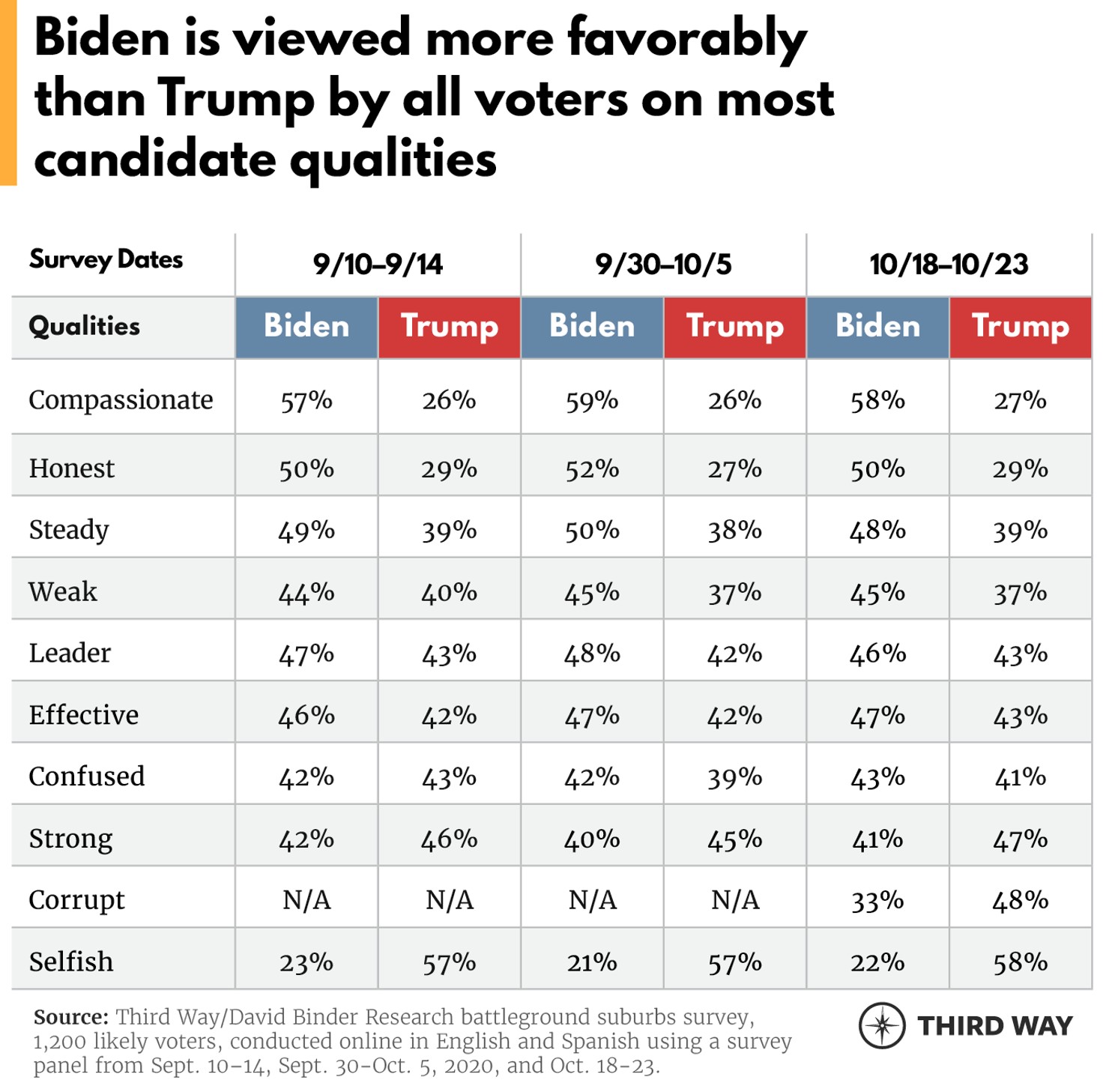
However, when asked which candidate is best described by the word “corrupt,” battleground suburban voters chose Trump by a 48–33%. For persuadables, the margin is 26–23%, with 33% saying it describes both. It’s clear that Trump’s attacks around Hunter Biden leave a negative impression in some suburban voters’ minds, but it is not evident that they are reshaping perceptions of the former vice president or eroding his suburban lead.
Trump’s economic message against Biden raises the most concerns with voters, but it has not reshaped the race. Any final efforts by Biden and Democrats to alleviate these concerns could help expand Biden’s margin in the battleground suburbs. Our recent research on countering Trump on the economy showed that it is essential to link an economic recovery to getting the virus under control. Biden’s most effective response on the economy may be equal parts linking back to the coronavirus and countering Trump’s specific lies on taxes, jobs, and small business.
3. Voters don’t believe Trump’s charge that Biden is bad for the suburbs.
Trump and his allies know the suburbs will be decisive this year, and so they claim that a Biden presidency would mean crime and problems in these communities. But Biden has effectively pushed back.
Biden holds a narrow lead on who would be better for the suburbs among suburban voters in battleground states. He leads Trump 45–42% overall on this question and splits persuadables 29–31%. After the first debate, he led 47–41% and persuadables split at 32–30% on this question. But Biden has rebutted Trump’s claim that a new administration would mean more crime and problems for the suburbs. At the beginning of this tracking project, suburban voters disagreed with this line of attack from Trump by a 50–43% margin, but persuadable voters were split 39–40%. But now, the margin of all suburban voters disagreeing with Trump is 51–40%, and persuadables also disagree by a 44–37% margin.
4. Biden heads into Election Day ahead on most issues, but Trump’s edge on the economy has ticked up.
There were no major changes in suburban voters’ perceptions of who would be better on the issues between surveys. Biden continues to lead on most—and he maintained his lead on suburban voters’ top issue, the coronavirus, although this advantage did narrow slightly from 19 to 16 points. But with persuadable voters in the suburbs, his lead on handling the coronavirus held steady at 29 points—a crucial edge which could bring those voters into the Democratic column. On Trump’s most favorable ground, the economy, his advantage grew from nine to 11 points. Since our first tracking survey, Trump’s edge on the economy has grown by five points overall. He continues to have a large lead with persuadables on the economy, and it inched up from 31 to 35 points between surveys. Any progress these final days toward narrowing Trump’s advantage on the economy could pay dividends for Biden in the battleground suburbs on Election Day.

Just like in our post-debate survey, suburban voters say Biden better conveys the characteristics of a leader and give Trump an edge on being strong. Trump continues to hold a wide lead with persuadable voters on strength (+17), while they are split between Biden and Trump on who is a better leader. The debates and other recent events have engrained suburban voters’ perception that Biden is the more honest and compassionate candidate, qualities on which he had an edge from the start. After the first debate, the margin of suburban voters saying Biden rather than Trump conveys weakness and confusion grew moderately. In this last survey, these margins did not expand further, but they also did not narrow.
5. Persuadables are joining all suburban voters to conclude that Biden would bring positive change
Battleground suburban voters are heading into Election Day with the clear sense that a Biden presidency would bring positive changes to the country. And among the remaining persuadable voters in the suburbs, this same sense is taking hold.
Suburban voters continue to feel that Biden would achieve more progress than Trump on getting the virus under control, with this margin virtually unchanged from our previous survey at 23 points. And Biden’s edge on this all-important issue expands to 33 points with persuadable voters in these suburbs. Notably, suburban voters are now split on whether a Biden presidency would lead to a weaker or stronger recovery, with the margin of those saying “weaker” narrowing from five to two points (persuadables still say weaker by 22 points). This sets up a divergence; suburban voters believe Trump will be better on the economy by 11 points but say Biden would do as good of a job leading a recovery. This may be explained by a growing sense that Biden could be better for suburban voters’ personal economic interests, despite still thinking that Trump is better for the economy in an abstract sense. Alternatively, it may just be the increasing belief that without properly handling the virus, recovery cannot begin.

On the question of who would provide more opportunities for the middle class, suburban voters say Biden by a 49–38% margin, and between surveys, the margin of persuadables picking Biden on this question increased from two to 10 points. And for small business, suburban voters also think Biden would provide more opportunities, though by a narrower 45–40% margin (with persuadables split on this question). Trump is unlikely to surrender his overall advantage on the economy, but Biden may have a chance to expand his margin in the suburbs if he can solidify this late progress on handling an economic recovery and boosting the middle class and small businesses.
Conclusion
One week out from Election Day, Biden is poised to win the battleground suburbs. But the size of his final margin will be determined by his ability to narrow Trump’s edge on economic issues and maintain his own advantages on the handling of coronavirus. When suburban voters are asked to imagine a Biden presidency, a potential pathway toward cutting into Trump’s economic edge emerges. Suburban voters now view a potential Biden presidency as better for the middle class and small business, and Biden has pulled into a statistical tie on handling the economic recovery. If Biden can maintain or even expand his edge in these communities, he will be in an even better position to win the White House next week.
Methodology
Third Way and David Binder Research partnered to conduct a survey of 1,200 suburban 2020 likely voters in Arizona, Florida, Michigan, North Carolina, Pennsylvania, and Wisconsin. This produced a margin of error of 2.8%. Suburbs were defined using a zip-code level classification. The survey was conducted online using a panel matched to vote history, in English and Spanish, from October 18 to October 23, 2020.


More from Third Way

Full Toplines: Battleground Suburbs Tracking Survey (10/23)

Battleground Suburbs Tracking Survey Deck (10/23)
Never Miss an Update
Sign up for updates on the pragmatic, center-left ideas shaping the future of American policy.