Battleground Suburbs Tracking Survey

Third Way, David Binder Research
Donald Trump and Republicans used their convention to outline the four messages they will use down the stretch in the election: Joe Biden is a Trojan Horse for the far left, he is weak on crime, he would crash the economy, and it was Trump who acted decisively on the coronavirus. Tracking the impact of these attacks with the voters who will decide the Electoral College outcome is essential. Trump failed the referendum of his presidency, most damningly through his response to the coronavirus, so his best shot at winning now is to try to disqualify Biden as an alternative through these attacks.

Third Way has launched a tracking project to regularly test the impact of these lines of attack with suburban voters in the battleground states until November. Are these messages sticking? If so, which ones, and with whom? Our research also includes questions on key issues, candidate qualities, and how voters picture a Biden presidency. This project will provide warnings if any of Trump’s attacks begin to take hold.
This survey was conducted before the tragic death of Justice Ruth Bader Ginsburg. But we expect the findings here, especially on persuadable voters who report higher levels of concern from Trump’s attacks on Biden, to still be highly relevant to voters’ decision-making in November.
Biden is ahead in the battleground suburbs, but warnings continue on economic issues.
The context for the research that follows is that Biden is performing well in the battleground suburbs. Biden leads Trump by nine points, 46% to 37% (52–43% w/ leaners). These same respondents report that they split their vote in 2016. Eighteen percent of suburban voters are not yet committed: they only lean toward a candidate, are undecided, or recently changed their vote to Biden or undecided. These persuadable voters are the focus of this memo. If Biden can lock in his advantage in the suburbs, he will be in good position to win.
But this survey also revealed continued vulnerabilities for Biden on economic issues. Trump’s most effective attack right now is one that goes after Biden on taxes, jobs and small business, and the economic recovery. Persuadable suburban voters are split over who would be best for the suburbs, and they believe Trump would be better on the economy and recovery by wide margins.
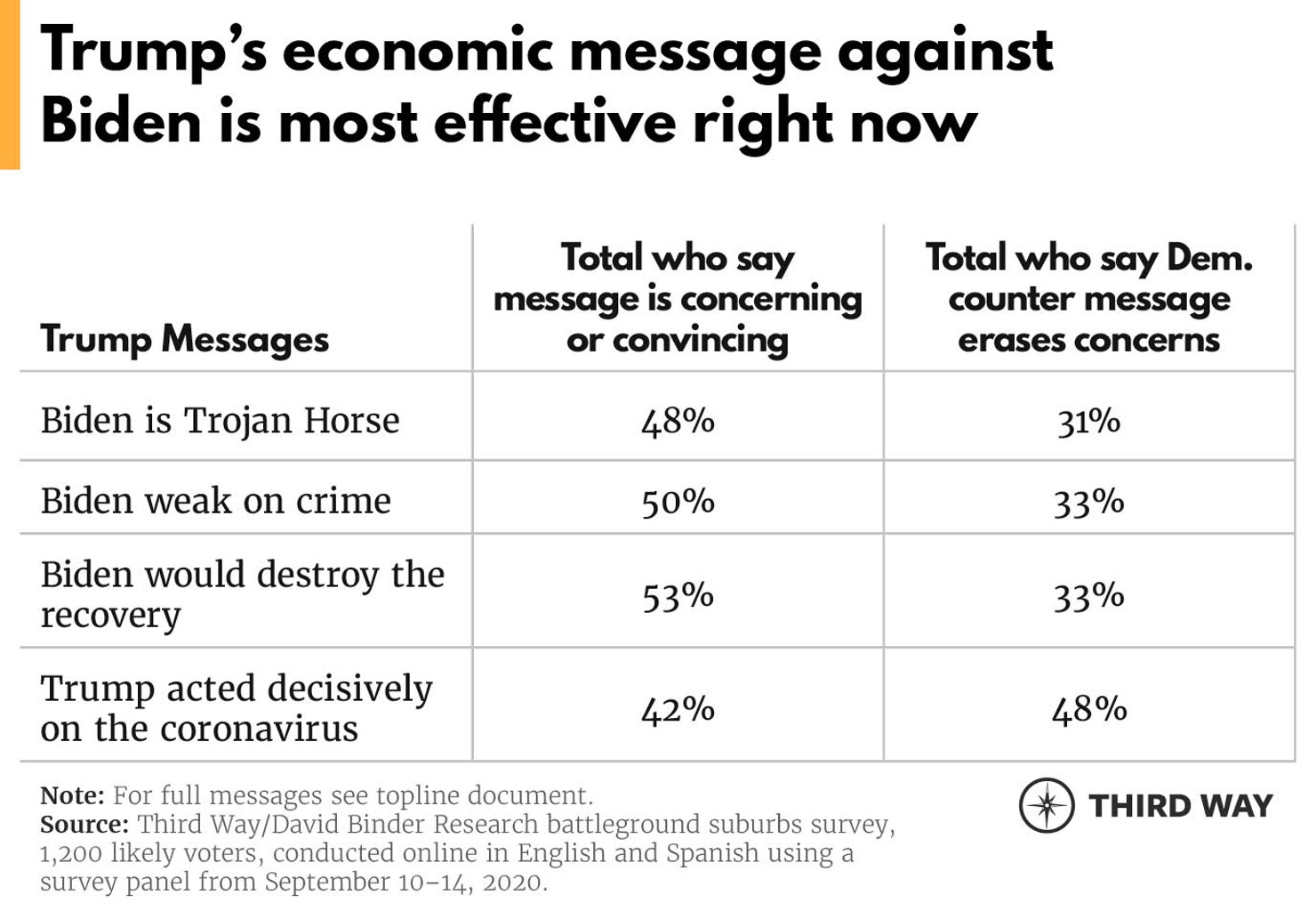
Biden is most vulnerable to Trump’s economic attack on taxes, small business/jobs, and the recovery right now.
Trump and allies dedicated most of their efforts at the convention to attacking Biden as weak on crime or as a Trojan Horse for the far left. However, it is an economic message that attacks Biden by saying he would raise taxes by “$4 trillion,” “hurt small business,” and destroy the “rapidly improving economy” that is breaking through with suburban voters.
Overall, 53% say that this economic message is “very” or “somewhat” concerning. When all respondents hear a hypothetical Democratic counter-message, 33% say it eliminates “all” or “most” of their concern. This message is even more concerning with persuadable voters. Sixty-six percent find it “very” or “somewhat” concerning, while only 27% say the counter-message eliminates “all” or “most” of their concern. The Democratic counter-message in this case outlined Biden’s “Build Back Better” agenda, but our recent polling on how to counter Trump on the economy also showed that it is essential for Biden to link a recovery to getting the virus under control. Biden’s most effective response on the economy may be equal parts linking to the coronavirus and forcefully pushing back on Trump’s specific claims about taxes, jobs and small business, and the recovery.
Views on the protests have turned more negative in recent months.
The Black Lives Matter (BLM) protests this summer have been an important and necessary step toward racial justice. But incidents of violence and property damage (perpetrated largely by those other than the protesters) have caused many suburban voters to have a less favorable view of the protest movement as a whole.
Overall, 41% say that their views of the protests have become more negative over the last three months to 29% who say more positive. Forty-five percent of persuadable voters have a more negative view to 25% who say more positive. Suburban voters are split on who is to blame for incidents of violence; equal shares blame BLM protestors and Trump at 27%. But persuadable voters blame the protestors over Trump by a 35–11% margin.
There is overwhelming, near-unanimous support for Biden speaking out against violence and lawlessness. Eighty-seven percent agree (72% strongly) with a recent Biden statement in which he condemned rioting and looting and called for prosecutions of those who do it. Among persuadables, 82% agree (61% strongly) with Biden’s statement. Supporting protesters’ goals while criticizing the behavior of the small number of lawbreakers is a winning formula for Biden with suburban voters.
Suburban voters in battleground states also believe that counter-protesters bringing firearms to protests are making things worse (69–19%). In addition, they see Trump’s actions as fueling the protests, not calming them (49–42%). Persuadables agree on both fronts. The President has real vulnerabilities in this area.
Persuadables are on the fence about whether life in the suburbs would be better with Biden.
Trump is making a specific and dark pitch to suburban voters: If Biden is elected, he will abolish the suburbs, meaning things like increased crime and more low income and mixed-use housing.
By a 47–42% margin, suburban voters say that Biden would be better than Trump for the quality of life in the suburbs. But persuadable voters are split between Biden and Trump (28–29%), while a plurality (43%) is unsure. When asked about Trump’s claims that a Biden presidency would mean more crime and problems for the suburbs, battleground suburban voters disagree by a 50–43% margin (persuadables are split 39–40%).
Biden leads on most issues and candidate qualities, but Trump leads on economic issues and strong leadership.
Suburban voters say Biden would do better than Trump on most issues. On their top issue, the coronavirus, Biden leads Trump by 15 points (a whopping 24 points w/ persuadables). On health care, Biden leads by 13 points with all voters and 18 points with persuadables. But while Trump has a narrow edge on the economy with all suburban voters (49–43%) his advantage swells to 35 points with persuadables. Finally, on civil unrest and public safety, Biden leads by eight with all voters, but he and Trump are tied with persuadables.

On candidate qualities, voters want someone who will bring leadership to the White House, but also decency. Trump has built up an edge on strong leadership with persuadable voters. By a four-point margin, all voters say that the word “strong” better describes Trump than Biden, and this margin expands to 24 points with persuadables. And while all voters say that “leader” better describes Biden by four points, persuadables side with Trump by 11 points. But not surprisingly, Biden has the decisive advantage on decency. He leads by 31 points on “compassionate” (46 points w/ persuadables) and 21 points on “honesty” (30 points). Given our myriad crises, steadiness could be a tiebreaking characteristic. All voters and persuadables say that “steady” (perhaps a stand-in for “leadership” in this moment) better describes Biden by 10 points. This may indicate that if Biden can land the case that he is “steady,” he will be able to counter Trump’s perception of strength.
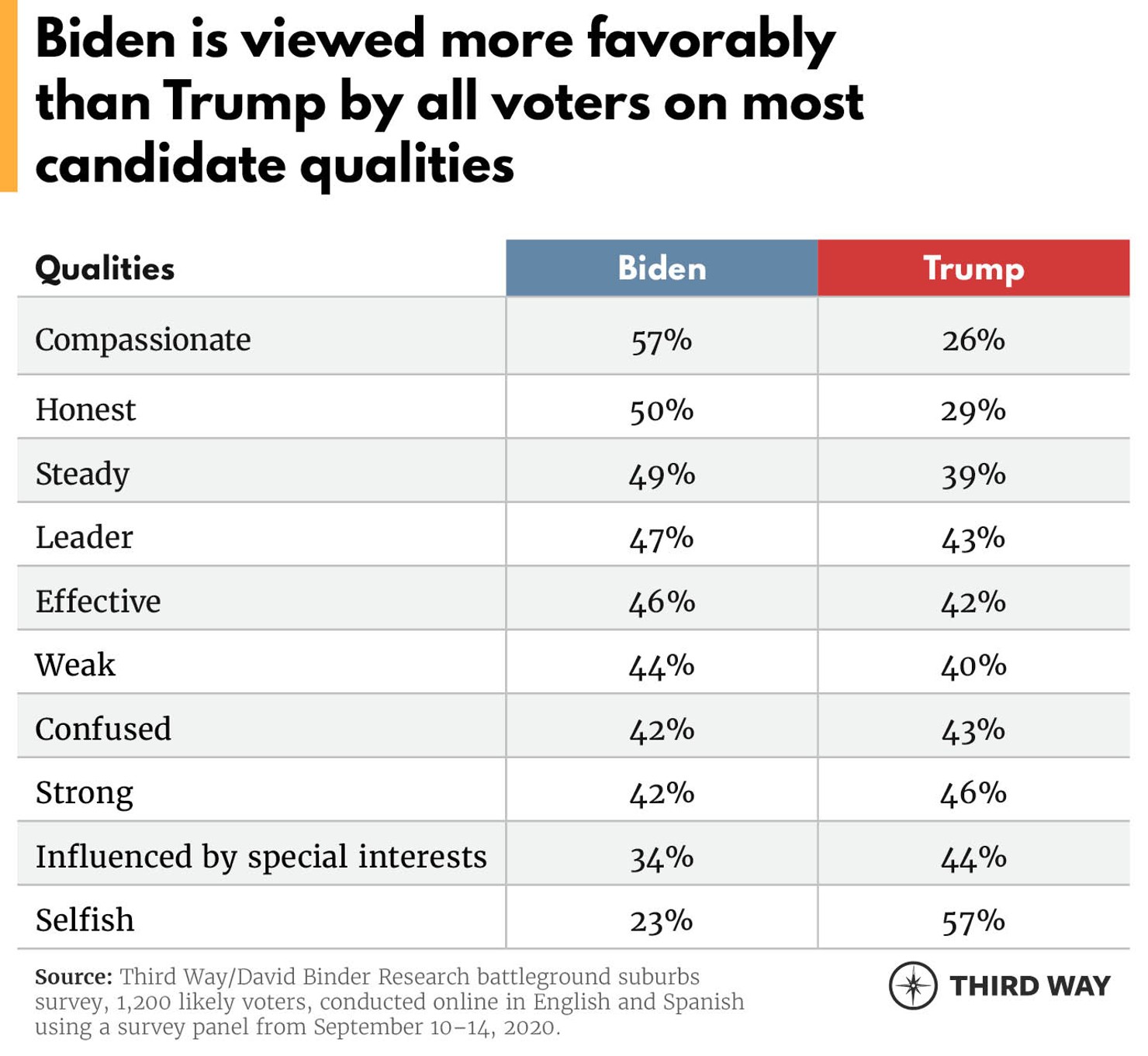
A majority of suburban voters say life would be better under a Biden presidency, but persuadables are more mixed.
While Trump failed the referendum of his presidency (most spectacularly in his coronavirus response), voters still need confidence in what the challenger has to offer before they will be ready to toss out the incumbent. Among suburban voters in battleground states, most believe a Biden presidency would bring positive change to the country, but persuadable voters in the suburbs are divided in some areas.
By comparable margins, suburban voters and persuadables agree that a Biden presidency would usher in more progress on the coronavirus, better race relations, and more opportunities for the middle class. But while all voters say a Biden presidency would mean more order over lawlessness by six points, persuadables say the opposite by an eight-point margin. Similarly, all suburban voters believe a Biden presidency would be better for small business by three points, while persuadables say the reverse by eight points. Most importantly for this moment, suburban voters say a Biden presidency would lead to a weaker recovery by a four-point margin, and this spread jumps to 35 points with persuadable voters. This is the attack that is most important to counter over the final weeks of the campaign.

Conclusion
Biden enters the home stretch with a significant lead in the battleground suburbs, which could turn into a dominating margin if he wins over enough persuadable voters. But this survey revealed continued warning signs for Biden on economic issues like taxes, jobs and small business, and the recovery. Trump could potentially leverage these issues to attack Biden on both the economy and as beholden to the far left. Biden won strong support from voters by forcefully condemning protests that have devolved into lawlessness. He could apply this same forceful approach to confronting Trump on the economy; pillory him on the coronavirus, and emphasize specific, reassuring policies like not raising taxes on households making under $400,000 a year. While Trump’s attacks have not disqualified Biden with suburban voters, these voters are also not rejecting every attack yet—especially persuadable voters.
While this survey was conducted before the death of Ruth Bader Ginsburg, we expect the findings on Trump’s messages against Biden to still be highly relevant to suburban voters’ decision in this election, especially the findings on the persuadable voters who are most impacted by Trump’s attacks.
Methodology
Third Way and David Binder Research partnered to conduct a survey of 1,200 suburban 2020 likely voters in Arizona, Florida, Michigan, North Carolina, Pennsylvania, and Wisconsin. This produced a margin of error of 2.8%. Suburbs were defined using a zip-code level classification. The survey was conducted online using a panel matched to vote history, in English and Spanish, from September 10 to 14, 2020.


More from Third Way
Battleground Suburbs Tracking Survey Deck

Toplines: Battleground Suburbs Tracking Survey
Never Miss an Update
Sign up for updates on the pragmatic, center-left ideas shaping the future of American policy.