Interview Published April 21, 2020 · 9 minute read
Interviews with Influencers: Dr. Bridget Burns
Nicole Siegel
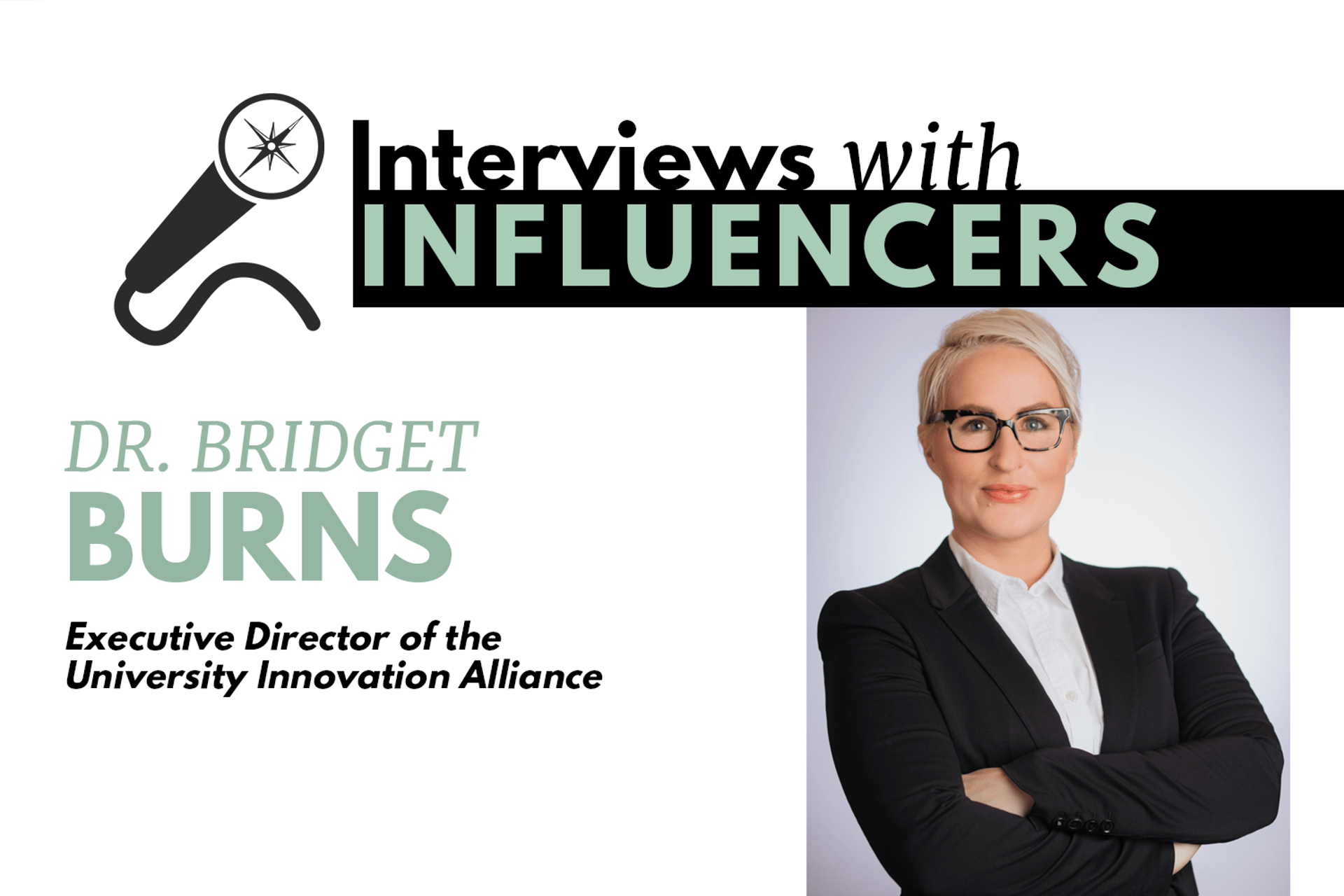

With disappointing graduation rates and growing student debt, it’s been clear for some time that our nation’s higher education system needs to better serve today’s students. But few have dared greatly enough to challenge the status quo and demand better from our colleges and universities. Enter Dr. Bridget Burns, who for the last decade, has advised university presidents and other higher ed leaders on strategies to expand access, promote completion, and address cost for all students. And she’s the founding Executive Director of the University Innovation Alliance (UIA), a revolutionary consortium of 11 public research universities working collaboratively to close their achievement gaps, improve student outcomes, and scale success.
The work of the UIA is nothing short of transformational, and as the stakes are higher than ever for students to get across the finish line, we couldn’t think of a better time to interview Dr. Burns.
Q: Why higher education? Tell me a little about your journey to working in education.
A: I really got bit by the higher education bug early and just never found anything else as compelling. Higher ed changed my life so significantly and I just wanted to be able to give other people that same experience, that same opportunity. I grew up in poverty in rural Montana. My family lived very remotely, 50 miles outside of an 8,000-person town. There weren’t a lot of expectations of me to go to college but if I did, I knew I’d have to pay for it.
I was given advice, but it wasn't great advice. My dad went to college on the GI Bill. And my brother was a superstar wrestler who got a full ride to Ohio State. Their advice was never going to be helpful for me because I wasn't either of those things and their experience really didn't translate in terms of giving me the guidance and support that would have helped me successfully transition into the "typical experience." So, I started at the community college, did not complete my associates, transferred to Oregon State, and was very fortunate that within a year and a half of stepping foot on that campus, I was elected student body president. And a year and a half later the Governor appointed me to the State Board of Higher Education. So that period, and the opportunities that were given to me by higher education, were really the fundamental trajectory shift in my life.
I think the misconception is that somehow, it's the student’s fault. And I think it's a place for self-reflection because millions of students have been lost and it's not an indicator that there’s something wrong with them or they’re not college material.
And then I was just hooked. Once someone fully explained to me the poverty cycle and the role that education played in it, I was just resolute that this was where I wanted to spend my life's work. I started working on raising money for need based aid while still an undergraduate student.
There are a lot of things to say about higher education, but ultimately it transforms people’s lives. The reason most people work in higher education is because their experience so significantly changed their own perspective, and they want to give that opportunity to other people.
Q: What do you think are some of the biggest misconceptions about why students don't cross the finish line and what can we do to help change the narrative?
A: I think the misconception is that somehow, it's the student’s fault. And I think it's a place for self-reflection because millions of students have been lost and it's not an indicator that there’s something wrong with them or they’re not college material. It's the design of our institutions that need to change - they need to adapt to the needs of students. Institutions need to take in the experience of students and give the practitioners who have spent their life working in the field the actual space and time to work on their design. Most of the time they're just trying to react to some deadline, some new report, some milestone. And with everything going on right now (COVID-19), no one's getting any time to even take a beat and take a breath because they’re assuming so many additional responsibilities to support students.
The net result of overwhelm and antiquated design is not positive for anyone. We need to reimagine how we support the professionals who are working in higher ed so that they can better support students. And at the end of the day, we always say the universities were not designed around students. Higher learning was not designed around students. That is a fundamental challenge.
There are a lot of things to say about higher education, but ultimately it transforms people’s lives. Most people work in higher education because their experience so significantly changed their own perspective, and they want to give that opportunity to other people.
Q: What was the impetus behind developing the University Innovation Alliance (UIA)? And what is your proudest accomplishment to date?
A: It all started with a meeting of 11 college presidents and chancellors. They were invited to have a conversation with Michael Crow, President of Arizona State University (you can read our interview with him here) – who for years had been exploring the idea of a national service university concept, where we would actually find universities banding together, and leveraging all their different strengths. And it’s important to note that at that time there really wasn't much discussion of the term student success, and university collaboration wasn’t being leveraged as vehicle for improvement and innovation. Now, I am proud to see it becoming more of a trend.
So, essentially this group of 11 presidents and chancellors became united around a sense of urgency that our sector was failing students because we were not producing enough college degrees to keep up with demand for the economic competitiveness of our country. We were particularly failing low- income, first-generation and students of color in large numbers and going it alone to try and address those very important challenges was simply not enough. By not collaborating to work towards a solution, we were wasting time, energy and money, and we believed that ultimately students were the ones paying the price. So that was really the purpose of the UIA.
This isn’t typically the talking point people are familiar with, but one of the accomplishments I’m proudest of to date at the UIA is the work of our Fellows. There’s this group of incredibly talented, diverse, young professionals who are now being tapped to lead other organizations. We've created a new talent pipeline for the future of higher ed that we think has the experience and background to lead and solve many of the challenges that we're facing.
We need to reimagine how we support the professionals who are working in higher ed so that they can better support students
.
And I’d be remiss if I didn’t mention the work our institutions have done to increase graduation rates for low-income students. The schools in the UIA have increased degrees for low-income students by 32% in the five years since we’ve started this work. (Check out this Inside Higher Ed piece for more on the impressive work these schools are doing to get students across the finish line).
Q: Do you think that more institutions are willing to publicly admit “we can and must do better”? What brought upon this change?
A: Yes. I think much of the change is thanks, in large part, to a handful of institutional leaders. In the first few years of my working in higher education, when I would tell people I didn’t think our system was designed around students, or that we were failing our students, I received a lot of negative pushback, like: “How dare you say that?”
But then a cultural shift started to occur, and the University Innovation Alliance had a hand in this transformation. We created social safety in the higher ed sector by gathering a group of very successful presidents and chancellors leading large public research institutions (and who are significant leaders in their own rights) and challenged them to share their successes and failures with one another, and more importantly to learn from these failures. By inviting the leaders of some of our nation’s most powerful institutions to share their failures, and work together to do better for students, it slowly started to create a ripple effect of innovation and collaboration across the sector to improve graduation rates.
The schools in the UIA have increased degrees for low-income students by 32% in the five years since we’ve started this work
.
Q: Who are some of your influencers in education and beyond?
A: From early on, I was impressed and inspired by Barbara McFadden Allen, longtime Executive Director of the Big Ten Academic Alliance - she was very helpful to me in my first few years creating UIA. I also really admire Nicole Hurd. What she's created with the College Advising Corp is nothing short of transformative. I have great admiration for the presidents in the UIA and am honored to work so closely with them. But frankly, a lot of our work at the UIA has been informed by Brené Brown's work.
Her research on the power of vulnerability, building trust, and social safety is deeply embedded into our work at the UIA. (Her TED talk is one of the top 10 most-watched ever, check it out here!).
By inviting the leaders of some of our nation’s most powerful institutions to share their failures, and work together to do better for students, it slowly started to create a ripple effect of innovation and collaboration across the sector to improve graduation rates.
Q: Your job takes you to a bunch of college towns. Do you have a favorite and why?
A: To not pick favorites from the locations of the schools in the UIA, I will say Bozeman, Montana. Bozeman is where my family lives and I get to see my niece and nephew and spend time with my father. So, Bozeman ranks #1.