Blog Published November 17, 2022 · 4 minute read
Not There Yet: Rising Access to Paid Family Leave Masks Disparities
Anthony Colavito

There is good news and bad news when it comes to paid family leave in the United States. The share of workers with paid family leave has more than doubled over the last 12 years. But today, only one-in-four workers have a paid family leave benefit through their employers. New data from the Bureau of Labor Statistics (BLS) can help explain both trends.1
There has been an uptick in the number of workers with paid family leave for two key reasons. Namely:
- States are creating paid leave programs. In 2010, California and New Jersey were the only states to provide any form of paid leave to workers. By 2022, seven states and Washington, DC had effective paid family leave programs, with four more states having passed legislation to implement their own.2
- Employers have a tax benefit to provide paid leave. In 2017, the Tax Cuts and Job Act (TCJA) created temporary tax credits for employers offering paid family leave to qualified employees.3
Unfortunately, there are many reasons why paid family leave is still relatively unavailable. Two key reasons:
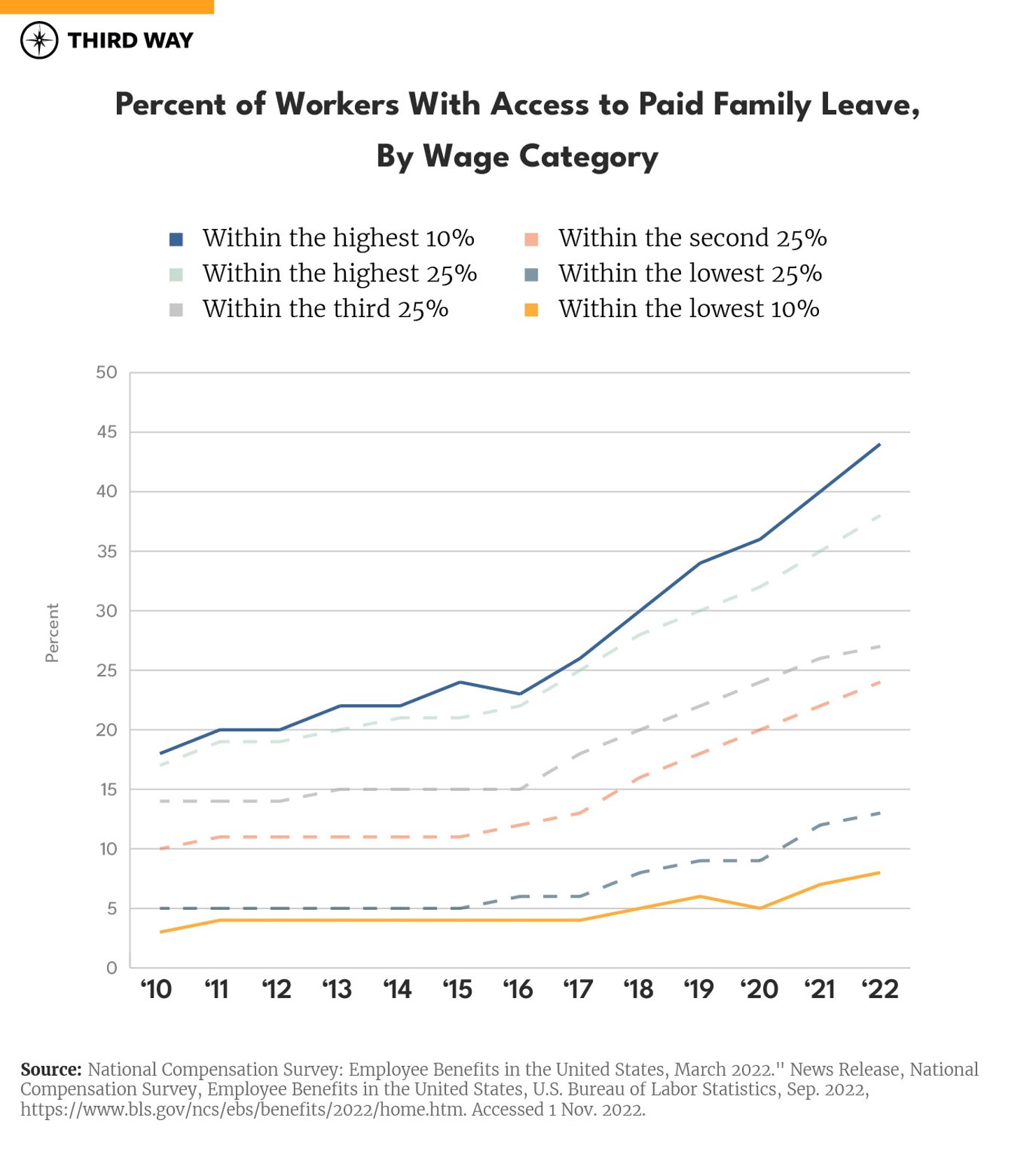
1. Lower-income workers and workers from vulnerable populations are often left out. In 2010, 18% of workers in the best paying 10% of occupations had paid family leave, compared to just 3% of workers in the worst paying occupations.4 In 2022, this 15-percentage point gap more than doubled to 36 percentage points. Now, 44% of workers in the top paying group have paid family leave compared to just 8% of workers at the bottom.5 This gap confirms paid family leave is still far too unavailable to workers least likely to have enough in savings to cover time off to care for a child or a loved one.
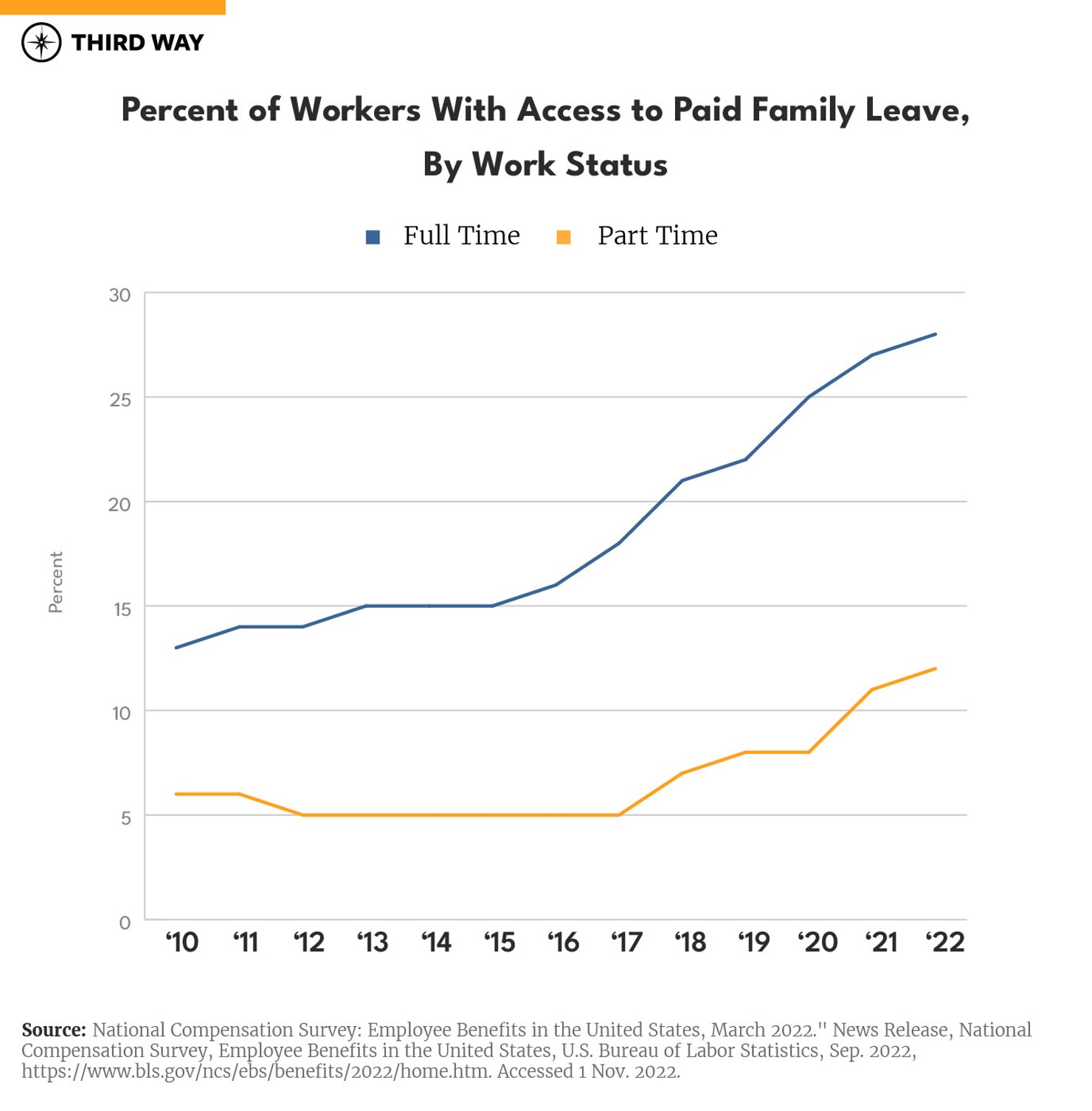
2. Part-time workers rarely have leave. Part-time workers, who often have job insecurity and unpredictable work hours, also benefitted less from the rise in paid family leave compared to their full-time counterparts. In 2010, just 6% of part-time workers had paid family leave, less than half the rate of full-time workers.6 By 2022, that seven percentage point gap doubled to a 14-percentage point chasm, as 28% of full-time employees had paid family leave compared to 12% of part-time workers.7 Over a third of part-time workers have part-time status because of economic reasons (such as unfavorable business conditions or an inability to find full-time work) or because of family obligations, health limitations, or a lack of access to child care. These individuals have high need for the income security that paid leave provides.8
And because it is often cheaper for employers to fire and replace low-income and part-time workers than it is to provide them paid time off, it’s unlikely these disparities will be fully resolved absent government action.9
We need more paid family leave
Lacking paid family leave can be catastrophic for workers. A working mom who just gave birth will not only have to deal with the costs of maternal care, which can rise to as much as $4,500 with employer-sponsored insurance, but also with the lost earnings due to time off from work.10 Without paid family leave, this new mom won’t have income to replace her lost earnings. And the lower she is on the earnings ladder, the less likely she is to have built up enough in savings to cover her needs during this challenging period.11
The burdens felt by low-income and part-time workers disproportionately affect women and people of color. Women are more likely than men to be part-time workers, explaining nearly all the gap in access to paid family leave between the two groups.12 And Black and Hispanic workers earn substantially less on average than their white counterparts, meaning they are less likely to have paid family leave.13
The rise in paid family leave since 2010 is a trend to applaud, but widening gaps in access underscore the need for a comprehensive, national paid family leave program. The market has been slow to deliver paid family leave to low-income workers and part-time workers, many of whom are women and people of color. Congress should follow in the steps of states and establish a program to provide for paid family leave for all Americans.