Report Published May 25, 2018 · 27 minute read
The Policy Imperative: Policy Tools Should Create Incentives for College Completion

Executive Summary
Poor college completion rates in America are not “new,” nor are they the fault of one political party or presidential administration. College attainment is a complex process with many institutional actors, types of students, and outside entities. Crafting federal and state policies to raise college completion rates may be an equally complex process, as Sarah Turner notes in this report, but it need not be a partisan battle. A key challenge for higher education reformers is using policy to raise completion rates while avoiding the unintended consequences that top-down reform invites. Clumsy or ill-conceived policy is fraught with perverse incentives for students and college administrators, who could become inclined to “game the system” without meaningfully raising the level of educational attainment in America.
With that caution in mind, Turner reviews a series of potential policy options to improve completion rates. One of the most common themes across higher education research is that money matters, but how our limited public resources should be spent is less clear-cut. One approach, used across 32 states, ties a portion of public subsidies to completion rates, with the most successful institutions receiving a larger share of public funding. However, it is uncertain how performance-based funding policies affect overall completion rates since these policies might simply encourage some schools to generate low-quality degrees or only admit the most academically prepared students in the first place. As Turner explains, a better approach incorporates multiple outcome metrics in performance-based funding formulas, which can lessen the incentives for institutions to distort behavior to a single output measurement.
At the national level, the surest way policymakers can affect college completion is through Title IV programs—such as Pell Grants, work study, and subsidized student loans—although, similar to performance-based funding policies, this has a large potential to distort institutional behavior and not necessarily improve educational offerings. Turner’s report highlights how state and federal policymakers should ensure that there are appropriate guardrails in place for any policy aimed at elevating college completion.
— Frederick M. Hess and Lanae Erickson Hatalsky

The problem of stagnant college completion rates is not new to the 21st century. The low levels of college completion observed today are similar to those observed a quarter century ago. There is no single cause of low rates of college completion, nor will there be a simple “magic bullet” policy solution. The challenge is persistent and complex, while the returns to increasing college completion are substantial.
The consequences of low college completion rates are magnified in an environment with high economic returns for those who complete college.1 The wage premium associated with collegiate attainment has increased markedly in recent decades. Compared to a worker with no more than a high school degree, the advantage in earnings for a college graduate has increased from about 46 percent in 1973 to about 82 percent in 2016; those with “some college” without a degree earn only slightly more than high school graduates.2 Looking at the broader picture, the differences in collegiate attainment by family income may limit long-term upward mobility in the US and exacerbate trends toward increased income inequality.
Policy: A Key Driver
Given the substantial role that state and federal policymakers play in funding, producing, and regulating postsecondary education, how can they improve college completion? Indeed, the federal government spent nearly $158 billion on student financial aid in higher education in 2015–16 (of this, $96 billion represented loan funds), with state and local appropriations exceeding $76.1 billion.3 In turn, more than 17 million students were enrolled at the undergraduate level in 2015, more than 13 million of whom were enrolled at public colleges and universities.4 With this level of public investment, the question is whether changes in public policies would increase completion rates.
Over the past decade, college completion has gained prominence in public discourse. Federal policymakers, state associations, policy organizations from across the political spectrum, and blue ribbon commissions have made strong statements about the goal of increasing collegiate degree attainment. In introducing the 2010 United States federal budget, President Barack Obama declared, “By 2020, America will once again have the highest proportion of college graduates in the world.”5 Similarly, the Gates Foundation’s initiative on postsecondary attainment is explicit in its objective:
We’ve set an ambitious goal to help the nation double the number of low-income adults who earn postsecondary degrees or credentials—meaningful credentials with value in the workplace and labor market—by age 26. To accomplish this, America must connect the millions of young Americans who have the will to get the education they need with a way to get there.6
The Lumina Foundation states a similar objective: “increasing the share of Americans with high-quality degrees, certificates and credentials to 60 percent by 2025.”7
Laudable as these goals are, they do not address the underlying challenges in the higher education market. Collegiate attainment is a complex, multidimensional process with many moving pieces, institutional actors, and types of students. Any expectation of a low-cost, quick fix in the form of an accountability mechanism or information-based intervention is unrealistic. And, although money matters in fostering college completion, the evidence discussed below does not suggest that increasing public spending without other adjustments in student behavior and institutional organizations would increase college completion substantially. Increasing completion rates with the type of degrees that produce labor-market rewards should be recognized as a hard problem, one that is worthy of sustained, iterative, and reflective policy investment at the state and federal levels.
There have been gains in the past decade—both modest increases in college completion and large improvements in the body of knowledge about college attendance and attainment.8 At the same time, there are still institutions with completion rates so low as to require remedial action.
The ongoing challenge is to use policy to provide incentives for college completion without generating unintended consequences, such as the proliferation of degrees that do not produce returns in the labor market. State and federal policy must foster consumer protections that safeguard the interests of students, particularly those who may have the least experience with higher education. Finally, another objective of state and federal policy is to foster a well-functioning postsecondary market in which individuals’ choices lead to efficiency and high productivity.
I will begin, then, by addressing the elusive promise of postsecondary accountability. I will then look at both the allocation of state funds and the role of federal financial aid to consider how resources (and their distribution) affect college completion.
Accountability: The Dominant Theme
The triumvirate of policy buzzwords in higher education is “access,” “affordability,” and—most recently—“accountability.” Although alliterative, all three lack a clear empirical definition. Common usage ties “access” to the enrollment of low-income students, “affordability” to the cost of college for students and families, and “accountability” to outcome measures with rewards and sanctions. Here is one assessment from about 15 years ago:
With few exceptions, recent discussions in policy circles have focused on questions of access, loosely defined as the extent to which individuals from different circumstances enroll in college to the near exclusion of questions of attainment. Emphasis on vaguely defined notions of “collegiate access and affordability” in public discourse has diverted attention away from the monitoring of outcomes such as courses completed and degrees awarded.9
Times have changed. “Accountability” has risen to be a dominant theme in higher education policy discussions, and college completion is among the most commonly referenced outcomes in this rubric.10
Federal Accountability Efforts
At the K–12 level, mandated federal test-based accountability policies took hold nationally in 2001 when President George W. Bush brought forward the No Child Left Behind Act.11 Slightly more than a decade later, President Barack Obama called for comprehensive accountability policy in higher education:
Today, the federal government provides more than $150 billion each year in direct loan and grant aid for America’s students. In an era of limited resources, we must allocate the federal investment in student aid wisely, in order to promote opportunity in higher education and ensure the best return on investment. The President will call on Congress to consider value, affordability, and student outcomes in making determinations about which colleges and universities receive access to federal student aid, either by incorporating measures of value and affordability into the existing accreditation system; or by establishing a new, alternative system of accreditation that would provide pathways for higher education models and colleges to receive federal student aid based on performance and results.12
An explicit goal was to design ratings based on measures such as college completion rates, given the absence of any viable test-based accountability metric for the postsecondary sphere. What emerged from the policy process was something more toothless than a federal accountability metric.13 And, as a policy matter, that may not be a bad thing. Were the federal government to endeavor to “score” diverse higher education institutions and attach punitive actions or financial rewards to these measures, the unintended consequences would likely dominate any potential benefits.14
Released in September 2015, the College Scorecard and its publicly available data provide a valuable accounting of differences among institutions in completion and post-enrollment earnings for students. The data are accompanied by a thoughtful, academic-friendly report, which is exceedingly rigorous in explaining the pitfalls and challenges of measuring college completion.15 That college completion rates are not the only outcome metric in these data is a methodological strength—not a weakness of the approach. The College Scorecard also includes earnings and debt after graduation. A basic tenet in economic theory is that including multiple outcomes in an evaluation metric lessens incentives to distort behavior on a single output margin, and that lesson would seem to apply equally in higher education.
What emerged from the federal process in 2015 was not a mechanism of rewards and sanctions, but something far more empirical in the form of a database with measures of collegiate outcomes, including completion rates and earnings. Although the comprehensive range of outcomes (including earnings) and alternative computational approaches are an innovation of the College Scorecard, the basic completion rate metrics were already reported in the federal College Navigator and in various research reports.16
Measuring Completion Outcomes
The College Scorecard measures and data repository might be the most comprehensive assembly of evidence on completion, earnings, and employment outcomes because it relies on data from institutional records from the IRS, Federal Student Aid, and the National Student Clearinghouse, in addition to data from the Integrated Postsecondary Education Data System (IPEDS). Broadly, this resource reiterates findings from the institutional IPEDS surveys and other federal and state sources about the current shortfalls on college completion.
It should be noted that measuring college completion rates comprehensively at the level of individual institutions is a tradition of less than two decades, even as many other outcomes of colleges and universities (including enrollment and degrees awarded) have been available for more than 50 years.17 The IPEDS surveys began including cohort completion rates in 1996, making 2002 the first year for observing bachelor degree completion within 150 percent of time.18 In addition to federal data-collection efforts, the expansion of databases that record the progression of individuals from K–12 through postsecondary education has facilitated the collection of information on completion rates. Since 2006, the federal government has given 47 states State Longitudinal Data System grants, which marry K–12, higher education, and workforce data. Such data allow researchers to identify how precollegiate characteristics affect collegiate outcomes and how collegiate outcomes, including choice of major and completion, affect labor-market outcomes.
The data from various sources tell a compelling story: There are vast differences among colleges and universities in college completion. This variation is particularly marked among institutions in the bottom half of the distribution of colleges as measured by selectivity or institutional resources. In addition, although college completion rates are closely associated with other measures of performance (such as earnings and student loan repayment rates) for four-year institutions, they are only weakly related to these outcome measures for two-year institutions.19
Figure 1 shows the association between completion rates (within 150 percent of expected time) and instructional expenditures by control of institution. Particularly for public and nonprofit institutions awarding four-year degrees, there is a marked positive relationship between instructional spending and completion rates.20 That said, there are also substantial differences among institutions with similar levels of expenditures in student outcomes; this variation is particularly prominent among for-profit institutions and among two-year or associate programs in the public sector.
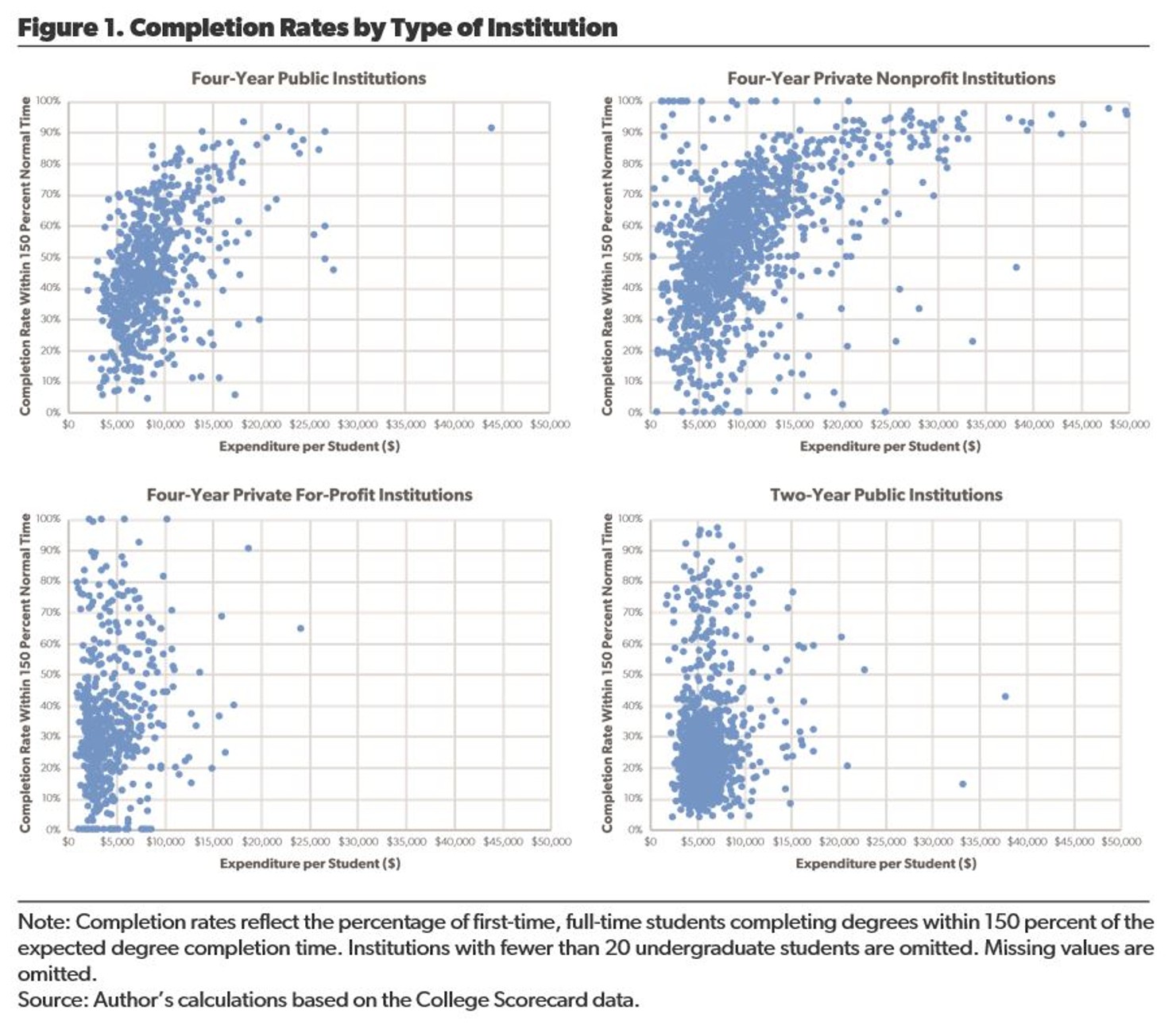
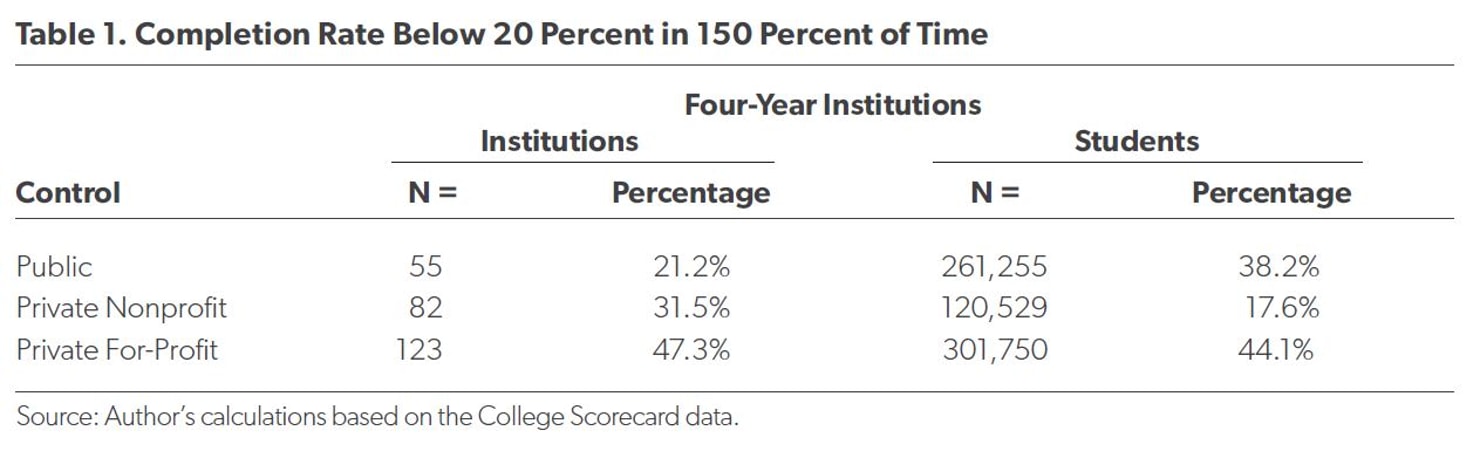
Table 1 shows counts of four-year institutions and students with completion rates below 20 percent. Although 20 percent is an arbitrary cutoff, a completion rate of less than one in five cannot be taken as a signal of strong performance. Notably, these poorly performing institutions are distributed among the for-profit, public, and nonprofit sectors; no group of institutions has the monopoly on poor performance. Although for-profit institutions (some of which are very small in scale) are the most numerically present (followed by nonprofits and then publics), 38 percent of students enrolled at four-year institutions with low completion rates are at public institutions, 44 percent are at for-profits, and the remainder are at nonprofits.
Beyond the four-year sector, low completion rates are rampant at community colleges, of which 352 public campuses (of about 910) have program completion rates below 20 percent. These institutions represent about 2.4 million students, or 40 percent of total enrollment in the community college sector.
A more chilling measure to accompany these institution counts is the incidence of institutions with completion rates less than the three-year cohort default rate on student loans. In 43 four-year public schools, the three-year cohort default rate is greater than the completion rate. This is also the case for 147 four-year private nonprofit schools and 98 for-profit schools. In other words, students in these schools who borrow face a greater likelihood of defaulting than completing a degree. It would seem, then, that college attendance at these schools leaves many students worse off—lacking a degree, defaulting on a student loan, or both.
State Policies and Appropriations
The decline in resources per student from state sources is unmistakable over the past two decades. Between academic year 2000–01 and academic year 2014–15, constant dollar appropriations from state sources to higher education held constant at about $77 billion while enrollment increased from 8.7 million to 11.1 million students. This resulted in a drop in appropriations from $8,886 to $6,966 per student.21
Money Matters
Because public providers account for 72 percent of undergraduate enrollment, the potential impact of this drop in appropriations is substantial. Some of the losses have been offset with increases in tuition levels, effectively shifting the burden of who pays for college. The share of public universities’ total educational revenues covered by net tuition revenue rose from 29.4 percent in 2001 to 43.3 percent in 2011.22 By 2017, tuition provided more revenue than state appropriations in 28 states.
When students and their families must pay for a greater share of the costs of education, it is not surprising that borrowing levels increase as well, as debt per college graduate has increased from $12,200 ($22,000 per borrower) to $15,800 ($27,000 per borrower) between 2005–06 and 2015–16.23 What is more, states with the most severe economic downturns in the 2008 recession were among those in which public institutions raised tuition the most, but many institutions still faced declines in total resources per student, with these declines most apparent outside the most selective public research universities.24
Such erosion in resources likely has real consequences for student attainment in completion rates and the time it takes students to obtain a degree.25 David Deming and Christopher Walters show that increases in collegiate spending produce substantial effects on completion rates and degree attainment, while changes in tuition levels do not appear to affect either enrollment or completion. Their results suggest a 10 percent increase in total spending is associated with a 0.52 percentage point increase in the graduation rate.26
Within states, appropriations cuts appear to translate differently in terms of real cuts in spending at different kinds of institutions. Flagship and relatively selective public institutions may be able to recoup some lost appropriations with increased revenues from other sources, including higher tuition charges and increases in the enrollment of students paying full tuition from out of state. However, broad-access institutions (colleges that admit nearly all students) are likely to face real declines in expenditures per student with declines in state appropriations; these institutions tend to have little capacity to attract full-pay students from out of state or abroad.
In a model in which expenditures are tied to attainment, a decline in resources per student leads to a decline in completion. System-wide, the result is increased stratification in resources among institutions in a state, combined with erosion in completion rates at the broad-access schools where many low-income students matriculate.
Even as erosion in public funding contributes to low completion rates, many public universities outside the selective research universities often face market challenges that go beyond short-term changes in state support. Public colleges and universities are not necessarily “nimble critters.”27 Location and curricular structure at many public universities and nonprofit colleges are poorly matched with market demand. Some colleges may be operating at a scale that is not sustainable, with deficit spending and deferred maintenance leading to long-term decline and erosion of assets. Yet, it is administratively difficult to close or merge programs that are no longer economically viable or that have outlived their usefulness, much less entire campuses. Often there are entrenched interests willing to invest substantial sums in litigation and lobbying to preserve the status quo.28
A distinction between poorly performing institutions in the for-profit sector and those in the public and nonprofit sectors is that market forces will force the former to exit the market. As a point of illustration, while 107 for-profit institutions closed their doors in 2014–15 and 2015–16, zero public institutions closed, and only 13 private nonprofit institutions closed.29
State policymakers have a particular responsibility for oversight in the public sector because market forces will not generate closure. Additionally, the short-term costs of restructuring struggling institutions often limit states’ capacity to do so, even though the long-term gains from restructuring can be sizable. A recent study of college consolidations affecting more than 10,000 students in the university system in Georgia found increases in student persistence for cohorts matriculating post-consolidation, without cost increases suggesting productivity improvements.30
Performance Funding
One strategy employed by states with increasing frequency is to tie some fraction of state institutional appropriations to degree completion, along with other measures of student characteristics and outcomes. Although there are a few examples of performance funding that date to the late 1970s (such as Tennessee), the vast majority of performance funding schemes were adopted after 2008, coincident with the fiscal pressures of the Great Recession and the increased attention to completion rates in public dialogue. One report from the National Council of State Legislatures indicates that 32 states have some sort of performance-based funding scheme, in which institutions with better outcome measurements receive a larger share of public funds.31 States differ markedly in the metrics used and the share of funds at risk or subject to performance targets. In addition to completion rate metrics, several states include measures of intermediate completion (such as retention and course completion).
In the main, the jury is still out on how these policies affect completion rates at the college level and outcomes more generally. Theory suggests some caution: Performance funding systems that weigh completion rates heavily could risk generating incentives for degree mills—schools or programs that churn out poor-quality degrees that have little value in the labor market. Such performance funding systems may also generate incentives for “cream skimming,” whereby only the most high-achieving students are accepted into degree problems, limiting opportunities for students who may be regarded as “higher risk.” In addition, funding formulas that identify subgroups on “threshold” characteristics, such as eligibility for a federal Pell Grant, risk shifting the composition of enrollment away from students who may be “near poor.”32
Federal Policy and Title IV
The primary funding channel through which the federal government affects college completion is federal financial aid, distributed largely under the heading of Title IV of the Higher Education Act. This aid includes need-based Pell Grants and federally subsidized student loans and covers a large umbrella of degree programs and students, including both recent high school graduates and students returning to postsecondary education after substantial labor-market experience.33 The rationale for these programs is to alleviate credit constraints that might otherwise deter students from making high-return investments in postsecondary programs, allowing them to borrow against their future predicted earnings to finance their education today.
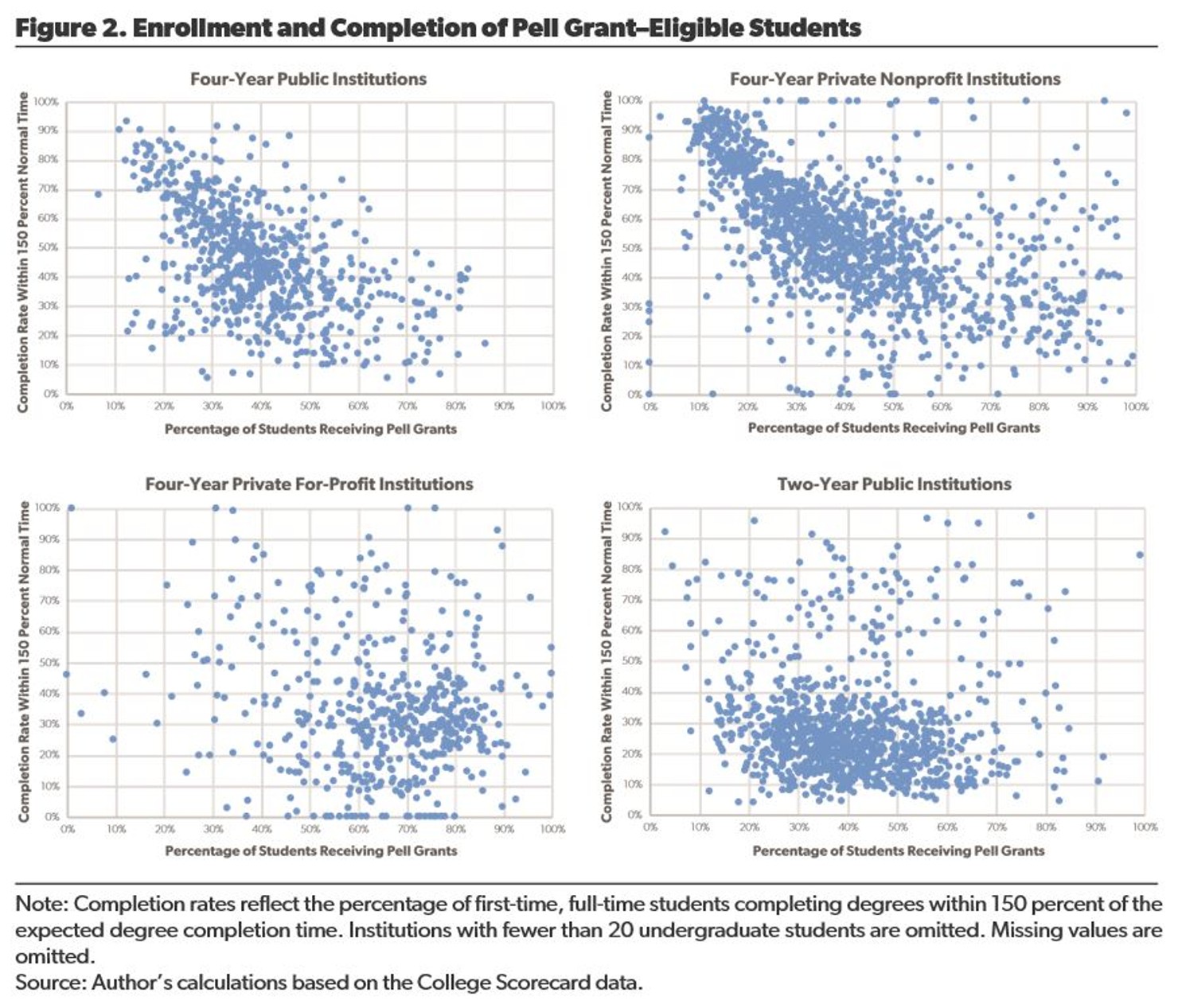
Yet demonstrably low completion rates among Pell Grant recipients, combined with high default rates among borrowers who do not complete school, raise questions about whether students and taxpayers would be better served if Pell Grants included explicit incentives for college completion.34 Figure 2 presents completion rates (150 percent of normal time) for Pell Grant recipients in four-year institutions. There is a striking negative relationship between institutions serving a large share of Pell Grant recipients and the completion rates of these students, even as there is clearly substantial variation among institutions. This suggests that a policy focus that rewards only enrollment of Pell Grant–eligible students would be poorly aligned with the objective to increase college completion among students eligible for those grants.
Several policy experts have asked whether federal student aid policy could include institutional incentives to increase student persistence and degree completion.35 Most prominent among these is a proposal by Blagg and Chingos to create some “risk sharing” that links student outcomes to the universities’ financial aid obligations, with institutions required to return a portion of the financial aid of students who drop out before the end of the term. These policy experts also note the importance of ending federal aid eligibility for colleges where a high proportion of students earn unacceptably low wages after leaving.36
Yet such proposals are admittedly hard to get right: If the incentives are too strong, they might foster social promotion among lagging students, and policy could drive behavior changes at the institution level that are not actually improving how those schools serve students. Alternatively, if incentives are too weak, the behavior of higher education institutions likely will not change a lot.
Institutional Eligibility for Title IV Aid
The strongest tool that the federal government has to change the behavior of colleges and universities is limiting access to Title IV aid. For many institutions, cutting off aid access is an effective death sentence.37 Yet, although default rates have been part of the policy guidelines for determining access to Title IV aid, college persistence and completion have not.
Two considerations argue for using completion thresholds in determining access for aid eligibility: First, they can be observed earlier than defaults, which may take several years to materialize in the data because, for example, a three-year default rate cannot be measured until at least three years after an individual has separated from a program. Second, they identify a broad range of programs in which educational outcomes are weak. Given the enormous cost burden to students of attending an institution unlikely to produce a pathway to improved labor-market outcomes, federal policy needs to be swift in requiring demonstrated change (or closure) among institutions with poor performance.
There is much to be said for better using federal regulatory policy to focus on protecting consumers from low-performing institutions.38 The current accreditation mechanism, which allows institutions access to Title IV dollars, imposes high compliance costs but provides little meaningful accountability. Whether the examples are outright fraud (such as the widely reported case of Corinthian Colleges) or simply poor performance, it is often the most vulnerable students who enroll at the programs with the lowest performance.39 And the accreditation system is not currently weeding out those programs.
Although one hopes that market forces generated by students making well-informed choices would force underperforming institutions out of the market, the simple truth is that some of the worst outcomes follow from a modest number of institutions and disproportionately affect low-income students already at a disadvantage.40 Whether these institutions are under-resourced (perhaps owing to limited state funding) or simply mismanaged is not relevant for students who find themselves worse off as a result of enrollment.
Indeed, Milton Friedman, a strong proponent of injecting private market forces in education, reminds us of the importance of government regulation in ensuring schools meet certain minimum standards. He noted the role of government in “assuring that the schools met certain minimum standards such as the inclusion of a minimum common content in their programs, much as it now inspects restaurants to assure that they maintain minimum sanitary standards.”41 Current federal policy does not sufficiently accomplish that goal.
The Road Ahead
The market environment that will foster increased college completion requires sufficient student financial aid to resolve credit constraints, but it also requires well-functioning colleges in the private and public sectors and well-informed college choice. Policymakers and researchers are much more focused on the challenges of college completion than they were two decades ago, and they have much better tools for measurement. Due to enhanced federal data-collection efforts, the capacity to measure college completion has been transformed and continues to improve with innovations in federal data collection and state systems that record progression in college toward degree attainment.
Improving College Choice
Unfortunately, what researchers and government agencies know about college completion rates and other outcome measures (such as default rates and earnings) does not appear to have substantially influenced how students decide on a college. Federal resources such as the College Scorecard and College Navigator may have more utility for researchers than for students and families.
There is ample evidence that many students do not apply to (or attend) colleges that are well matched to their achievements and aspirations. In particular, high-achieving low- and moderate-income students are less likely than their more affluent peers to attend an institution where expected graduation rates are high.42
Most of the policy action and research literature has focused on the choices of recent high school graduates, yet guidance is likely most lacking with older students (including the many independent students receiving Pell Grants). Adults with limited college education and several years of full-time labor-force participation may lack the resources, such as high school guidance counselors and a large group of peers making similar decisions, that are available to those at the transition from high school to college.43 Adult students’ challenges in choosing a college are particularly acute during labor-market downturns when unemployment or the obsolescence of skills generates increased participation in higher education.
Improving college choice is likely among the most powerful potential college completion reform strategies. If students choose colleges that have strong records of completion and are well matched with their academic preparation and career aspirations, they may be more likely to complete degree programs. Moreover, when students “vote with their feet” and make well-informed choices about where to attend college, the higher education marketplace improves as strong institutions are rewarded and low-performing ones exit or reform.
Although the idea of helping students improve college choice with information-based interventions holds great promise, such approaches are in the developmental stages, and most do not have demonstrated efficacy. It would be a mistake—and a waste of resources—to simply declare another federal program to deliver information.44 What is needed are federal and state investments in developmental efforts to understand how different strategies of information dissemination and education improve students’ and parents’ ability to use data in decision-making.
There are two pieces to the challenge of improving market information available to students. The first is improving the raw metrics that are available in the public domain that record student outcomes. Given that so much of the relevant data are effectively in federal control, the organization and release of these data require federal policy action. This includes both student-level inputs and institution-level metrics of outcomes and program progress.45
The second piece of the challenge is to enable students, their families, trusted adults, and college counselors to analyze the data in terms of benefits and costs of different college choices. Because students’ needs are likely to differ markedly with their environments, family circumstances, and level of achievement and objectives, it seems highly unlikely that the federal government is well positioned to develop a single application that meets such a broad range of needs. Rather, a decentralized yet competitive development process is likely to benefit both students and the collegiate market.46 One approach would be for the federal government to provide a small number of development teams—potentially comprised of researchers and policy entrepreneurs—with resources to develop and test efficacy of delivery modules.47
Degree completion rates are an important outcome measure for higher education because they are the most direct indicator available of whether a student achieved competency in a chosen course of study. Particularly at the level of the bachelor’s degree and in some certificate programs, degree completion is also linked to substantial labor-market rewards. Recognition (if not applause) that there has been substantial progress in measuring completion rates is certainly in order. Even as the improved metrics have been a bonus to academic researchers, those improvements have not yet sufficiently influenced student choices or state and federal higher education policy.
Addressing Poor Performance
Given the substantial role that state and federal policymakers play in funding, producing, and regulating postsecondary education, how can they improve college completion? It is useful to recognize what policy can and cannot do (along with what policy should and should not do) to increase college completion. State and federal policy can neither “regulate” nor “buy” increased production of high-return college graduates because the production of college-level knowledge requires the active investment of students and institutions. Attempts to address the college completion challenge with policy efforts focused narrowly on accountability, ratings, and incentives will almost surely end poorly with a proliferation of “degree mills” or efforts by institutions to limit postsecondary opportunities (“cream skimming”).
Still, an important role for state and federal policy is to ensure that there are sufficient guardrails in place so that institutions that do not demonstrate systematic patterns of success in college completion, as well as other indicators such as earnings and loan repayment, do not lure students to an unfulfilled promise of college education. While colleges unquestionably have different missions, along with varying levels of student preparation and institutional resources, each institution that is eligible for federal financial aid should be able to demonstrate realistic prospects for college completion. Institutions with the lowest completion rates often serve the most at-risk populations, potentially contributing to a cycle of poverty rather than fostering the economic gains that are part of the promise of higher education.
Policymakers should use this moment to assess carefully whether there are opportunities to provide incentives to improve completion rates and increase the efficiency of higher education more generally. While regulation to address the poorest-performing institutions is one tool in the policy quiver, broad-based gains in college completion require innovations in how students choose colleges and the organization of colleges and universities. The opportunities to improve completion rates—and the quality of higher education more generally—are substantial.
About the Author
Sarah Turner ([email protected]) is University Professor of Economics and Education and the Souder Family Endowed Chair in Economics at the University of Virginia. She is a Research Associate of the National Bureau of Economic Research.
Acknowledgement
Turner is grateful to Cody Christensen for excellent assistance with the College Scorecard data along with considerable help and patience in the editorial process.
© 2018 by the American Enterprise Institute and Third Way Institute. All rights reserved.
The American Enterprise Institute (AEI) and Third Way Institute are nonpartisan, not-for-profit, 501(c)(3) educational organizations. The views expressed in this paper are those of the author.
AEI does not take institutional positions on any issues.
